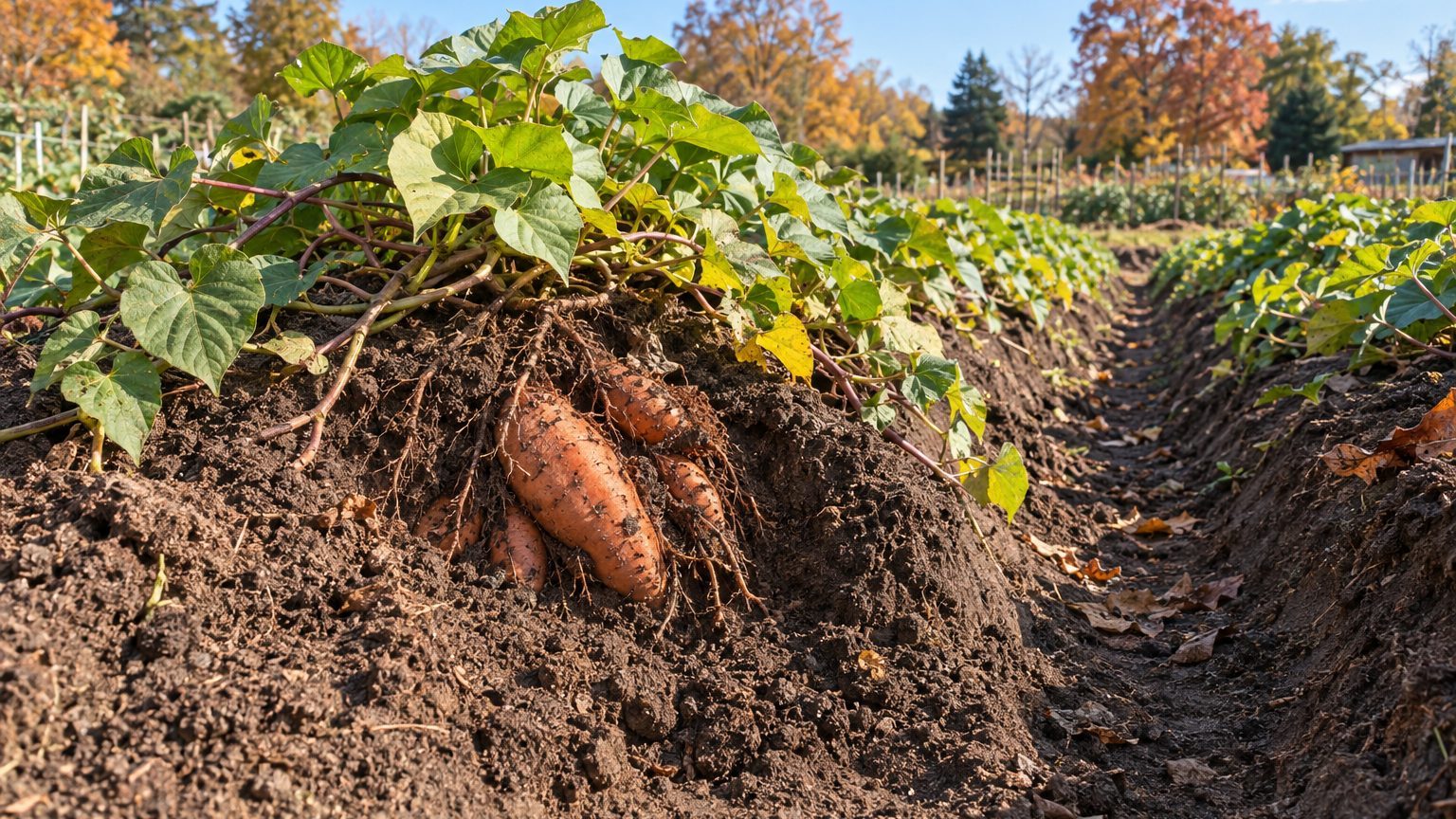

Sweet potatoes are grown on ridges because a ridge solves three problems at once: cold soil, soggy soil and hard soil. A raised row of loose earth warms sooner in spring, sheds excess water, and gives storage roots room to swell instead of bending around compacted ground. Ridges suit long rows, mounds suit small spaces, and in deep, loose, fast-draining soil a flat bed can work just as well.
What is actually going on
The ridge is not decoration. Sweet potato is a tropical vine (a relative of morning glory, not of the potato), and nearly everything about the ridge follows from that ancestry.
Warmth
A plant built for heat sulks in cool ground. A freshly set slip in cold, wet soil stops growing, and a stalled slip is an easy target for rot. Lifting the root zone above the surrounding ground exposes more soil surface to sun and air, and loose, drier soil heats faster than dense, wet soil. The ridge is a small act of climate engineering. If your season runs short or cool, Black Plastic and Sweet Potatoes: Buying Warmth covers the next step up.
Drainage
Roots breathe. Soil that stays saturated pushes out the air they need, and storage roots sitting in it are more likely to rot, crack or stay small. Water runs off the crown of a ridge and collects in the furrow between rows, which acts as a built-in drainage ditch. Heavy clay gains the most from this. A sandy loam that drains on its own gains the least.
Depth
The part you eat starts as fine roots along the buried section of the slip. Some of them swell into storage roots, provided they can push down and out through loose soil. Meet a hard layer and they turn thin, forked or crooked. A ridge stacks a good foot or so of loosened soil on top of whatever lies below, so the roots never have to negotiate with subsoil.
One label warning belongs here. Supermarkets often call sweet potatoes yams, but a true yam is a different plant entirely. Sweet potato is not a potato either, and it is not a nightshade, so it does not rotate with potatoes or tomatoes. Its ridge advice is its own.
In the garden
Ridge dimensions and what goes wrong
The figures below are common starting points, not law. Your state extension service will have numbers tuned to local soils. The right-hand column matters as much as the middle one, because knowing how a ridge fails lets you adjust it.
| Detail | Common starting point | What happens when it goes wrong |
|---|---|---|
| Height | Roughly 8 to 12 inches of loose soil | Too low and roots meet hard ground or standing water. Too tall and the crown dries out fast in sandy or hot conditions. |
| Base width | Roughly 12 to 18 inches, with a rounded top | Too narrow and it slumps in rain, exposing roots. Too wide and it stops warming quickly. |
| Row spacing | Roughly 3 to 4 feet apart | Too tight and vines tangle, shade the ridge and root into the furrow. |
| Slip spacing | Roughly 12 to 18 inches along the ridge | Too close and roots stay small. Too far and you waste space. |
| Building the ridge | Soil that crumbles in your hand, loosened well below ridge height | Worked wet, it dries into clods, and the roots come out thin or misshapen. |
| Settling before planting | Rake the top level, let it firm a little, then plant | A fluffy new ridge sinks unevenly, leaving some slips too deep and others exposed. |
When the shape matters most, and when it doesn’t
The ridge earns its keep in heavy clay, in wet summers, in cool springs and anywhere the topsoil is thin over a hard layer. In those gardens it can be the difference between a decent harvest and a row of pencil-thin roots.
The flat-bed case is real. If you have a raised bed filled with a foot or more of loose, well-drained soil, the bed already does the ridge’s job, and a further mound adds little. Deep sandy soil in a dry, hot climate can go the other way, since a tall ridge dries out quickly. There a low ridge or flat planting with mulch is often the better call.
Mounds are simply ridges shrunk to one plant, usually a broad hill a foot or so across. They work in small gardens, in wet corners and around the edge of a bed. Rows of connected ridges are easier to water, weed and dig.
Vines will root wherever their nodes touch soil, and those extra roots stay small while pulling energy from the main ones. Lift the vines off the furrow now and then. The trimmings are edible, too, as explained in Sweet Potato Greens: The Crop Above the Crop.
What it depends on where you are
The national part
Some of this holds across the country. Sweet potatoes want warm soil, air around their roots and loose ground to swell in. The reasoning behind the ridge is the same in every state, and so is the caution about building it from wet soil.
The local part
Ridge height, timing and even whether to build one at all depend on three things this page cannot know about your yard: how long your growing season lasts, how hot your summers run, and how much rain falls in them. A gardener with a short, cool season leans toward taller ridges and extra warmth. One with hot, humid summers and clay soil leans toward tall ridges for drainage. One with sandy soil and dry summers may go low and mulch heavily.
Even inside one state the answer shifts. Coastal sand, river bottomland and upland clay each call for a different ridge, and a valley may warm weeks before a hillside a few miles away. Variety choice shifts too. Types bred for shorter seasons and types that sprawl for long ones do not want the same treatment, and I won’t name specific ones here, because the ones that have been trialled where you live are the ones worth planting.
Start with your state’s land-grant extension service and search for its sweet potato guidance. It will list tested varieties, planting windows and soil advice for your area. Then read the state pages in this series, which put those regional differences in context. For the general picture from slips through curing, the parent guide is Growing Sweet Potatoes: Slips, Heat, and a Careful Cure.
The mistake that costs the most
Building the ridge from wet soil
Plenty of things can go wrong with a sweet potato crop, but the costliest ridge error is easy to make and hard to see until harvest: shaping the ridge while the soil is wet, then packing it down. It happens because spring gardening urgency meets a rainy week, and the slips are waiting. Wet clay pulled into a ridge does not stay loose. It dries into hard lumps, or it seals into a dense crust. The ridge looks perfect and behaves like the compacted ground you were trying to avoid.
The roots pay for it all season. They push against the lumps and bend around them, turning out thin, forked or long and stringy. Water sheds off a crusted surface instead of soaking in, so the crop swings between dry and soggy. And when you dig, the tight soil makes it easier to nick or cut roots. Damaged skin is a poor start for curing, and a nicked root is the one to eat first instead of storing.
What to do instead
Wait until a handful of soil crumbles when you squeeze it, rather than forming a sticky ball. Loosen the ground well below the height of the future ridge, then pull loose soil up from both sides and shape it. If the weather won’t cooperate, add compost or other organic matter to lighten heavy soil, but do not use it to rescue a ridge made wet. Rake the crown roughly level and plant slips into moist, crumbly ground. Delaying a week costs less than a summer of stunted roots.
At harvest, dig with care, well away from the row. Then inspect each root. A soft patch or a weeping spot ends the question, and that root does not go into storage. Keep cured roots somewhere moderately warm and dry, never in a refrigerator or a cold cellar. Cold injury below the storage range is irreversible and can ruin a good harvest.
Common questions
Ridge or mound: which should I build?
Build ridges for rows and mounds for small spaces, containers or wet spots. The mechanism is identical, since both raise loose soil around the slip. Ridges are easier to water and dig, while mounds fit odd corners.
Do I hill sweet potatoes up during the season, like potatoes?
No. Potato hilling covers tubers that form above the seed piece. Sweet potato roots form from the buried slip, so the ridge is built before planting. A light touch-up after heavy rain, to cover exposed roots, is reasonable.
Can I skip ridges in a raised bed?
Often, yes. A raised bed with a foot or more of loose, well-drained soil already provides warmth, drainage and depth. Check that the bed isn’t sitting on a hard layer that stays wet, and that it doesn’t dry out too quickly in hot weather.
Do ridges affect harvest and storage?
They make digging easier, which means fewer nicked roots. Storage is another matter. Cure and store only sound roots, and discard any with a soft patch or a weeping spot. Never keep sweet potatoes in a refrigerator or a cold cellar, because cold injury cannot be undone.