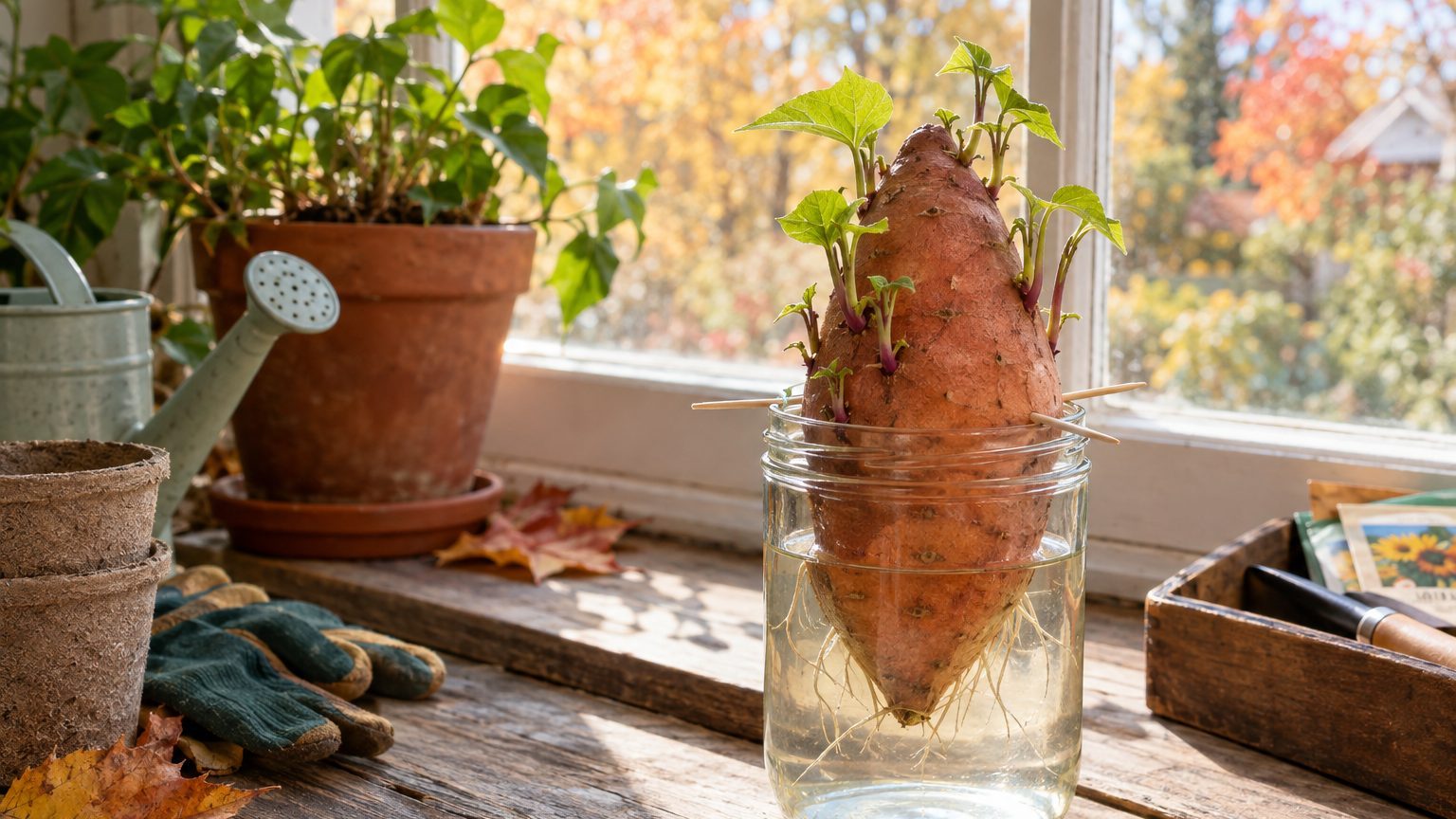

You can grow your own sweet potato slips from a stored root, and it works well when the root is healthy and kept warm. Expect a wait of several weeks, not days. The one trap is the root itself: a chilled or treated one may rot or just sit there. The rest of this page explains how sprouting works, so you can adjust the method to your own garden.
What is actually going on
The thing to understand here is sprouting. A sweet potato is a swollen storage root, and along its surface sit dormant buds. Give the root warmth and steady moisture and those buds wake up and push out shoots. Gardeners call the shoots slips. Once a slip is detached from the root, its stem base grows roots of its own, so each shoot becomes a separate plant. One healthy root can feed a whole row of them.
That mechanism explains the timing. The buds respond to warmth, so a root sitting in a cool room will move slowly, and a root in a warm, bright spot will move faster. Nobody can promise you a number of days, because your kitchen is not anyone else’s. What you can do is plan backward. Transplanting happens when the soil is reliably warm, not on a calendar date, and the slips need several weeks before that moment. The usual advice from extension programs is to start roughly six to eight weeks ahead, and your state service can tell you how to set that for your area.
A few plain facts about the plant help here. A sweet potato is not a potato. It is not a nightshade, it does not belong in a potato rotation, and it does not behave like a seed potato that you cut up and bury. It is also not a yam, whatever the supermarket label says (the Sweet Potatoes and Yams Are Not the Same Thing page untangles that). Treating it like a potato is where a lot of trouble starts.
Which brings up the trap. The mechanism only works if the root is alive and undamaged. A root that has been chilled can look perfectly normal and then fail to sprout or start to break down. Some store-bought roots are also treated to hold back sprouting. Before you start, look the root over. It should feel firm, with intact skin. A soft patch or a weeping spot ends the question: that root goes in the trash, not in a jar. And because slips can carry rot or disease from the root, you cut them off above the root surface rather than pulling them away with a chunk attached.
In the garden
Step by step, and what happens when a step goes wrong
There are two common ways to start a root: half-submerged in a jar of water, held up with toothpicks, or laid in a tray of damp sand or potting mix. Both follow the same sequence.
| Step | What to do | What happens when it goes wrong |
|---|---|---|
| Pick the root | Choose a firm root with unbroken skin. A local grower’s root is often a better bet than a grocery one. | A soft, shriveled or cold-damaged root rots or never wakes up. |
| Count back | Start about six to eight weeks before your soil is warm enough to transplant. | Too early, and you hold leggy slips indoors with nowhere to put them. Too late, and the season is spent before the plants get going. |
| Set it up | Put the root half in water, or half buried in damp medium, in a warm spot. Move it into good light once shoots appear. | A fully submerged root rots. A cold windowsill stalls everything. |
| Wait and tend | Keep the medium moist, not soggy. Refresh jar water regularly. | Cloudy or sour-smelling water means rot has started. Remove the root. |
| Detach | When a shoot is around six inches long with several leaves, twist or cut it off above the root surface. | Pulling off a piece of root carries decay along. Cutting too soon gives a weak slip. |
| Root the slip | Stand the base in water for a few days until roots form, or plant it into moist soil right away. | A wilted, dried-out slip struggles. Leaves left underwater turn slimy. |
| Transplant | Harden the slips off for a few days, then plant once the soil is reliably warm. | Cold soil stalls or damages slips that looked healthy in the jar. |
The root keeps producing shoots after you take the first batch, so you can pull slips more than once as they reach size. Full details on planting out, heat needs and curing live in Growing Sweet Potatoes: Slips, Heat, and a Careful Cure.
Why a supermarket root may never sprout
Three things work against you. The root may have spent a long stretch in cold storage, which damages the tissue without changing its looks. It may have been treated to suppress sprouting. Or it may simply be old and dry. None of this shows on the skin. The practical answer is to start more than one root, ideally from more than one source, and to not read a dead one as a sign that you did something wrong. If a root shows no shoots after a good stretch of warmth, and it has gone soft or smells off, discard it.
What it depends on where you are
Some of this page holds everywhere. Roots sprout in warmth and moisture. Slips are cut clean above the root. A soft or weeping root gets thrown out. A sweet potato never goes in the refrigerator. Those are facts about the plant, and they do not change at a state line.
Other parts are local, and this page cannot know yours. Three things move the answer. The first is season length: a long, hot summer leaves room for slips to grow into a full crop, while a short one leaves very little margin. The second is summer heat, since sweet potatoes want it, and a cool summer slows the plants no matter how good the slips were. The third is summer rainfall, which affects how you water young transplants and how well drained the bed needs to be.
Those three factors decide when you start the root, when you transplant, and whether starting your own slips is worth the effort at all. Gardeners with a short summer sometimes do better buying slips from a supplier that ships at the right moment for their region. If that is you, read Sweet Potatoes Where the Summer Is Short before you commit a windowsill to a jar of roots. This site’s state pages go further into how the growing season plays out in each place.
Your state’s cooperative extension service is the other half of the answer. Search for your state name plus “cooperative extension” and look for sweet potato guidance. That is where you will find which varieties have been trialled in your area, the local planting window, and how the service suggests handling slips from home-started roots. Choosing a type (a moist, orange-fleshed one, or a drier, paler one) matters less than choosing one that has been tested near you.
The mistake that costs the most
Putting the root in the refrigerator. It sounds harmless, because that is where we put potatoes, carrots and anything else we want to keep. But a sweet potato is a tropical plant, and cold does lasting harm to it. Chilling injury is irreversible, and it does not always announce itself. A root that spent time in the cold can look fine on the counter and then fail to sprout, or start to break down from the inside a while later.
The same rule applies before and after the growing season. Before it, a chilled root is the most common reason a jar of water produces nothing. After it, cold is the most common way a good harvest gets ruined. Never store sweet potatoes in a refrigerator or a cold cellar. Once cured, they belong somewhere that stays cool but not cold, in the range your extension service publishes for storage (around the mid-50s to 60°F is what you will usually see quoted). Curing and storage are worth doing carefully, and the main growing guide covers them.
So what do you do instead? Keep the root at room temperature or warmer from the moment you bring it home, and away from cold drafts and unheated porches. If you have already refrigerated it, or bought it from a cold display, do not give up entirely, but do not rely on it. Start two or three roots and treat any that stay dormant or turn soft as lost. Inspect each root for a soft patch or a weeping spot, and throw away any that has one. A root that looks sound is not proof that it is sound inside.
Common questions
Can I use a sweet potato from the grocery store?
Sometimes. Many gardeners do, and it works often enough to try. The risk is that the root may have been chilled, treated against sprouting, or stored a long time. Start several, and consider a local grower’s root, which is less likely to have been through that.
Can I just plant the sprouted root?
You can, but it is a poor use of the root. Separate slips give you far more plants, each with its own root system, and they let you leave the original behind if it starts to rot. Pulling slips is the standard practice for that reason.
Can I save roots from my own harvest to start next year’s slips?
Yes, if they cured well, stayed out of the cold and still pass inspection when you check them. Firm and unblemished is the standard. Any soft patch or weeping spot means that root is out. Some gardeners buy fresh slips periodically because disease can carry over from one year to the next.
How many slips will one root give me?
It varies with the root, its size and how warm you keep it, so no honest number applies. What holds steadily is that the root keeps pushing new shoots after you pull the first ones, so it pays to keep tending it for a while and take slips as each one reaches size.