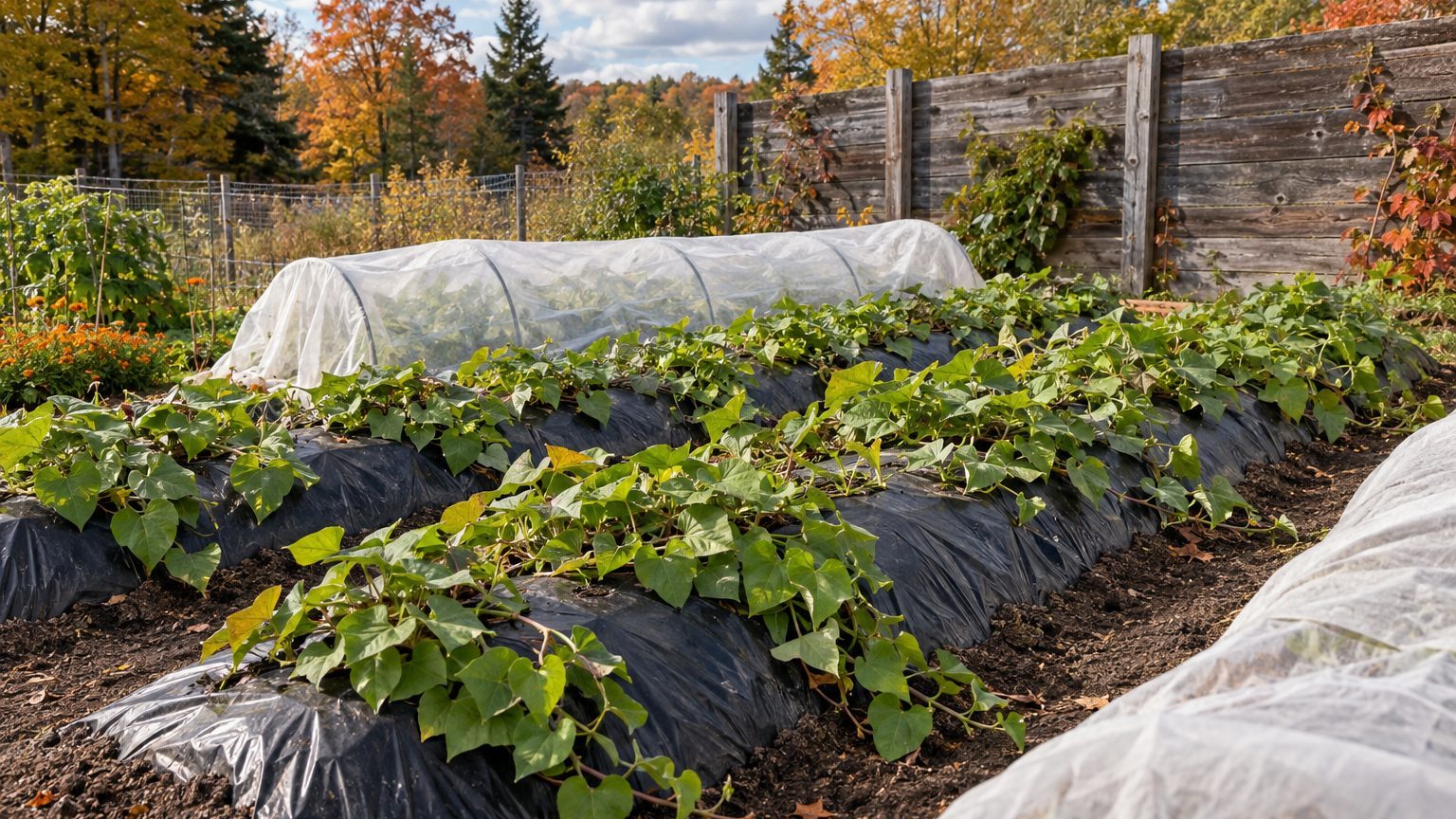

Sweet potatoes can be grown well north of where most gardeners try them, but the crop has to be treated as a warmth-gathering project, not a normal planting. Early-maturing types, black plastic, ridged soil, row covers and a sheltered wall each add a little heat. Stacked together, they can stretch a short summer. Alone, none of them is a shortcut.
What is actually going on
Start with the plant’s origin. Sweet potato is a tropical vine, a cousin of morning glory. It is not a potato, and it is not a nightshade, so it has no place in your potato rotation and does not share that family’s blights. It is not a yam either, however the supermarket bin is labeled. True yams are a different plant altogether. What matters for a northern gardener is that this vine runs on heat, and it keeps a running tally.
Think of accumulated warmth as a bank balance. Every warm day and warm night makes a deposit. Cool, cloudy stretches deposit almost nothing, and a cold snap can make a withdrawal by stalling the plants. The roots need a certain total before they bulk up into something worth digging. A long, mild summer and a short, hot one can reach the same total. A short, cool one never gets there, no matter how many calendar days it offers.
That is why frost-free days are a poor guide by themselves. The number that counts is how much usable warmth reaches the roots, and the roots sit in the soil. Cold soil at planting time slows the slips from the start. Cool nights in midsummer slow the swelling. Then a killing frost ends the season whether the roots are ready or not.
Four ways to collect more warmth
Everything in the short-season toolkit falls into one of four moves. The first is choosing a type that needs less warmth: early-maturing, short-season selections that size up sooner, usually with smaller or more modest roots than the long-season standbys. The second is warming the soil, with dark plastic mulch and ridged or raised planting, both of which raise root-zone temperature. The third is warming the air around the vines with row covers or low tunnels in the cool weeks at each end of the season. The fourth is picking a warmer site, such as the base of a south-facing wall or a spot beside paving that holds afternoon heat and gives it back at night.
Each one adds a modest amount. None of them turns a cold summer into a hot one.
For which early types have actually been trialed near you, ask your state extension service. Varieties perform differently from one region to the next, and a local trial result beats any list a general article could offer. If you are new to the crop, the Growing Sweet Potatoes: Slips, Heat, and a Careful Cure guide covers the basics that the rest of this page builds on.
In the garden
The moves below are listed roughly in order of return for the effort, biggest payoff first. The right-hand column matters as much as the middle one, because every one of these tricks has a way of backfiring.
| Move | What it buys you | What happens when it goes wrong |
|---|---|---|
| Early-maturing type | Roots that size up on less accumulated warmth | Planting a long-season type “because it’s what the catalog raves about” leaves you with pencil-thin roots at frost |
| Planting into warm soil, with healthy slips | No stall after transplanting; growth starts immediately | Slips set into cold soil sulk, yellow and lose weeks you cannot get back |
| Black plastic mulch | Warmer root zone, fewer weeds | Laid over dry soil, it sheds rain and the bed goes bone dry; on a scorching day it can cook a fresh slip touching the film |
| Ridges or raised beds | Better drainage, and soil that warms faster in spring | In a dry, hot summer the ridges dry out fast; in a very wet one, they help, but only if they are tall enough to drain |
| Row cover or low tunnel | Warmer air early, a buffer against cold nights and a little frost protection | Left closed through a hot afternoon, it turns into an oven; left on too long, it holds the vines back once they fill out |
| Sheltered site or container by a south wall | Reflected heat and a windbreak | A pot in full sun can overheat roots, and a wall that shades the plant half the day defeats the purpose |
Two things come before all of that. First, the slips: buy or grow healthy, well-rooted ones timed to arrive when the soil is ready, not weeks ahead. If you want to raise your own, Growing Your Own Slips From a Stored Root walks through it. Second, watering: plastic and ridges change how a bed dries, so check the soil under the film instead of trusting the surface.
Where does it stop being worth it? When you need the early type, the plastic, the tunnel and the wall all at once just to reach thumb-sized roots in a normal year, you are running a hobby, not a harvest. If frost regularly arrives before the roots have swelled, even with a well-run stack, try a small trial patch, or grow the vines for their edible leaves, rather than committing a big bed.
Harvest timing matters more in a short season than anywhere else, because the last weeks are when the roots gain the most and when frost threatens hardest. Lifting Sweet Potatoes at the Right Moment covers how to read the vines and the forecast together.
After lifting, the roots need curing in a warm, humid place, following your extension service’s instructions, and then storage at moderate room temperature. Never the refrigerator, and never a cold cellar or unheated garage. Cold injury is real and permanent, and it ruins more home crops after a good harvest than any pest does. Inspect every root as you handle it. A soft patch or a weeping spot ends the question for that root: do not eat it, and do not assume the rest are fine because they look sound.
What it depends on where you are
Some of this page is national, and some of it is local. The mechanism is the same everywhere: roots need accumulated warmth, and the stack of techniques adds to it. The food-safety rules on cold storage and soft spots are also the same everywhere.
Season length is local. So are summer heat and summer rainfall, and together they change the answer more than any single technique does. A garden with a long but cool summer behaves very differently from one with a short, hot summer, even if the frost dates look similar on paper. Plastic mulch that is a lifesaver in a cool, damp climate can be a liability in a dry, blazing one. A row cover that saves plants in a late spring can be unnecessary in a place that warms quickly.
Use the state pages in this series for the regional picture, and use your own state’s cooperative extension service for the specifics: which types have been trialed nearby, when local soil is warm enough, and how they recommend curing and storing.
The mistake that costs the most
Planting too early. It is the natural instinct, and the wrong one. Every short-season gardener feels the pull to get slips in the ground the moment the weather turns pleasant, on the theory that a head start banks warmth. It does the opposite. Slips set into cold soil do not grow slowly and catch up. They stall, yellow, sometimes rot, and spend the weeks you wanted to gain just recovering. The season you were trying to stretch is shorter than if you had waited.
What to do instead is to spend your effort before planting, not on planting early. Warm the bed first: lay black plastic over the ridges a couple of weeks ahead, so the soil under it is already warm when the slips go in. Keep the slips growing in a bright, warm spot indoors until then, and harden them off gradually so they are not shocked by outdoor conditions. Use your extension service’s guidance on soil warmth as the go signal, and check the soil itself, not the air, with a thermometer at root depth.
Then plant on a mild, overcast day, water them in, and cover the bed if a cold night is forecast. Two weeks of patience in spring buys back far more warmth than two weeks of hurry, because the plants take off instead of sulking.
Common questions
Can I grow sweet potatoes in a short summer without plastic?
Sometimes, yes. In a place with warm soil by planting time and a decent stretch of warm nights, an early-maturing type may do fine with just ridges and good timing. Plastic helps most where the soil warms slowly. Ask your extension service whether local gardeners in your area get by without it.
Do sweet potatoes count as potatoes when planning crop rotation?
No. They are not related to potatoes and are not nightshades, so they do not share potato diseases and do not belong in a potato rotation. They are also not yams. Treat them as their own crop and rotate them with an eye to soil health and past plantings of sweet potatoes specifically.
Should I buy slips or grow my own?
Either works, as long as the slips are healthy and ready when the soil is warm. Growing your own from a stored root gives you control over timing, which matters in a short season. If you buy, choose a seller whose stock suits your region, and ask your extension service what local growers use.
Can I keep the harvest in the refrigerator or a cold cellar?
No. Cold below the proper storage range causes chilling injury that cannot be reversed, and roots often look fine until they are cooked. Cure them warm, then store them at moderate room temperature. Check the roots regularly, and discard any with a soft patch or a weeping spot.