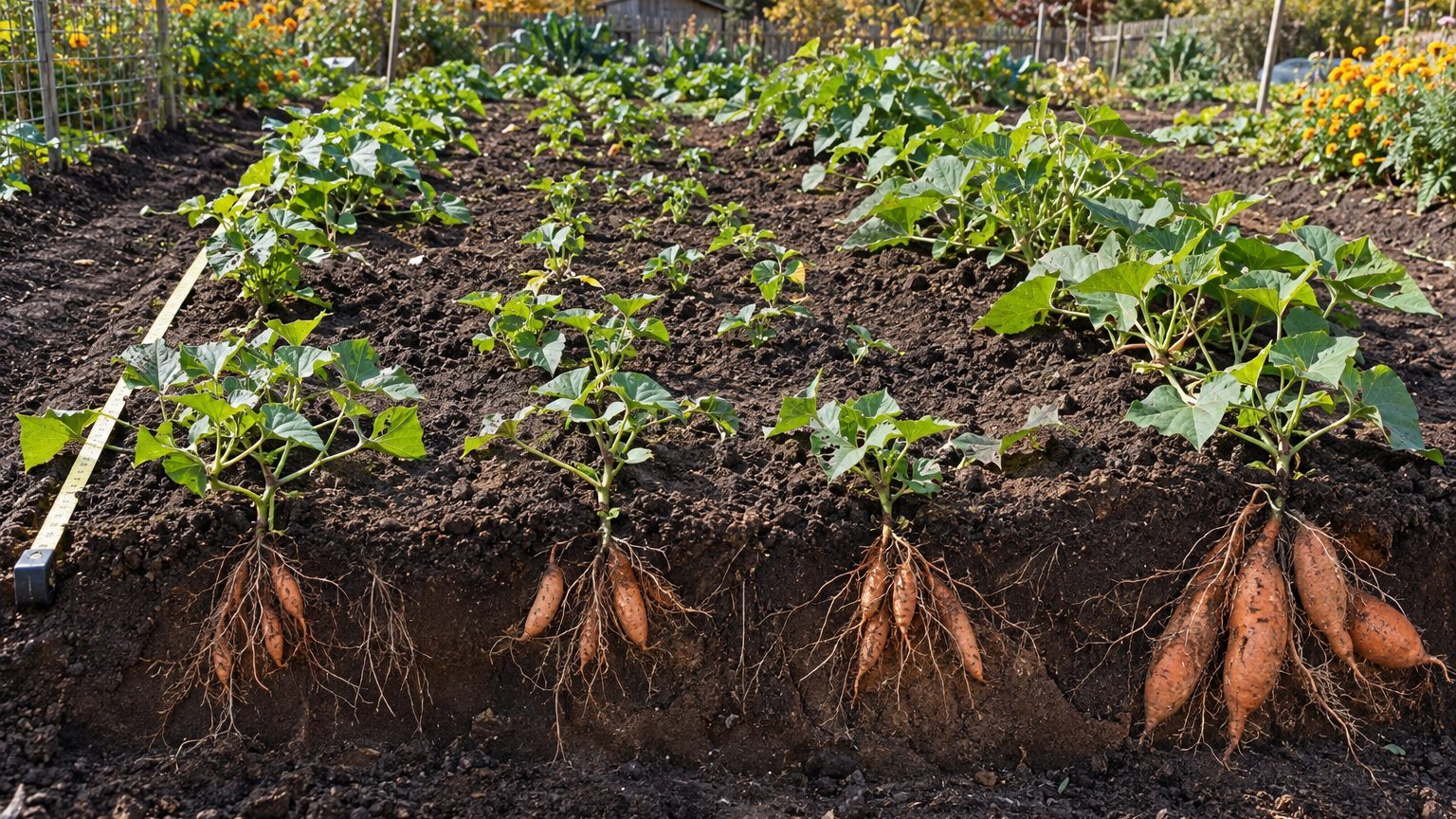

Give each sweet potato slip about 12 inches of row, with 3 to 4 feet between rows, and you’ll get a mix of table-sized roots. Squeeze closer and the roots run small. Open the spacing up and they run large, sometimes too large to cook well. The number is a lever, not a rule, so here is how to pull it for the harvest you actually want.
What is actually going on
Competition underground
The thing to understand is competition. Each slip sends out a web of roots, and only some of them swell into the storage roots you eat. How many swell, and how big they get, depends on how much soil, water, nutrition and sunlight each plant can claim. Closely spaced plants share a small patch, so they set many small roots. Widely spaced plants have room to spare, so they set fewer, larger ones. Few crops respond this directly to a tape measure.
That is also where potato habits mislead people. A sweet potato is not a potato. It is a root, not a stem tuber, and it belongs to the morning glory family, not the nightshades. It is not a yam either, whatever the supermarket label says. True yams are unrelated tropical plants, and the orange roots sold as “yams” are sweet potatoes. None of this is trivia. It means potato spacing charts, potato hilling advice and potato rotation rules don’t transfer.
Why the decision comes early
Roots begin deciding whether to swell in the first weeks after transplanting, well before the vines cover the ground. By midsummer the vines look lush whether the spacing was right or wrong, and the only way to find out is to dig. You can’t add room afterward.
Spacing also shapes the canopy. Tight plantings close over the soil sooner, which shades out weeds and holds moisture. Wide plantings leave bare ground for weeks, so you’ll be hoeing longer. Soil texture matters too. In loose, well-drained ground, roots can expand freely at nearly any spacing. In heavy or stony soil, roots bend, split and stay small no matter how far apart you plant. Fixing the soil often beats adjusting the spacing.
In the garden
Spacing by outcome
The ranges below are the commonly cited ones. Extension services vary a little, so treat them as a starting point. The last column is the part most charts skip.
| What you want | Between plants | Between rows | What happens when it goes wrong |
|---|---|---|---|
| Many small, even roots | 8 to 10 inches | 3 feet | Too tight and you get thin, pencil-like roots, some of which never swell. Vines tangle and are hard to walk through. |
| A household mix of sizes | 12 to 15 inches | 3 to 4 feet | Forgiving. A few inches off either way costs little, though a dry or compacted spot will still show. |
| Fewer, larger roots for baking | 15 to 18 inches | 3 to 4 feet | Push it and you risk oversized roots that crack, turn stringy or cook unevenly. Weeds get a long head start. |
| Beyond 18 inches | Wider than 18 | 4 feet or more | Bed space wasted, with no guarantee of better roots. Big roots are more likely to be misshapen. |
Planting on a low ridge or mound of loose soil helps at every spacing, because roots swell more evenly when they aren’t fighting for space in packed ground. Compact, short-vined types can sit closer than long-running types, so check what you’re growing before you set the stakes.
Which one suits a household
Market growers chase uniform size because buyers pay for it. A household has no such need. Most families are better served by the middle row: medium roots that cook evenly, plus a few big ones for baking and a few small ones for a quick side dish. If you have to err, err slightly wide. A root that’s a bit big is still a good meal, while a root the width of a pencil isn’t worth peeling.
Pots change the question entirely, since the limit is the container and not the row. That case gets its own treatment in Sweet Potatoes in a Container. For the full picture of slips, heat and curing, start with Growing Sweet Potatoes: Slips, Heat, and a Careful Cure.
What it depends on where you are
The national part and the local part
Some of this holds everywhere. Competition governs root size in every garden, the outcome-based ranges above are a sound starting frame, and soil that’s loose beats soil that’s tight. Those pieces travel.
The rest is local, and this page doesn’t know your garden. Season length is the biggest unknown. A short season leaves less time for roots to bulk up, so extra-wide spacing may not pay off, while a long, warm one gives roots time to keep swelling. Summer heat changes how hard the vines run, which changes how quickly they shade the ground. Summer rainfall matters as well. Heavy rain on dense soil can rot roots or split them, and a long dry stretch followed by a soaking can crack them regardless of spacing. If your summers swing between the two, mulch and even watering will do more than an extra inch or two between plants.
Where to check next
The state pages on this site cover how these factors play out region by region, and they are the best next stop for the season you actually have. Your state’s cooperative extension service is the second one. It knows which varieties have been trialled in your soil and climate, and it can tell you whether locally recommended spacing runs tighter or wider than the ranges here. Ask about vine type too, since long-vined and compact types don’t need the same room. If you’re deciding how much sprawl to allow, Sweet Potato Vines: Leave Them or Lift Them covers what the vines are doing while you wait.
The mistake that costs the most
Crowding to get more
The costliest error is planting slips too close because more plants feels like it should mean more sweet potatoes. It’s potato logic, and it fails here. Every added plant splits the same soil among more roots, so the total doesn’t climb the way you’d expect. What climbs is the count of small, thin roots that nobody wants to scrub and cook. A bed that looks packed and green in July can turn out to be a pile of pencils in October.
The damage is quiet, too. Nothing looks wrong during the season. Vines grow, leaves shade the soil, and you feel productive. The mistake reveals itself at harvest, when it can no longer be fixed, and a season of heat and space has already gone into roots too small to use.
What to do instead
Decide the outcome first, then measure. For most households that means about 12 to 15 inches between plants, with a ruler or a marked stick, not the eye. Eyeballed rows drift closer as you go. If the bed is small, plant fewer slips and give each one its room, rather than cramming more in.
If you’ve already planted too tightly, act in the first few weeks. Pull out every other plant, then replant the extras elsewhere or compost them. It feels wasteful, but it beats a bed of thin roots. Later in the season, keep an eye on the vines, because they can root wherever their nodes touch the soil and set small roots that compete with the main ones. The vines guide covers when to leave them and when to lift them.
Common questions
Can I plant closer together if my bed is small?
You can, but expect smaller roots. Going as tight as 8 to 10 inches gives a bigger count of small ones, and it’s a fair choice if small roots suit you. Below that, many plants stop swelling at all. Fewer plants at proper spacing usually beat more plants shoehorned in.
How many slips fit in a container?
That depends on the pot’s size and depth, not on row spacing, and the answer is usually fewer than people expect. The container guide walks through it in detail, so check Sweet Potatoes in a Container before you fill a pot.
Do the vines need room to run?
Yes, and how much varies by type. Long-vined types will roam well past the row, while compact types stay closer. Your state extension service can tell you which types have done well nearby. Keep paths clear so the vines don’t root into them, or they’ll set small roots where you don’t want them.
Do bigger roots store as well as smaller ones?
Size alone doesn’t tell you. What matters is that the roots are cured and stored properly, and that means somewhere comfortably warm indoors, never a refrigerator or a cold cellar. Cold injury is permanent and is a common way a good harvest gets ruined. Check every root before you store it. A soft patch or a weeping spot ends the question, and looking sound doesn’t make a root safe to keep or eat. The cure steps are in the main growing guide.