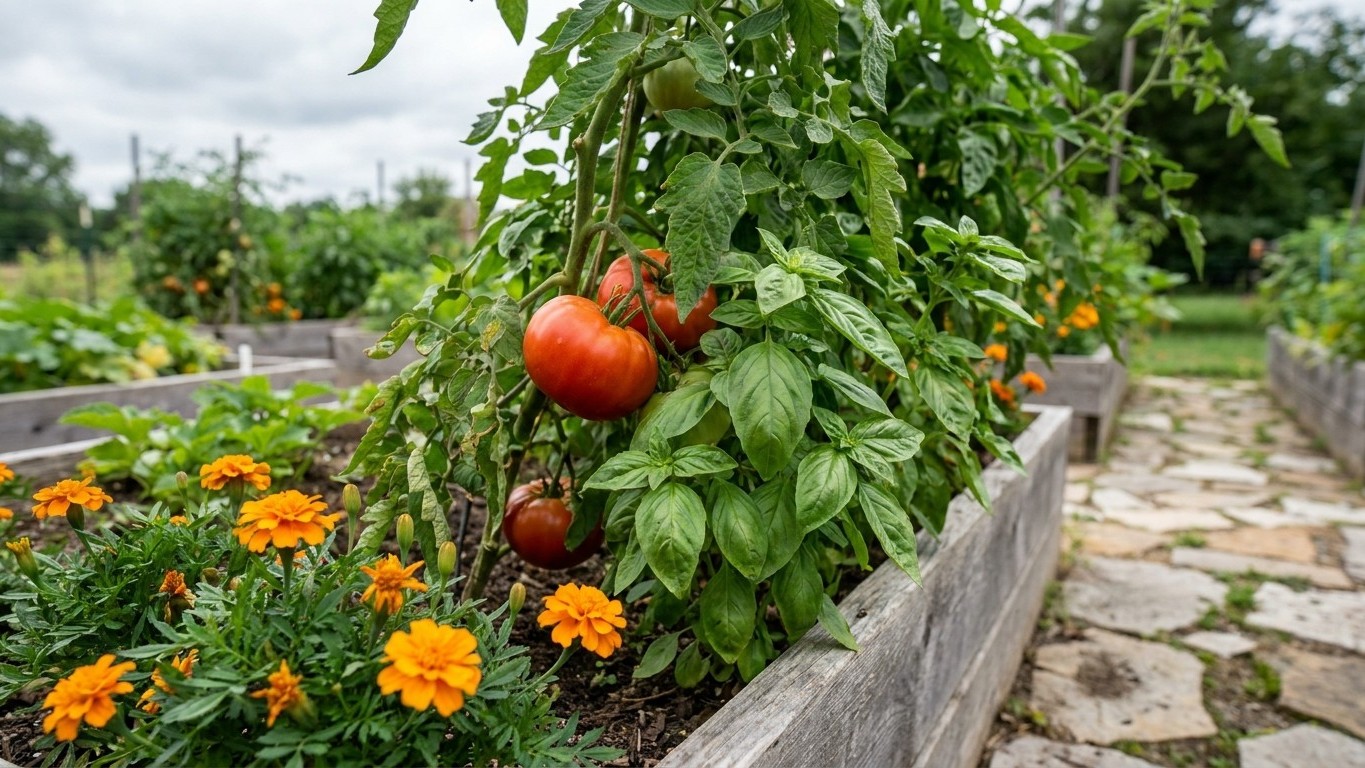

Some companion pairings for tomatoes hold up under study, most don’t. Marigold roots release compounds that measurably suppress root-knot nematodes in soil, and basil’s strong scent appears to disrupt some pest insects’ ability to find tomato foliage, while classic pairings like tomato-and-carrot or tomato-and-onion have never shown any measurable yield or pest benefit in trials. The one thing worth doing this season: ring each tomato with French marigold and keep fennel, corn and potatoes well away from the bed entirely.
Why this matters
Companion planting changes three things around a tomato plant: what insects can smell, how crowded the root zone gets, and how much airflow moves through the lower leaves. None of that is folklore. A strong-scented plant like basil growing close to a tomato’s canopy can make it harder for pest insects that hunt by smell, such as whiteflies and some thrips, to find the crop. French marigold (Tagetes patula) does something more specific: its roots release compounds into the soil that have been shown to reduce populations of root-knot nematodes, a soil pest that stunts tomato roots and shows up as swollen galls if you pull a dead plant at season’s end.
Get the layout wrong and you lose more than you gain. Pack four or five different companions around a single tomato plant and you’ve built a dense low canopy that holds moisture against the tomato’s lower leaves overnight, exactly the condition that lets early blight and other fungal spores germinate. Skipping companion planting entirely costs you little: it’s a genuine but modest help, not a substitute for good spacing, mulch and a working disease or resistant-variety plan. The mistake is treating it as either magic or worthless, when it’s neither.
When to do it
Companions go in at the same growth stage as the tomato itself, not on a separate calendar. If you’re starting marigold or basil from seed indoors, sow them alongside your tomato seedlings, as covered in our guide to Starting Tomatoes From Seed: Timing, Light and the Mistakes That Cost You Weeks, so both are a similar size and can go into the ground together without one shading out the other before it’s established.
Wait for the tomato transplant itself first. Get the tomato in the ground and past the initial droop of transplant shock before adding anything around its base, since a plant still recovering doesn’t need competition for water at the root zone. Once it has put out a new set of leaves and stands upright rather than wilting in the afternoon heat, that’s your signal the root system has taken hold and you can safely under-plant.
For pollinator-focused companions like borage, timing matters more. Tomatoes are mostly self-pollinating but benefit from the vibration bumblebees provide, so aim to have borage or similar insect-attracting plants blooming by the time the tomato sets its first flower clusters, established a few weeks ahead rather than seeded at the same moment as the transplant.
Nematode-suppressing marigold works on a slower timeline. It needs a full season of root growth in the same soil to build the effect, so it does less for this year’s tomato than for whatever you plant in that bed next.
How to do it

Decide what you actually want the companion to do, then choose one plant for that job rather than surrounding a single tomato with five different species at once. The three legitimate jobs companion plants do for tomatoes are masking scent to confuse pests, attracting pollinators and predatory insects, and suppressing soil-borne nematodes. Trying to stack all three around one plant just crowds the bed.
Placing each companion
For scent-masking, plant basil directly under and around the tomato’s canopy, roughly one basil plant per tomato at a distance of about 8 to 12 inches from the main stem. That’s close enough for the scent to mix with the tomato’s foliage but far enough that the basil isn’t shaded out once the tomato canopy fills in.
For nematode suppression, ring the base of each tomato with French marigold spaced about 6 to 8 inches apart. The suppression comes from the marigold’s living roots interacting with nematodes in the soil, so it only works if the marigold is actually growing in that spot, not scattered a few feet away in a border.
For pollinator and beneficial-insect support, put borage at the corners of the bed rather than crowding it in with the tomatoes, since it grows into a large, sprawling plant. One borage plant per two or three tomatoes is enough to bring in bumblebees and the predatory wasps that go on to eat aphids and hornworm eggs.
Nasturtium works differently. It’s a trap crop, meaning you want aphids to prefer it over your tomatoes. Plant it a foot or two away from the tomato row, not touching it, and check it every week or two through the season. Once it’s visibly overwhelmed with aphids, pull it and replace it rather than letting the population build to the point where it spills over onto the tomatoes anyway.
Chives or garlic tucked one clump into each gap along the row add a mild sulfur scent some growers find deters aphids, though the effect is modest next to marigold’s documented nematode suppression. Water everything in at planting and treat companions as bed residents competing for the same water and nutrients as the tomato: if you’re feeding the tomato, don’t assume the companions are doing the work of your regular feeding schedule for you.
| Companion | Effect on tomato | Evidence | Spacing from tomato |
|---|---|---|---|
| French marigold (Tagetes patula) | Suppresses root-knot nematodes | Backed by soil studies | 6 to 8 inches |
| Basil | Masks scent, may reduce whitefly and thrips landing | Modest, observational | 8 to 12 inches |
| Borage | Attracts pollinators and predatory wasps | Well documented for pollinator draw | Bed corners, 1 per 2-3 tomatoes |
| Nasturtium | Trap crop, draws aphids away | Well documented as trap crop | 1 to 2 feet, separate row |
| Carrot, onion (classic pairs) | None measurable | Folklore, no trial support | N/A |
What goes wrong

Overcrowding is the most common mistake. Growers plant a full guild, basil ring, marigold ring, nasturtium border and borage in the corners, around every single tomato, and the combined foliage holds humidity against the lower leaves through the night. That’s exactly the microclimate early blight and septoria leaf spot need to establish, so a bed planted for protection can end up with worse fungal pressure than one left bare underneath.
The mistake that looks like extra care but isn’t: mulching or under-planting living ground cover right up against the tomato’s main stem to protect the soil. Any planting or mulch touching the stem holds moisture against it, the same condition that invites stem rot and gives soil-splashed fungal spores a bridge to the lowest leaves during watering or rain. Keep a clear ring of bare, mulched soil at the stem itself even when companions surround the plant further out. In pots this crowding shows up faster because there’s less soil volume to go around, something worth checking against our guide to Growing Tomatoes in Containers: Pot Size, Compost and Watering Rhythm.
Another common error is planting a known antagonist without realizing it. Fennel is documented to release root compounds that inhibit the growth of many neighboring plants, tomatoes included, and has no place in the same bed. Potatoes share the same blight pathogen family as tomatoes, so growing them close together raises the risk that an outbreak in one crop jumps to the other. Corn draws the same fruitworm moth that attacks tomatoes, so growing them side by side can raise pest pressure on both rather than lowering it on either.
Doing it differently
In containers, there’s rarely room for a full guild around one plant, so pick a single function rather than layering several. A single marigold works well tucked into a shared pot to guard against nematodes carried in with garden soil, while basil suits a container that’s mostly about kitchen convenience anyway. Our guide to Growing Tomatoes in Containers: Pot Size, Compost and Watering Rhythm covers pot sizing that leaves room for a second plant without crowding the tomato’s own root ball.
In a greenhouse or under season-extending covers, pollinator-attracting companions do less work, since covered tomatoes are usually hand-pollinated or rely on vibration rather than open access to bumblebees. If you’re using row covers or a hoop house to push the season, as described in our guide to Extending the Tomato Season: Getting Weeks More at Both Ends, skip borage and nasturtium under cover and lean on basil instead for the humid, pest-prone conditions covered growing tends to create.
Raised beds usually have enough depth and width to run a proper three-plant guild, basil, marigold and one allium, without any of them competing directly with the tomato’s own root system, since raised beds tend to hold more soil volume than a typical in-ground row.
Indeterminate tomato varieties, which keep growing and sprawling all season, will eventually shade out low companions planted on their shaded side as the canopy fills in, so plant scent- and pollinator-companions on the sunward side of an indeterminate vine. Determinate, bush-type varieties stay compact enough that this rarely becomes a problem.
Common questions
Does planting basil next to tomatoes actually make them taste better?
No, there’s no evidence that basil changes tomato flavor through soil or root contact. The benefit basil offers is scent-masking against certain pest insects, not flavor transfer, and any perceived taste difference comes down to how the tomato itself was grown, not what’s planted beside it.
Can I plant tomatoes and peppers next to each other?
Yes, tomatoes and peppers are both nightshades with similar water and feeding needs, so they grow well side by side. Watch for shared pests and diseases between them, and treat them as one bed for rotation purposes rather than two separate crops.
What’s the one plant I should never put near tomatoes?
Fennel is the clearest case. Its roots release compounds documented to inhibit the growth of many neighboring plants, tomatoes among them, so keep it in a separate bed entirely. Potatoes and corn are worth avoiding too, though for disease-sharing and pest-sharing reasons rather than the direct root chemistry fennel causes.
Is companion planting enough to stop hornworms or blight on its own?
No. Companion planting shifts pest and disease pressure a little, but it doesn’t replace scouting for hornworms by hand, removing infected foliage promptly, or choosing disease-resistant varieties in the first place. Treat it as one layer of a broader plan covered in our main guide to How to Grow Tomatoes, not a stand-alone fix.