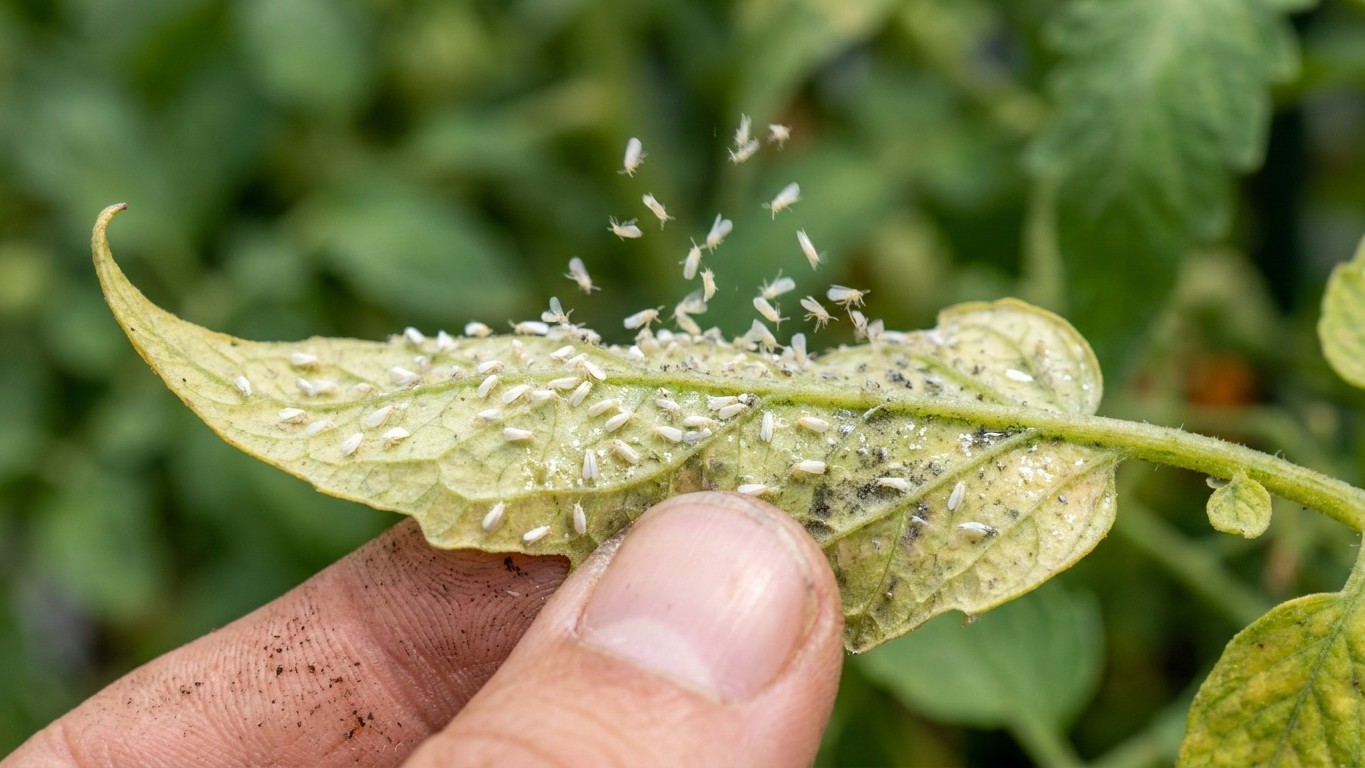

Brush a tomato plant and a pale cloud lifts off the underside of the leaves, hovers for a second, then settles right back down. That’s whiteflies. They’re sap-feeders, not chewers, and on a mature, established tomato plant they’re mostly a nuisance and a warning sign rather than a crisis. On a young seedling, the math changes fast, because a small plant has far less leaf area to spare.
What the damage looks like

The cloud itself is the giveaway, but it’s worth knowing what’s happening on the leaf before the insects even take flight. Flip a lower leaf over and you’ll see tiny, moth-like insects, about the size of a pinhead, dusted white as if someone tapped flour onto the underside. They sit still until disturbed, then scatter in a loose swarm and re-land within a few feet, usually back on the same plant.
Look closer and the leaf surface tells the rest of the story. Whiteflies feed by inserting a needle-like mouthpart into the phloem and drawing out sap, and what they excrete afterward is a clear, sticky residue called honeydew. That residue coats the upper surface of the leaves below wherever the insects are feeding, and within a week or two it often grows a black, sooty film. That black film, sooty mold, is not itself damaging to the plant tissue, but it blocks light from reaching the leaf and is the single most recognizable secondary sign of a whitefly infestation on tomatoes.
The leaves themselves may yellow, curl slightly, or look stippled where feeding has been heaviest, and a heavily infested plant can show stunted new growth because so much sap is being pulled away from developing shoots. On established plants with a full canopy, none of this usually threatens the harvest. The plant has enough leaf area and enough vigor to outpace the feeding. The real damage shows on transplants and young seedlings still building their first true leaves, where even a modest population can slow growth measurably because there’s so little spare capacity to draw on.
One more detail separates whitefly damage from most other tomato pest damage: the insects themselves are visible in numbers, in daylight, without needing a hand lens. That’s unusual. Most sap-feeders on tomatoes are either too small to see easily or hide well enough that you rarely see the insect itself, only its damage. Whiteflies are the opposite. The population announces itself the moment the plant is touched.
Making sure it is this and not something else
The cloud-on-touch behavior is close to diagnostic on its own, but a few other tomato pests produce similar-looking symptoms, and it’s worth ruling them out before treating.
Aphids
Aphids also produce honeydew and sooty mold, and they cluster on the undersides of leaves and new growth. The test is simple: aphids don’t fly off in a cloud when disturbed. They’re slow-moving, pear-shaped, and stay put or drop off the leaf rather than taking to the air. If brushing the plant produces no flying insects at all, look for aphids instead.
Spider mites
Spider mites cause stippled, dusty-looking leaves and fine webbing between stems, but they’re far too small to see as a “cloud” with the naked eye, and they don’t fly. Hold a sheet of white paper under a suspect leaf and tap it. Mites show up as tiny moving specks on the paper; whiteflies show up as flying insects in the air above the leaf.
Thrips
Thrips cause silvery streaking and distorted new growth, and they’re slender, fast-moving insects that hide inside curled leaves and flowers rather than resting openly on the leaf underside. They don’t cluster in visible numbers on the leaf surface the way whiteflies do, and shaking a flower over white paper is a better way to find them than brushing foliage.
If the insects are pinhead-sized, moth-shaped, powdery white, rest in numbers on the leaf underside, and lift off in a loose swarm when the plant is disturbed, that combination points to whiteflies specifically, not to any of the three look-alikes above.
When it shows up
Whiteflies build populations fastest once a plant has a full, dense canopy of foliage, since the closed, humid microclimate under a leafy tomato plant is exactly what the insects favor for feeding and laying eggs. That means the risk period isn’t a fixed point on the calendar, it’s a plant stage: from first flowering onward, once the lower canopy has filled in and the plant is putting out enough leaf mass to shade its own base.
Seedlings and very young transplants can pick up whiteflies too, usually by insects moving over from a nearby infested plant, whether that’s another vegetable, an ornamental, or a weed host growing along a fence line or garden edge. This early-stage exposure is the one that matters most, because a seedling has so little leaf surface that even a light feeding population can slow it down. Once the plant is established and vigorously growing, the same population size becomes far less consequential.
Warm, still conditions favor rapid population growth, since the insects reproduce quickly in heat and don’t disperse well in the absence of wind. A greenhouse, a hoop house, or a densely planted garden bed with poor air movement will tend to hold a whitefly population longer and let it build higher than an open, breezy planting will. That’s a condition worth watching for, not a date to circle: dense, still, warm foliage is whitefly weather regardless of when it happens.
What to do now
- Confirm the scale first. A light dusting of whiteflies on a few leaves of an otherwise vigorous, mature plant often doesn’t need any intervention at all. Established plants tolerate light feeding well; save the effort for seedlings or for infestations heavy enough to visibly slow growth.
- Hose them off. A strong jet of water aimed at the undersides of infested leaves knocks adults and nymphs to the ground, where most won’t make it back onto the plant. This costs nothing and works best done in the cooler part of the day, repeated every few days while the population is active.
- Set out yellow sticky traps. Whiteflies are strongly attracted to yellow, and a few sticky cards placed near the plant, at leaf height, will catch adults and give a rough read on whether the population is rising or falling without any insecticide involved.
- Remove the worst leaves. Leaves coated heavily in honeydew or sooty mold, especially lower leaves that are already yellowing, can simply be pruned off and disposed of away from the garden. This removes both the mess and a chunk of the insect population at once.
- Protect young plants with row cover. On seedlings and new transplants, a lightweight floating row cover set in place before whiteflies arrive keeps adults from ever landing to lay eggs. Remove it once the plant flowers, since pollinators need access at that stage.
- Bring in or protect natural predators. Lady beetles, lacewings, and several small parasitic wasps feed on whitefly eggs and nymphs and can hold a population in check on their own in an established garden. This is the main reason to hold off on spraying: a broad-spectrum insecticide kills these predators along with the whiteflies, which often leads to a worse rebound once the spray wears off.
- Use insecticidal soap or horticultural oil as a last resort. These are the two chemical options genuinely available to home gardeners for whiteflies, and they work by direct contact, so they need to be sprayed onto the underside of the leaf where the insects actually sit. Both break down quickly and are gentler on beneficial insects than synthetic insecticides, but they still should be applied only when the population is heavy enough on a young or struggling plant to justify it, and never in full sun or high heat, which can scorch treated leaves.
Stopping it coming back
- Inspect transplants closely before planting them out, since bringing in a few infested seedlings from a nursery is one of the most common ways a garden ends up with an early, heavy population.
- Space tomato plants with enough room for air to move through the canopy once they mature; dense, still foliage is what lets populations build unchecked.
- Keep an eye on nearby ornamentals and weeds, since many common landscape plants and weedy hosts along fences or garden edges carry whiteflies between seasons and reinfest tomatoes from a few feet away.
- Set out yellow sticky traps early, right after transplanting, as a monitoring tool rather than waiting until a visible cloud appears; catching a rise in adult numbers early makes every other control easier.
- Avoid routine broad-spectrum spraying as a preventive habit. It strips out the lady beetles, lacewings, and parasitic wasps that would otherwise keep whitefly numbers low on their own, and gardens that spray least often end up with the smallest whitefly problems season over season.
- Clean up spent tomato plants and other host debris promptly at the end of the season rather than leaving foliage to sit, since adults and nymphs can persist on decaying plant material nearby.
Common questions
Do whiteflies actually kill tomato plants?
Rarely on established plants. The bigger risk is to seedlings and young transplants, where heavy feeding can stunt growth significantly. A mature, well-grown tomato plant usually tolerates even a fairly visible population without lasting harm.
Is the honeydew or sooty mold dangerous to eat?
No. Sooty mold sits on the leaf surface and blocks light, but it doesn’t grow on the fruit itself in any way that affects food safety, and washing produce as usual removes any residue.
Will whiteflies spread to other vegetables in the garden?
Yes, whiteflies feed on a wide range of garden plants beyond tomatoes, including peppers, eggplant, squash, and many ornamentals, so a population left unchecked on one crop can move to neighboring plants, particularly in a dense, still planting.
Why do the whiteflies come right back after I spray them?
Contact sprays only kill the insects present at the moment of application, not eggs already laid on the leaf underside, and broad-spectrum products also kill the predators that would otherwise suppress the next generation. Repeated, targeted treatment on the leaf undersides, combined with protecting natural predators, controls populations more durably than a single heavy spray.