
Seventy-three days on the packet is the number that gets people in trouble, because they count it from the day they sowed seed instead of the day the transplant went into the ground — and then wonder why a vine that should be loaded is still setting its first green fruit when the neighbors are already slicing tomatoes for sandwiches. Add the five to seven weeks that seed needs indoors before it’s ever ready to go out, and a planting planned around the wrong start date can run a full month behind, right into the stretch where a cool August pushes ripening later still.
What Big Beef actually is

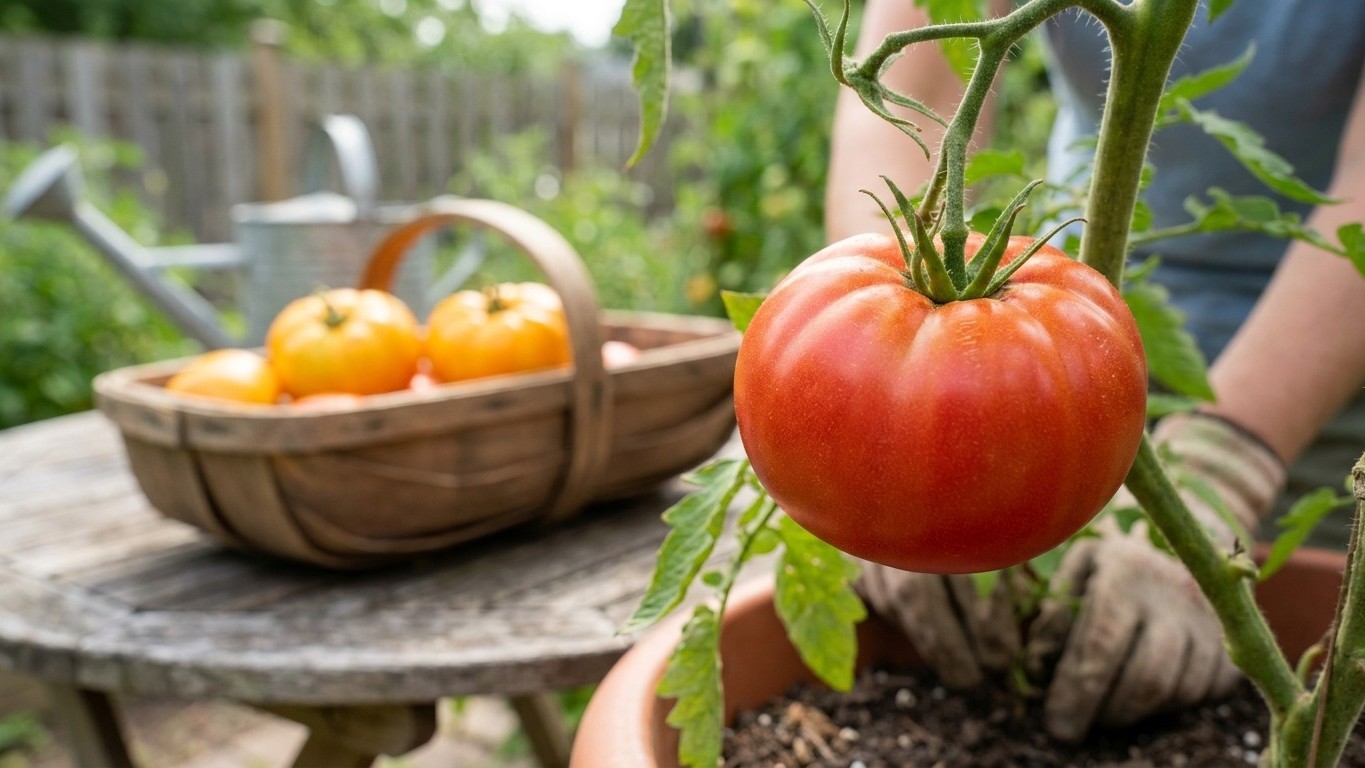
Big Beef is an indeterminate beefsteak tomato, bred to keep producing large slicing fruit on a vine that keeps growing until frost stops it, rather than setting one flush and quitting. The fruit runs large and round, deep red at full ripeness, with the dense meaty flesh and few seed cavities that make a beefsteak good for sandwich slices rather than sauce. It reaches harvest in about 70 days from transplant, the figure printed on the seed packet and repeated by every major catalogue that carries it.
That count starts the day a transplant goes into the ground, not the day seed is sown indoors. Seed started indoors needs another five to seven weeks under lights or on a windowsill before it is ready to go out, so the real gap between sowing and first ripe fruit runs closer to four months than to ten weeks. Catalogue figures also assume a season of ordinary warmth. A cool, cloudy stretch after transplant can push the actual date a week or two past the printed number, and a hot, sunny run can pull it forward. Treat 70 days as the middle of a range, not a fixed appointment.
Because it is indeterminate, Big Beef needs a full-season commitment: a cage or stake tall enough to hold a vine that keeps climbing, and spacing that accounts for months of growth rather than one compact flush. That single fact decides more about how the plant is grown, a habit shared across most of the crop covered in the wider look at Tomato Varieties, than the fruit’s size or color ever will.
What Big Beef is good for
Its published flavor description is short and specific: an old-time tomato taste, on large fruit borne by vines bred to shrug off many of the problems that discourage growers. Beyond that documented sweetness, what a beefsteak is good for is a matter of structure rather than taste.
A beefsteak carries its weight in flesh, not juice, and that is the reason to grow one. The internal walls are thick and the flesh solid enough that a slice holds its shape on a knife rather than collapsing into liquid. That structure is what a sandwich or a burger needs: a slab that stays put between two pieces of bread instead of soaking through them. Big Beef’s fruit runs large enough that a single slice can cover a full piece of toast, which is the practical test of a good slicing tomato.
That same density works against it in a saucepan. Cooking down a tomato means driving off water, and a beefsteak simply doesn’t carry the low-moisture, high-flesh ratio that a paste tomato does, so a batch of sauce made from Big Beef takes longer at the stove and yields less finished sauce per pound than the same weight of a paste variety would. This is not a flaw in the fruit; it’s a mismatch of tool to job. Save Big Beef for the plate, not the pot.
Where it does its best work is anywhere the tomato is eaten raw and whole or in thick pieces: sliced onto a sandwich, layered with cheese, fanned out on a plate with salt and oil, or diced into a chunky salad where pieces need to
Where it ripens in time, and where it is a gamble
Since Big Beef needs 70 days from transplant, the question for any garden is whether the frost-free window, minus the couple of weeks the soil needs to sit warm before tomatoes can even go in, leaves 70 days for the plant to reach first ripe fruit, plus real margin for picking after that. A margin under thirty days means one flush of fruit and a cool year takes the crop before it produces much at all.
Where the margin runs out
At the tight end, Yukon, tracked from the station at Whitehorse, has growers setting out around mid June and reaching first ripe fruit only in late August, which puts the first ripe tomato landing after the average first frost rather than before it, a margin of roughly minus three days. Nunavut, from Rankin Inlet, is only slightly better, with about two days of margin between first ripe fruit and first frost, meaning a single cool spell erases the harvest entirely. In both places the season’s accumulated warmth, not just the frost-free stretch, falls far short of what a beefsteak tomato needs to swell fruit, so an unheated bed is not a realistic option here. A greenhouse or high tunnel is the only way to grow Big Beef in either territory.
Where a tunnel makes it possible
Move to Northwest Territories, tracked from Yellowknife, or Alberta, from Calgary, and the frost-free window widens enough to give the plant roughly a month of margin after its 70 days are up, around 32 to 34 days by each station’s numbers. That is enough for a real harvest, but still tight enough that cover remains the safer call rather than an open bed. Manitoba, from Winnipeg, and Saskatchewan, from Saskatoon, push that margin to around 38 and 39 days, workable under cover, though the season’s accumulated heat is described as marginal at both stations, and a plastic mulch to warm the root zone changes the outcome more than anything else a grower there can do.
Where the margin stops being the limit
Further south the picture flips. Washington, from Seattle, already carries about 156 days of margin, and states further south run well past that. In those places the frost calendar stops being the constraint on Big Beef, and a different limit takes over.
| Territory | Reference station | Margin | Verdict |
|---|---|---|---|
| Yukon | Whitehorse | -3 days | Impossible in the open |
| Nunavut | Rankin Inlet | 2 days | High risk |
| Northwest Territories | Yellowknife | 32 days | Greenhouse |
| Alberta | Calgary | 34 days | Greenhouse |
| Manitoba | Winnipeg | 38 days | Greenhouse |
| Saskatchewan | Saskatoon | 39 days | Greenhouse |
| Washington | Seattle | 156 days | Comfortable |
| South Carolina | Charleston | 164 days | Comfortable, split season |
| Florida | Jacksonville | 180 days | Comfortable, split season |
| Texas | Houston | 191 days | Comfortable, split season |
| Nevada | Las Vegas | 226 days | Comfortable, split season |
| Louisiana | New Orleans | 228 days | Comfortable, split season |
The two ways a season goes wrong
A long, frost-free stretch does not automatically mean a good tomato season. Two limits that never show up on a frost date table can each cost the crop.
In short-season regions, the problem is not just the calendar, it is accumulated warmth. A place can carry a frost-free window that looks workable on paper while still falling far short of the total heat a beefsteak tomato needs to swell fruit, because growing degree-days, not just calendar days, are what actually build a tomato. On top of that, tomato flowers do not set fruit at all once night temperatures fall persistently below 50°F, which is common through spring and again through early autumn in the far north, shortening the usable season further than the frost dates alone suggest. Because Big Beef runs a full 70 days and is not one of the early, cold-tolerant varieties bred to squeeze into a short window, cold-limited regions are the harder problem for this particular variety. A gardener working with a Yukon or Nunavut season is better served by an early, cold-hardy slicer such as Stupice Tomato, which reaches ripeness in a fraction of the time.
At the opposite end, heat is the limit, not cold. Once daytime temperatures run consistently above 86°F, tomato pollen turns sterile and flowers drop without setting fruit, which is why growers across Texas, Florida, South Carolina, Nevada, and Louisiana treat the deep summer as dead time and run a spring crop and a separate autumn crop rather than one continuous season. For Big Beef in those states, the wide frost margin matters less than timing the transplant early enough to finish the spring flush before the heat shuts pollination down, and starting a second round of transplants in time to catch the autumn window before the real frost date arrives.
What it resists, and what it does not
What the resistance codes mean
Big Beef carries high resistance to two soil-borne diseases that ruin more tomato harvests than most gardeners realize: Verticillium Wilt and Fusarium Wilt races 1 and 2. High resistance means the plant can grow in soil carrying these pathogens without the yellowing, wilting, and dieback that would otherwise take it down mid-season, which matters most for anyone replanting tomatoes in the same bed for several years running.
High resistance is not the same grade as intermediate resistance, and the distinction is worth keeping straight even though Big Beef sits on the strong end of it here. Intermediate resistance slows a disease’s progress and reduces its severity, it does not stop the plant from showing symptoms under heavy pressure, while high resistance holds up under ordinary garden conditions.
What still gets it
What Big Beef’s resistance package does not cover is the short list of foliar diseases that actually show up most often in a home garden:
- Early blight, which spreads from soil splash onto lower leaves in warm, humid weather
- Late blight, which moves fast in cool, wet stretches and can take a whole planting
- Septoria leaf spot, which starts low on the plant and climbs if left unchecked
None of these are listed among Big Beef’s resistances on the seed packet. Because the plant stays in the ground longer than an early, one-flush variety, its lower leaves spend more weeks exposed to soil splash and humid air, which is exactly the exposure that lets these fungal diseases establish. Mulching to keep soil off the lower foliage, watering at the base rather than overhead, and pruning the lowest branches once the plant is established do more against these three diseases than any resistance code on the packet.
Growing it without the usual mistakes
Because Big Beef is indeterminate, it needs a support built for the long haul: a stout stake or sturdy cage able to carry a vine that keeps setting new growth into fall, not the lighter ring cage that works fine for a compact determinate. Give it real spacing, since crowded plants trap humidity around the lower leaves where early blight and septoria take hold first.
Feed it on a schedule that matches its habit rather than stopping early. A determinate variety that ripens in one flush can be fed hard early and left alone once fruit sets, but an indeterminate like Big Beef keeps flowering and setting new fruit for months, so nitrogen should taper rather than stop, and a side-dressing of compost or balanced fertilizer partway through the season keeps the vine producing instead of stalling out after the first big flush. That continuous-cropping habit is closer to what a variety like Blue Tonic Tomato does than to a one-flush beefsteak, and the same rule about not cutting off feeding too soon applies to both.
The mistake this variety’s own timing invites is starting too early rather than too late. Because 70 days feels like a long wait compared to a 55-day salad tomato, gardeners push the transplant date up to compensate, setting it into soil that has not warmed enough. Cold soil stalls root growth for weeks, and a stalled transplant set out early often ends up ripening no sooner, sometimes later, than one set out on schedule into properly warmed ground. Wait for the soil to actually warm, not just for the calendar to say it should have.
Common questions
Is Big Beef the same thing as a regular beefsteak tomato?
No. Beefsteak describes a fruit type, large, meaty, few seeds, and many different named varieties are bred in that shape. Big Beef is one specific cultivar within that category, with its own days-to-maturity figure and disease resistance profile printed on the packet.
Can I grow Big Beef in a container?
It can be done, but a container needs to be large, at least the size used for other full-size indeterminate tomatoes, and it will need a tall stake or cage anchored well since the plant keeps growing all season. A compact patio variety is an easier container choice if space or a sturdy support is the constraint.
Why are my Big Beef tomatoes cracking on top?
Cracking usually follows a dry spell broken by heavy watering or rain, which swells the fruit faster than the skin can stretch. Even soil moisture through the season, helped by a layer of mulch, reduces it more than any variety trait does.
How many tomatoes will one Big Beef plant actually produce?
There is no fixed count worth quoting, because yield swings with climate, feeding, and how long the plant stays healthy before disease or frost ends the season. What matters more than a number is keeping the vine picked regularly, since a plant left to hold ripe fruit slows down setting new flowers.