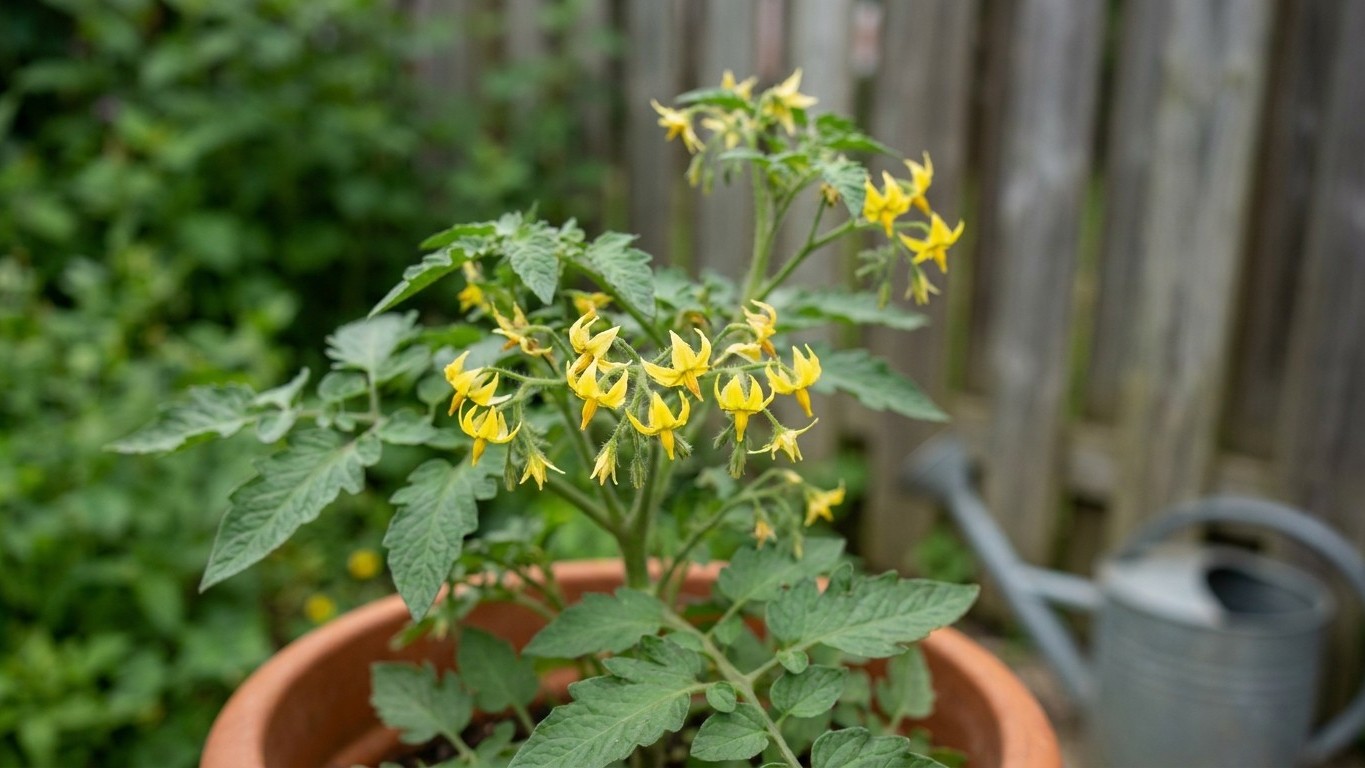

Tomato plants that flower heavily but never set fruit almost always have a temperature, pollination, or nitrogen problem, not a disease or pest. The flowers open, then wither and drop from the stem instead of swelling into fruit. Stop feeding the plant any nitrogen fertilizer right now and check whether daytime heat, cold nights, or still air without pollinator activity lines up with when the drop started.
What you are looking at

Look at the flower clusters, called trusses, along the stem. On a plant that is failing to set fruit, you will see flowers open normally, sometimes in good numbers, and then turn pale yellow at the base before the whole bloom detaches and falls. What is left behind is a bare, slightly swollen stub on the truss where the flower used to be, called the pedicel. No green fruit ever forms behind it.
This is different from a plant that is simply thinning its own flower load, which every tomato does to some degree. A healthy plant drops a small percentage of its earliest or weakest blooms and still sets fruit steadily on the rest of the truss. What you are dealing with is a truss that sets few or no fruit at all across several weeks, not the occasional single flower.
It also needs to be told apart from two other common problems. Fruit that has already set and then develops a sunken, leathery, dark patch at the bottom end is blossom end rot, a separate issue covered in Blossom End Rot on Tomatoes: Why Calcium Is Rarely the Real Problem, and it means the plant did set fruit, so you are past the stage this page covers. Fruit that sets but grows misshapen, with rough scarring or splits in the skin, is a different stress response covered in Why Tomatoes Crack and Split, and How to Stop It Happening Again. If your plant has dark, curling, or yellowing foliage alongside the flower drop, check Yellow Leaves on Tomato Plants: What the Pattern Tells You to rule out a nutrient or watering problem running alongside the fruit set issue, since the two sometimes overlap.
Confirm the diagnosis before changing anything: flowers opening and falling with no fruit behind them, on multiple trusses, over an extended stretch is the pattern this page addresses.
What actually causes it
Tomato flowers are self-fertile, meaning each one carries both male and female parts and does not need a separate pollinator plant. What it does need is movement, usually wind or the vibration from a foraging bee, to shake pollen loose from the anthers onto the stigma inside the same flower. Without that mechanical shake, pollen can sit in the flower and never transfer, and the bloom eventually drops unfertilized. This is the most common cause of poor set on plants grown close to a wall, in a sheltered corner, or in a greenhouse with the vents closed.
Temperature is the second major driver
Pollen becomes unreliable at both ends of the temperature range. In sustained heat, pollen turns sticky and clumps instead of dispersing, and the flower’s own reproductive structures can be damaged faster than the plant can replace them. In a cold snap, pollen germination slows down and the tube that carries it to the ovary may not form in time before the flower senescs and drops. Either way the flower looks the same from the outside: it opens, fails to fertilize, and falls.
The myth worth naming directly is that heavy flowering without fruit means the plant needs more fertilizer. It is usually the opposite. Excess nitrogen pushes the plant into vegetative overdrive, building thick stems and dark, dense foliage, and the plant’s hormonal balance shifts toward leaf and stem growth at the expense of fruit set. A nitrogen-driven plant tends to look unusually lush and vigorous, with flowers that form but abort regardless of the weather, and it does not improve when a heat wave passes the way temperature-driven drop does.
To tell the causes apart, watch the pattern. Temperature-driven blossom drop tracks the weather: it worsens during a hot or cold stretch and eases within a couple of weeks once conditions moderate. Pollination failure is steady regardless of temperature and often clears up the moment wind, an open greenhouse vent, or bee activity picks up. Nitrogen-driven failure persists through mild weather and comes with visibly oversized, deep green foliage and thick, almost woody-looking stems.
What to do now

The flowers that have already dropped are gone. There is no treatment that brings back a bloom once it has fallen from the truss, so do not waste time or product trying to save fruit that never set. The plant’s energy is better spent on the trusses still forming and the ones yet to open.
What you can influence going forward:
- Stop or cut back nitrogen fertilizer immediately if the plant looks lush and dark green with thick stems, and switch to a feed weighted toward phosphorus and potassium instead.
- Hand-pollinate open flowers once a day by tapping the flower cluster firmly with a finger or a pencil around midday, when pollen is driest and most likely to shake loose, or use a battery toothbrush pressed briefly against the stem.
- If plants are in a greenhouse or tunnel, open vents and doors during the day and run a fan across the canopy to replace the wind movement outdoor plants get for free.
- Give plants some relief from the harshest part of the day with shade cloth or the natural shade of a taller neighboring plant during a prolonged heat stretch, without blocking pollinators entirely.
- Keep watering even and consistent, since drought stress compounds both heat stress and nitrogen imbalance and makes flower drop worse on top of whatever else is going on.
Fruit set usually returns once the underlying condition, whether that is weather, air movement, or nitrogen, has actually changed, not on a fixed schedule. Watch new trusses as they open rather than the ones that already failed, and check How to Grow Tomatoes if you are unsure whether your feeding schedule or spacing is contributing to the problem in the first place.
What does not work
Crushed eggshells scattered around the base of the plant are aimed at a calcium shortage, and fruit set failure is not a calcium problem at all. Eggshells also break down far too slowly to supply any nutrient to the plant within a single season, so even where calcium is the actual issue, this remedy does close to nothing.
Foliar calcium sprays have the same problem from a different angle. Calcium moves through the plant in the water stream, drawn mainly to the leaves that transpire fastest, and very little of it ever reaches the fruit no matter how much you spray on top. That mechanism explains why calcium sprays fail against blossom end rot too, and it means they have nothing to offer a plant that is failing to set fruit for temperature or pollination reasons, since calcium was never the bottleneck.
Adding lime to soil that already has adequate calcium is worse than doing nothing, since it pushes soil pH upward and can lock out other nutrients the plant does need, like iron and manganese, creating a new problem on top of the one you were trying to solve. Test soil before adding any amendment rather than adding one on the assumption that it can only help.
Shaking the plant once and moving on
A single, one-off shake of the plant will not fix poor pollination. Pollen transfer needs to happen close to the time each individual flower is receptive, which means repeated, regular vibration over the days a truss is in bloom, not a one-time gesture. Commercial blossom-set sprays containing synthetic plant hormones can sometimes trigger fruit development on unfertilized flowers, but the fruit they produce is often seedless and smaller, and the spray does nothing to fix the temperature, nitrogen, or airflow problem causing the drop in the first place.
Preventing it next time
Of everything on this list, managing nitrogen is the single change most within a grower’s control, since weather cannot be adjusted and pollinator activity only partly can. Hold off on high-nitrogen fertilizer once flowering starts, and switch to a formula proportioned toward phosphorus and potassium, which supports flower and fruit development instead of leafy growth.
Beyond feeding, a few habits reduce the odds of a repeat:
- Space plants for airflow rather than crowding them together, since still, humid air between densely packed plants both discourages pollinators and lets pollen clump.
- Tap or lightly shake flowering trusses every day or two as routine maintenance, especially for greenhouse or container plants that get less natural wind.
- Keep an eye on the weather forecast during flowering and use shade cloth proactively ahead of a forecast heat stretch rather than reacting after flowers have already dropped.
- Water on a consistent schedule through the flowering period, since drought stress on top of heat compounds the problem far more than either one alone.
None of these guarantees every flower sets, since some blossom drop is normal even on a healthy plant. The goal is reducing how often and how badly it happens, not eliminating it entirely.
Common questions
Why do my tomato flowers turn yellow and fall off without any fruit forming?
This is blossom drop, usually caused by temperature stress, poor pollination from still air, or excess nitrogen pushing the plant toward leafy growth instead of fruit. Check which pattern matches your plant, since the fix is different for each cause.
Should I remove the flowers that already dropped?
You do not need to. Dropped flowers detach and fall on their own, and there is nothing to clean up or cut back on the truss itself. Focus your attention on the flowers still open and the new trusses forming above them.
Can too much nitrogen really stop tomatoes from fruiting even if the plant looks healthy?
Yes, and it often looks like the healthiest plant in the garden while it does it. Dense, dark green foliage and thick stems with sparse or aborting flowers is the classic sign of nitrogen pushing the plant toward vegetative growth at the expense of fruit set.
Is this the same thing as blossom end rot?
No. Blossom end rot happens after a fruit has already set, showing up as a dark, sunken patch on the fruit itself, while blossom drop means the flower never became a fruit at all. They have different causes and different fixes, so confirm which one you are looking at before treating either.