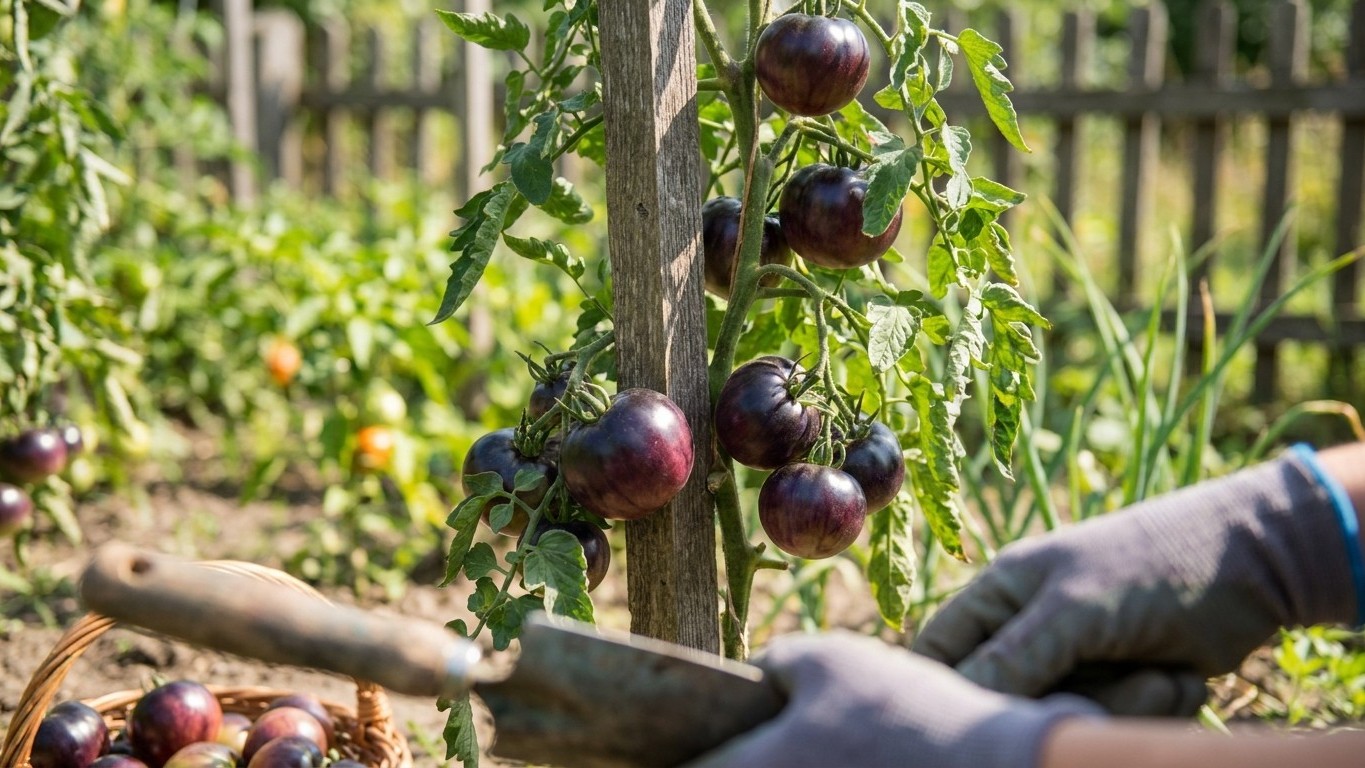

Cherokee Purple is an heirloom indeterminate tomato grown for its dusky, brick-red-and-purple beefsteak fruit and rich, low-acid flavor, and seed catalogs put it at 72 days from transplant, not from seed. That maturity window is long enough that timing decides more than variety choice does: a short-season garden needs a head start under cover, and a hot-summer garden needs to plan around a stall in fruit set during the peak of the heat. Check your local frost-free window against that 80-to-85-day figure before you set plants out, and if the numbers run tight, start seed indoors early enough to transplant a stocky, well-rooted seedling rather than a tall, leggy one.
What Cherokee Purple actually is

Cherokee Purple is an heirloom slicing tomato grown for its fruit rather than for yield, disease resistance, or shelf life, the qualities that dominate a lot of the modern tomato varieties bred for market growers. Seed catalogs put its days to maturity at 72 days, counted from the day you transplant a seedling, not from the day you sow the seed. That distinction matters for planning: add another five to seven weeks of indoor growing time before transplant if you start from seed, since the 80-to-85-day clock does not begin until the plant goes into the ground.
The plant is indeterminate, meaning it keeps growing taller and setting new flower clusters through the whole season instead of stopping after one flush of fruit like a compact bush type. That habit calls for a tall, sturdy stake or cage from the start, and enough space between plants for the vine to sprawl without shading its neighbors.
The fruit is what growers actually plant this variety for: a large beefsteak, often ten ounces to a pound, with dusky brownish-purple-pink skin over deep red-green flesh and far less acidic bite than a standard red tomato. It is a slicing tomato through and through, best eaten fresh on a sandwich or in a salad, and its low acidity makes it a poor candidate for canning without added acid, a point worth knowing before a big harvest lands all at once.
What Cherokee Purple is good for
Cherokee Purple is built for eating raw, not for cooking down. Beefsteak-type flesh like this holds a high percentage of water in loose, juicy cells, so a slice gives up liquid the moment a knife goes through it. That’s exactly what you want stacked on a sandwich or fanned out on a plate with salt and olive oil, where the juice seasons the dish instead of working against it. It’s also why the low acidity and rich flavor read as “sweet” rather than sharp on the tongue: there’s less acid to cut through the sugars, and nothing else competing for attention on a raw plate.
That same water content makes it a poor candidate for sauce. Cooking a tomato down means driving off water until what’s left is thick enough to coat a spoon. A dense-fleshed paste tomato has little water to begin with, so it collapses into sauce in twenty minutes with nothing but heat. Cherokee Purple, by contrast, would need a long simmer to reduce all that liquid, and the flavor and color it’s prized for cooks away well before the water does. You’d end up with a thin, muddy sauce that took far longer than a paste variety and tasted like less.
The same logic rules out canning whole or as a shelf-stable product: canning recipes are built around predictable acidity and flesh density, and this tomato’s low acid and high water content work against both. It also isn’t a cherry tomato, so there’s no case here for eating it straight off the vine by the handful — it’s a knife-and-cutting-board tomato, meant to be sliced and served the same day.
No fact is published about how it performs dried, fermented, or juiced, so nothing more can be said there. Its use is straightforward: grow it to slice and eat fresh, not to cook.
Where it ripens in time, and where it is a gamble
The frost-free window is only the starting number. Three deductions come out of it before you get a usable margin: the couple of weeks the soil needs to warm before you transplant, the 72 days Cherokee Purple takes to set and ripen its first fruit, and whatever is left over is the actual margin for picking before frost ends the season.
Where the margin runs out
At the tight end, Yukon‘s Whitehorse station gives a mid-June set-out and a first ripe fruit expected only in late August, which lands the crop about five days after frost is due rather than five days ahead of it. A margin under thirty days means one flush of fruit and a cool year takes even that, and a negative margin means the arithmetic never closes outdoors at all. Rankin Inlet, the reference station for Nunavut, comes out at zero days of margin: first ripe fruit and first frost land the same week, which is not a margin so much as a coin flip. In both places the yearly heat total runs so far below what a tomato plant needs that a heated greenhouse or tunnel is not optional, it is the only way the crop happens at all.
Move south to the prairies and the picture improves, but only from impossible to marginal. Saskatoon, the reference station for Saskatchewan, and Winnipeg, for Manitoba, both post roughly 36 to 37 days of margin with an early-June set-out and first fruit expected by mid-August, enough for a real picking window if the season runs true to form. Both are still listed as greenhouse territory, because their seasonal heat accumulation sits low enough that a long-season variety like Cherokee Purple can come up a few warm weeks short even with frost held off. A plastic mulch or an earlier-maturing companion planting changes that outcome more than staking or feeding ever will.
At the wide end of the range, Houston, the reference station for Texas, shows 189 days of margin, with a set-out window running from mid-February to mid-March and first fruit by late May. New Orleans, for Louisiana, goes further still at 226 days of margin, the widest of any territory in this comparison, with plants going in from early to late February and first ripe fruit by early May, months ahead of any frost risk. Both give Cherokee Purple far more time than it will ever use in a single season, which shifts the limiting factor away from frost entirely and onto the summer heat covered next.
| Territory | Reference station | Set-out window | First ripe | Margin before frost | Verdict |
|---|---|---|---|---|---|
| Yukon | Whitehorse | mid June | late August | -5 days | impossible outdoors |
| Nunavut | Rankin Inlet | early July | mid September | 0 days | greenhouse only |
| Saskatchewan | Saskatoon | early June | mid August | 37 days | greenhouse |
| Manitoba | Winnipeg | early June | mid August | 36 days | greenhouse |
| Texas | Houston | mid Feb to mid March | late May | 189 days | comfortable |
| Louisiana | New Orleans | early Feb to late Feb | early May | 226 days | comfortable |
The two ways a season goes wrong
A frost-free window only tells you when the killing cold arrives, not whether the growing season in between was warm enough to use. Growing degree days, the running total of heat accumulated above the level a tomato plant needs to grow, is the number that actually predicts a harvest, and it can fall short even where the calendar leaves plenty of room. Rankin Inlet in Nunavut totals only a few hundred growing degree days across a full year, and Whitehorse in the Yukon not much more, against totals in the low thousands for the prairie provinces. Cherokee Purple, at 72 days to maturity, sits on the long side for a slicing tomato, and a long-season variety spends more of that heat budget than a quick one does. That is why every far-northern and prairie territory above is marked for greenhouse growing regardless of its frost dates: a margin of thirty-plus days does not guarantee ripe fruit if the heat behind it is thin. Fruit set has its own floor as well, since tomato flowers largely stop setting once nights run consistently below 50°F, a threshold the far north crosses through much of its short summer.
The opposite failure shows up in the warmest states named above. Once daytime temperatures push past roughly 86°F, tomato pollen turns sterile and flowers drop without setting fruit, which is why growers in Louisiana and Texas plant in two windows rather than one: an early crop that finishes before the hottest stretch of the year, and a second one started once temperatures ease back down. For Cherokee Purple, a variety that already needs 72 days to finish, that sterile stretch is the more practical limit south of the Gulf Coast latitudes named above, because a plant flowering into the hot months simply stops producing regardless of how much calendar time is left. A quicker cultivar, such as the one grown in our guide to Tidy Treats Tomato, can duck under that heat window more easily than Cherokee Purple’s longer timeline allows. In the north, the shortfall in accumulated warmth is the deciding factor, not frost date. In the south, the pollen-sterile stretch decides the outcome, not the length of the season.
What it resists, and what it does not
Seed catalogs list no disease-resistance codes for Cherokee Purple. That is a real gap next to hybrids bred specifically for resistance, such as Big Beef Plus, which carries resistance letters on its own seed packet where Cherokee Purple’s stays blank. Growing an heirloom with no built-in resistance means the usual fungal and soil-borne problems are managed entirely through practice, not genetics: crop rotation, spacing for airflow, and watering at the soil rather than overhead.
The practical risks worth watching for on this variety:
- Fusarium and verticillium wilt, both soil-borne and both untreatable once a plant is infected
- Early blight and septoria leaf spot, worse in humid climates or with overhead watering
- Blossom end rot, more common on this variety’s large fruit when watering swings between dry and soaked
- Cracking around the shoulders after heavy rain, tied to the fruit’s size and thin skin
- Cat-facing, puckered scarring near the blossom end, when fruit sets during a cool snap
None of these problems are unique to Cherokee Purple, but a variety with no resistance codes gives none of them a genetic head start against it, which is the tradeoff heirloom growers accept in exchange for the flavor.
Growing it without the usual mistakes
Cherokee Purple is indeterminate: it keeps growing, flowering, and setting new fruit until frost or disease stops it, rather than ripening in one flush like a determinate bush variety. That habit changes almost everything about how you support and feed it. A cage sized for a determinate plant will not hold this vine past midsummer, so plan on a stake or cage built for six to eight feet of growth, driven in at planting time before the roots fill the bed.
Spacing, feeding, and the timing mistake this variety invites
Give each plant more room than you would a compact bush type, since a vine this large shades and competes with neighbors set too close. Feed with a balanced fertilizer at planting, then lightly again once fruit starts to set, but avoid a heavy nitrogen feed through the growing season. Too much nitrogen on an indeterminate vine pushes leafy growth at the expense of ripening fruit, and Cherokee Purple already takes 72 days to get there without the extra delay. Water at the soil rather than overhead, and keep the schedule even through the season, since a dry spell followed by a heavy soak is what causes the cracking and blossom end rot covered above more than any single watering mistake on its own.
The timing error specific to this variety’s length is starting too late. Because 72 days is on the long side for a tomato, gardeners who start seed on the same schedule as a 60-day cherry variety, or who wait to transplant until well after their local frost has passed, push the plant’s ripening window right up against the first fall frost instead of finishing weeks ahead of it. In any territory listed above as marginal, that gap is the whole difference between a full harvest and a handful of green fruit pulled in ahead of a freeze. Check your local extension office’s recommended transplant date rather than guessing from the seed packet alone, since the packet’s days-to-maturity figure assumes conditions rarely present in a real backyard.
Common questions
Why did my Cherokee Purple tomatoes never turn fully purple?
They probably did ripen, just not to a solid color. Ripe Cherokee Purple fruit is a dusky mix of brownish-purple, pink, and green, especially around the shoulders, and it rarely turns a uniform deep purple. Judge ripeness by a slight give when you press the fruit gently and a deepening color at the blossom end, not by an even skin tone.
Can I grow Cherokee Purple in a container?
You can, but it is not the easiest candidate. As an indeterminate vine, it needs a large container and a tall, well-anchored stake or cage, and it will outgrow a pot sized for a compact patio variety within a few weeks. A large grow bag or half-barrel with sturdy support does better than a standard planter.
Is Cherokee Purple the same as Cherokee Chocolate or Cherokee Green?
No. Those are separate heirloom sports of the same lineage, selected for different skin colors, and they are grown and staked the same way as Cherokee Purple, but the ripe fruit color is different in each case.
Can I can Cherokee Purple tomatoes safely?
Low-acid heirloom tomatoes like this one often need added acid, such as bottled lemon juice or citric acid, to can safely in a water bath. Check current USDA or your state extension’s canning guidelines before you process a batch, rather than relying on a family recipe written for a standard red tomato.