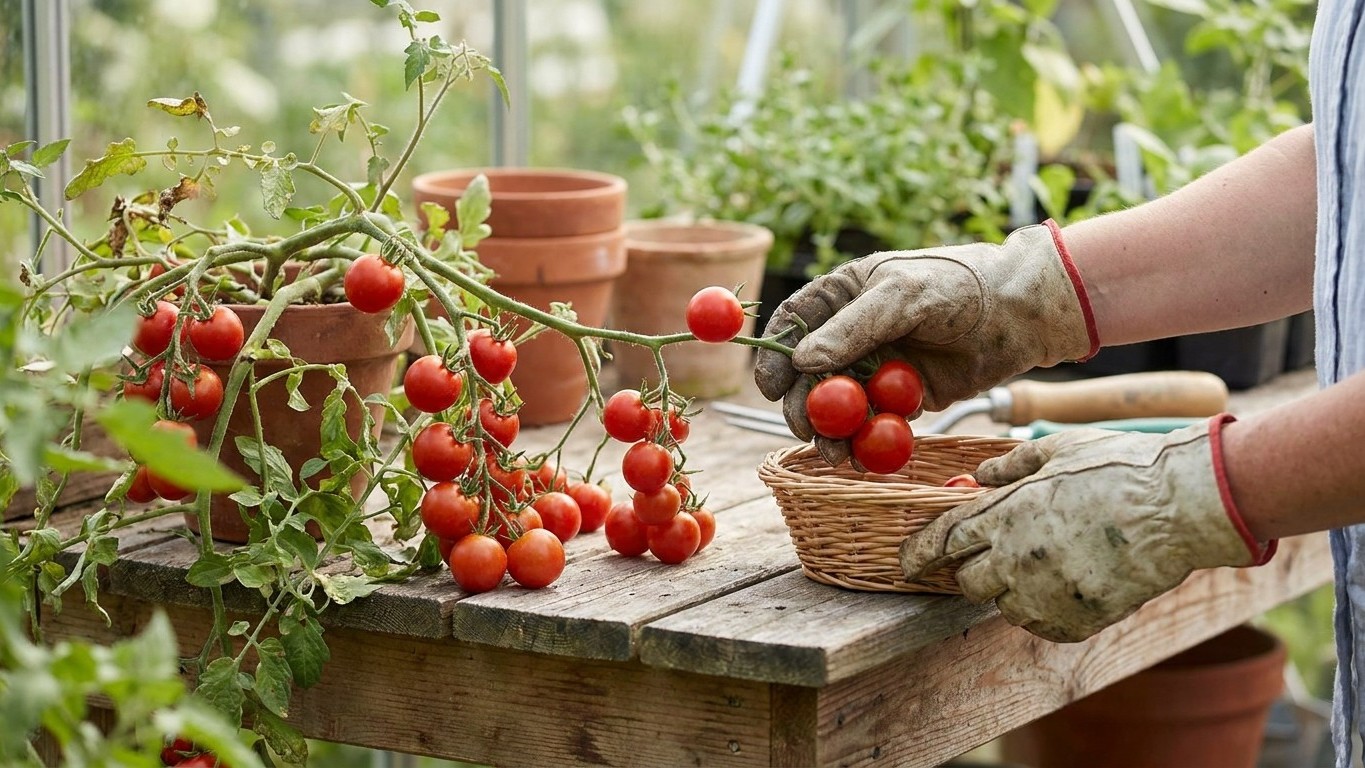

Tidy Treats is a dwarf cherry tomato bred for containers and small beds, and it ripens in about 60 days from transplant according to its seed catalog listing. That short season means it beats the frost in nearly every U.S. garden, though a handful of far northern Territories still race the clock. Count backward from your area’s average first frost using that 60-day figure, plus the couple of weeks the soil needs to warm after transplant, before you settle on a start date.
What Tidy Treats actually is

Tidy Treats is a compact, dwarf-type tomato bred for pots, window boxes and tight raised beds rather than open field rows. Its seed catalog listing puts days to maturity at about 60 days, counted from the day you set transplants out, not from the day you sow seed indoors. That distinction matters because a grower who starts the clock at sowing will expect ripe fruit two to three weeks earlier than the plant can actually deliver.
The habit is bushy and self-limiting: the plant tops out at a modest height and needs only a short stake or a small tomato cage rather than the tall trellis an indeterminate slicer demands. That makes it one of the easier tomatoes to fit into a small yard or a patio, and it is why it shows up so often on lists built for container growing rather than for row crops. If you are comparing it against other options before committing a container to it, the broader Tomato Varieties roundup lays out how habit and days to maturity trade off against each other across dozens of cultivars.
The fruit itself is small, round and red when ripe, produced in tight clusters rather than singly, typical of a cherry type bred for snacking and salads rather than slicing or sauce. Because the plant stays small, a single specimen produces less total weight of fruit than a full-size indeterminate, but it produces it earlier and in a footprint that fits a balcony rail.
What Tidy Treats is good for
This is a cherry tomato, and the small, round fruit that trait implies is the reason it works better dropped whole into a jar or a pot than sliced onto a sandwich. Cherry types pack a high skin-to-flesh ratio and a small enough size that whole fruit hold their shape through processing, which is exactly what canning calls for: no coring, no cutting, no juice lost to a knife before the jar ever goes in the water bath.
For sauce, what matters is how much fruit you’re working with, not how thick each piece is. A paste tomato reduces fast because it starts with little water to boil off. A cherry tomato like this one carries more water per fruit, so a pot of them takes longer at the stove to cook down to a spoonable sauce. What compensates is how prolific the plant is: heavy clusters of fruit mean a grower can pick enough at once to fill a stockpot, and the extra time on the burner is a fair trade for not having to ration a small paste harvest across a whole batch.
The fruit is red at ripeness, which matters for canning in a plain, practical way: color is one of the few visual cues for judging ripeness in a cluster of fruit that all look similar at a glance, so a grower harvesting for a canning batch can sort by eye rather than by feel.
Documentation for this variety describes the flavor only in general terms, as bright and vibrant, without laying out specifics like sugar or acid balance. Beyond that broad description, no detailed flavor profile is published, so a grower deciding between eating these fresh off the vine and cooking them into sauce is working from the fruit’s category and size rather than from a documented taste comparison.
Where it ripens in time, and where it is a gamble
Because Tidy Treats needs only about 60 days from transplant, it is one of the more forgiving tomatoes to place in a short season, but the arithmetic still has to work: start from the average window between your last spring frost and first fall frost, subtract the week or two the soil needs to warm before you set plants out, then subtract the 60 days to maturity. What is left is the margin, the number of days of picking before frost cuts the season short. Anything under thirty days of margin means one flush of fruit, and a cool year can take even that.
| Territory (station) | Set out | First ripe | Margin | Verdict |
|---|---|---|---|---|
| Yukon (Whitehorse) | mid June | mid August | 7 days | risky |
| Manitoba (Winnipeg) | early June | early August | 48 days | greenhouse start advised |
| Louisiana (New Orleans) | early to late February | late April | 238 days | comfortable |
At the tight end, Yukon, measured at the Whitehorse station, gives Tidy Treats only about 7 days of margin: growers there set plants out in mid June and see first ripe fruit around mid August, right at the edge of the season closing. Nunavut, measured at Rankin Inlet, is only slightly better at roughly 12 days, with transplant in early July and first ripe fruit in early September. In both places the frost-free window is not the only problem: the region simply does not accumulate enough warmth over the season for a tomato to size and ripen fruit reliably, and a greenhouse or tunnel is the only way to close that gap.
The middle ground is more workable. Manitoba, at Winnipeg, and Saskatchewan, at Saskatoon, both land in the high-40-day range of margin, enough for a real harvest but still tight enough that a plastic mulch to warm the soil, or the earliest transplants a nursery can supply, makes the difference between a good year and a disappointing one. Alberta, at Calgary, and the Northwest Territories, at Yellowknife, sit in the same range and carry the same caveat.
Further south, the margin stops being the limiting factor at all. Washington, measured at Seattle, already has 166 days to spare. South Carolina, Texas, Nevada and Louisiana all clear 170 days of margin and some pass 230, measured respectively at Charleston, Houston, Las Vegas and New Orleans. In those places the question is not whether the season is long enough, but whether the middle of summer is too hot to use, which is the next problem.
The two ways a season goes wrong
A long frost-free window is not the whole story, and the margin numbers above can hide two separate failures that a frost table never shows.
Too little accumulated warmth
In the northern territories, the problem is not necessarily the calendar date of the first frost, it is the total heat the plant collects over the summer. Saskatchewan, at Saskatoon, accumulates around 1,549 degree-days across the season, and Manitoba, at Winnipeg, around 1,832, both described as marginal even though the frost-free window itself is long enough on paper. Below roughly 50F at night, tomato flowers stop setting fruit regardless of how many frost-free days remain, so a cool, cloudy stretch in midsummer can cost a harvest the calendar said was safe. This is the more relevant risk for Tidy Treats in short-season territories, because a fast 60-day variety still needs those days to be warm ones, not merely frost-free ones.
Too much heat in midsummer
In the deep South, the failure runs the other way. South Carolina, Florida, Texas, Nevada and Louisiana all report the same limit: once temperatures push past roughly 86F, tomato pollen turns sterile and flowers drop without setting fruit, typically across a stretch from late spring into early autumn depending on the state. Growers in those states plant a spring crop, harvest before the heat locks in, then plant again for an autumn crop rather than expecting one plant to carry a whole season. For a fast variety like Tidy Treats, that pattern works in its favor: 60 days is short enough to slot a full crop into the spring window before pollination shuts down, and a second planting can do the same in the cooler weeks of fall.
What it resists, and what it does not
Tidy Treats is bred primarily for compact habit and early yield, and its seed catalog listing does not carry the disease-resistance letter codes seen on many hybrid slicers, no VFN or similar shorthand attached to the name. That means there is no built-in resistance to fall back on here, and sanitation and spacing do the work a resistant gene would otherwise do. Treat it as you would any non-resistant hybrid: assume it is vulnerable to the common soil-borne wilts and to early blight until your own local extension diagnostics tell you otherwise.
The practical risk with a dwarf, container-grown type is less about the classic field diseases and more about splash and crowding. A compact plant in a pot sits closer to the soil surface than a staked indeterminate, so soil-borne fungal spores land on the lowest leaves more easily in heavy rain. Mulching the surface of the container and watering at the base rather than overhead cuts that risk substantially. Blossom end rot, a calcium-delivery problem rather than a disease, shows up on this variety the same way it does on any tomato grown in a container that is allowed to dry out between waterings, and it is the single most common complaint reported against dwarf types in small pots.
If disease resistance letter codes matter more to your growing situation, for example because a bed has a known history of fusarium or verticillium wilt, that is a reason to pair Tidy Treats in the same garden with a hybrid bred specifically for resistance, such as the varieties compared on the Celebrity Plus page, rather than expecting this variety to carry that load itself.
Growing it without the usual mistakes
Tidy Treats is a determinate-leaning dwarf, and that changes the whole care plan compared with an indeterminate variety that ripens over months. The plant sets most of its flower clusters early and then commits its energy to sizing and ripening that one main flush, rather than continuing to grow new stem and set new flowers all season. Heavy nitrogen feeding late in the season does the plant no favors: it pushes leaf growth at the expense of fruit already set, and on a plant this compact there is little room for extra foliage anyway. Feed at transplant and again once flowering starts, then taper off as fruit sizes.
Container and spacing
A single plant does well in a container in roughly the 12 to 16-inch diameter range, or spaced at a similar distance in a raised bed. Crowding two dwarf plants into one small pot to double the harvest is the most common mistake with this type: both plants end up competing for the same small volume of soil moisture, and neither sizes fruit properly. A short stake or a small cage set in at transplant time is enough support. There is no need for the tall trellis or the string-and-clip system an indeterminate slicer requires, which is one of the reasons this variety gets recommended for balconies and small patios in the first place.
Watering, the real risk in a pot
Because the whole point of a dwarf variety is a small container, the soil volume is also small, and it dries out faster than a garden bed does, especially once the plant is carrying a full load of fruit in summer heat. Inconsistent watering on this variety shows up as blossom end rot and as fruit splitting, both preventable with a consistent watering schedule and a layer of mulch on the container surface. If your household is comparing this dwarf type against a larger cherry variety before committing container space, the Amai page covers a similarly small-fruited option bred for a different growth habit worth weighing side by side.
Common questions
Do I count the 60 days from when I sow seed or when I transplant?
From transplant, not from sowing. The catalog’s day count assumes a plant already at transplant size and rooted, so add the four to six weeks most Tidy Treats seedlings need indoors before they are ready to move outside, on top of the 60 days to first ripe fruit.
Should I prune or sucker Tidy Treats like I would a full-size tomato?
No. Because it is a determinate, dwarf-habit plant, pruning out side shoots removes the stems that carry its main flush of fruit rather than redirecting energy the way it does on an indeterminate slicer. Leave the plant to branch naturally and only remove leaves that are yellowing or touching the soil.
Can I plant Tidy Treats straight in the garden bed instead of a pot?
Yes, it grows the same way in open ground, spaced at roughly the same distance you would give it in a container. Its compact habit is a convenience for small spaces, not a requirement, so a garden bed with full sun works just as well and needs less frequent watering than a pot does.
Why do my Tidy Treats tomatoes keep splitting on the vine?
Splitting on a small cherry tomato like this one is almost always a sudden jump in water after a dry stretch, which swells the fruit faster than the skin can stretch. Keep the watering schedule even rather than letting the container or bed dry out between waterings, and pick fruit as soon as it colors up during a rainy spell rather than leaving it on the vine.