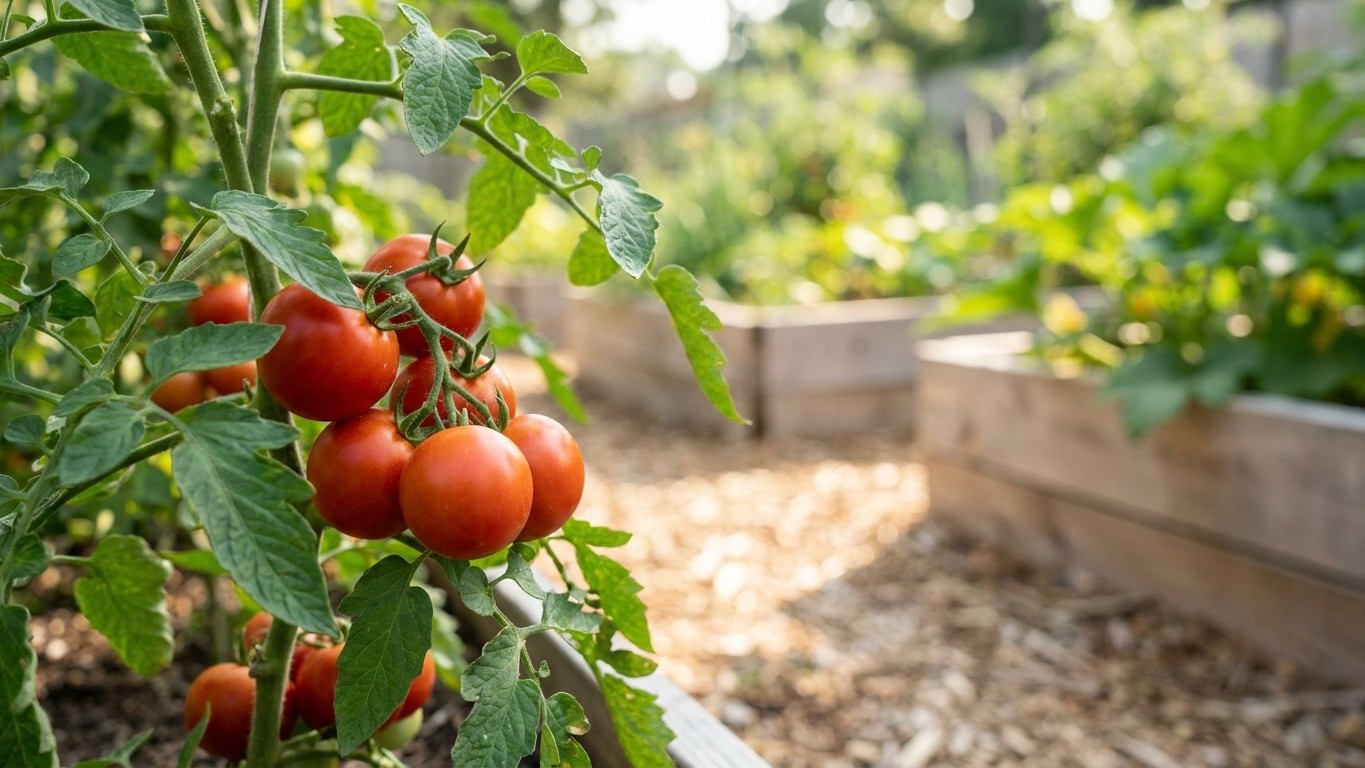

Early Girl is a hybrid slicing tomato bred to fruit fast, an indeterminate vine that ripens its first tomatoes in about 60 days from transplant, sometimes listed as 54 to 59 days depending on the catalogue. That head start is the whole point of the variety: it lets gardeners in short-season climates pick a real harvest before frost, and it lets gardeners in hot climates finish a crop before summer heat shuts pollination down. Check your region’s frost-free window against that 50-day clock before you decide how many plants to set out.
What Early Girl actually is

Early Girl is a hybrid, meaning the seed does not come true if you save it, and it is indeterminate: the vine keeps growing, flowering and setting new trusses until frost or disease stops it, rather than ripening one flush and quitting. That habit is where the variety earns its reputation among growers who want a long, steady kitchen supply rather than a single canning weekend.
Catalogues list Early Girl at around 60 days to maturity, with some seed companies printing 54 or 57 days for the same variety. That count starts from the day you set a transplant in the ground, not from the day you sowed the seed indoors, and it assumes warm soil with no setback from cold nights or transplant shock. A packet date is a lab result, not a promise.
The fruit itself is a mid-size red slicer, round and smooth-skinned, usually running four to six ounces, with a texture soft enough for a sandwich and firm enough to hold a slice. It is built for the counter and the burger, not the sauce pot, and growers who want a paste tomato instead should look at a determinate type such as Granadero, bred for heavier, more concentrated flesh.
What Early Girl is good for
A slicing tomato carries more water in its flesh than a paste type, and that water sits in open, juicy cells rather than dense, packed ones. Cut raw, that structure is exactly what you want: the juice runs when you bite into it, which is what makes a sandwich or a salad taste like a fresh tomato instead of a dry one. Put the same fruit in a saucepan and that water works against you — it has to boil off before the sauce thickens, which means a longer cook, more evaporation, and a thinner result than you’d get starting with a paste variety bred to have less water in it to begin with.
Early Girl’s high water content and looser flesh make it an asset raw and unheated on the cutting board, but reduced over heat that same juiciness just means extra time at the stove for a sauce that a dense-fleshed variety would have given you faster and thicker. Slice it for a burger, a BLT, or a plate of tomatoes with salt and oil, and the texture is doing what it’s built to do.
The indeterminate habit shapes how that usefulness arrives in the kitchen over a season. Because the vine keeps setting new trusses instead of ripening everything at once, you get a rolling handful of slicing tomatoes most weeks rather than a single heavy harvest to process all at once. That suits kitchens that want fresh tomatoes on hand through the summer more than it suits anyone planning a big batch of sauce or salsa for canning in one sitting — for that kind of volume-and-cook-down project, a determinate paste variety is the better fit, not this one.
Beyond texture and water content, nothing about flavor intensity, acidity, or sweetness is documented here, and none should be assumed from the category alone.
Where it ripens in time, and where it is a gamble
The arithmetic behind this variety is simple once you write it out. Take your area’s frost-free window, the stretch between the average last spring freeze and the average first fall freeze. Subtract the two or so weeks most gardeners wait after that spring date for the soil to actually warm enough to set a tomato transplant without stalling it. Subtract Early Girl’s roughly 60 days to first ripe fruit. What is left is your margin, the days you actually get to pick before frost ends the season. Less than thirty days of margin means a single flush of fruit, and a cool year can take even that.
Where the margin is tightest
At the tight end, Yukon’s Yukon sits right on that edge. Whitehorse gardeners setting out in mid June see their first ripe fruit by mid August, leaving about 7 days of margin before the average frost, one flush and nothing to spare. Worse, Whitehorse accumulates only around 600 growing degree-days across the season, well short of what a tomato needs regardless of how long the frost stays away, so the variety needs a greenhouse or tunnel there to have any real chance. Nunavut‘s Rankin Inlet is similar: about 12 days of margin and only 159 degree-days on the year, a climate a tomato cannot ripen in unprotected no matter which variety you choose.
The Canadian prairies sit a step better but still call for cover. Alberta‘s Calgary and Northwest Territories‘s Yellowknife both run in the low forty days of margin, and Manitoba‘s Winnipeg and Saskatchewan‘s Saskatoon stretch to around 48 to 49 days. Their degree-day totals, 1832 in Winnipeg and 1549 in Saskatoon, still sit at the marginal edge, which is exactly the kind of gap Early Girl’s early maturity is built to close, alongside a greenhouse, tunnel or plastic mulch to bank extra heat.
| Territory (reference city) | Set out | First ripe | Margin before frost | Verdict |
|---|---|---|---|---|
| Yukon (Whitehorse) | mid June | mid August | 7 days | risky, greenhouse recommended |
| Nunavut (Rankin Inlet) | early July | early September | 12 days | risky, greenhouse recommended |
| Manitoba (Winnipeg) | early June | early August | 48 days | greenhouse or mulch helps |
| Washington (Seattle) | mid March to early April | late May | 166 days | comfortable |
| Texas (Houston) | mid February to mid March | mid May | 201 days | comfortable |
| Louisiana (New Orleans) | early February to late February | late April | 238 days | comfortable |
Further south the arithmetic stops being the limiting factor at all. Washington‘s Seattle carries about 166 days of margin, and Texas, Nevada and Louisiana run into the 200s: Texas‘s Houston shows around 201 days, Nevada‘s Las Vegas about 236, and Louisiana‘s New Orleans about 238. In those climates the frost window is not the problem. The heat is, which is the subject of the next section.
The two ways a season goes wrong
A frost table only measures one risk. The other two do not show up until the plant is already in the ground.
In short-season climates, the growing season can look long enough on paper while still lacking the accumulated warmth a tomato plant needs to actually build fruit. Growing degree-days, the running total of heat above a base temperature, matter more than the calendar in places like Yukon’s Whitehorse or Nunavut’s Rankin Inlet, where the frost-free window might allow a handful of weeks but the sun is simply not strong enough for long enough to push a plant through flowering and fruit-set at any pace. Tomato flowers also stop setting fruit once night temperatures fall below 50°F, a real risk in these same short, cool seasons even when daytime highs look fine.
In hot climates, the opposite failure shows up. Once daytime temperatures push past roughly 86°F, tomato pollen turns sterile and flowers drop without setting fruit, which is exactly what happens through the hottest stretch of summer in South Carolina‘s Charleston, Florida‘s Jacksonville, Texas‘s Houston, Nevada‘s Las Vegas and Louisiana‘s New Orleans. Growers in those states do not get one long season from a single planting. They plant a spring crop early enough to finish before the heat arrives, then a second crop in late summer for an autumn harvest once nights cool again.
Early Girl’s short 50-day clock is an advantage on both ends of that spectrum. In cool climates it needs less banked heat than a 75 or 80-day slicer, which is why it is one of the varieties most often reached for under cover in short-season Territories. In hot climates its speed lets a spring-set plant finish a full harvest and often start a second flush before the worst of the heat shuts pollination down. That is closer to what keeping fruit coming until frost actually means for this variety: it is less that Early Girl tolerates heat, and more that it gets its harvest in before the heat matters.
What it resists, and what it does not
Early Girl carries two disease resistances worth knowing before you plant it in a bed with tomato history. It is graded High resistance to Verticillium Wilt and to Fusarium Wilt races 1 and 2, both soil-borne fungal diseases that build up over years in beds that grow tomatoes or their relatives repeatedly. High resistance means the plant is bred to fend the disease off in most seasons, not that infection is impossible in a heavily contaminated bed.
What the catalogue does not list matters just as much. Early Girl carries no published resistance to late blight, early blight, root-knot nematodes or tobacco mosaic virus, so a grower relying on its Verticillium and Fusarium resistance to skip crop rotation or sanitation is trading one risk for another. Resistance to two named diseases is not resistance to tomato disease in general, and a site with a history of blight still calls for rotation and staking for airflow no matter which variety goes in.
- Resists: Verticillium Wilt (High)
- Resists: Fusarium Wilt races 1, 2 (High)
- No published resistance: late blight, early blight, root-knot nematodes, tobacco mosaic virus
Gardeners with a known nematode or blight problem in a bed might do better with a variety bred specifically against that pressure, the same way a paste grower with a fusarium history would check Granadero‘s own resistance package rather than assume every hybrid covers every disease. Reading a variety’s full resistance code on the seed packet, not just the two most commonly advertised letters, is worth the extra minute before you buy.
Growing it without the usual mistakes
Because Early Girl is indeterminate, it needs a support plan built for a plant that keeps growing all season, not a small ring cage sized for a compact determinate. A five to six-foot stake or a heavy-duty cage set at planting time, before the roots spread, saves you from wrestling a loaded vine into a cage weeks later. Space plants for real vine growth rather than the tight spacing that works for a bush type.
Its speed invites an early mistake
The most common mistake with this variety is not a growing error at all but a timing one: gardeners see “60 days” on the packet and set transplants out as early as the calendar allows, before the soil has actually warmed. A tomato transplant set into cold soil does not just pause, it can suffer a setback in root growth that costs more time than the two weeks the gardener was trying to save. Wait for the soil, not just the frost date, and if you want the earliest possible harvest, warm the bed with black plastic mulch or a cold frame instead of rushing the transplant.
Because Early Girl keeps setting new trusses through the season, it also keeps demanding nutrients longer than a one-flush determinate does. Feed it at planting and again when the first fruit sets, but taper nitrogen once the vine is fruiting heavily. A plant pushed hard with nitrogen late in the season puts out leaf growth at the expense of ripening fruit, the opposite of what a gardener growing this variety for a steady supply actually wants. Regular, even watering matters more here too, since the long fruiting window gives blossom-end rot and cracking more chances to show up than a short-season variety ever gets.
Growers who want the same steady-production habit in a different fruit type might compare notes with Lucky Tiger, a cherry-type indeterminate that shares Early Girl’s long fruiting window but ripens a smaller, striped fruit rather than a full-size slicer. Both belong on the same shortlist as anyone building out a full plan of tomato varieties for a season that needs an early slicer and a small snacking tomato running side by side.
Common questions
Is Early Girl the same as Early Girl Bush?
No. Early Girl is indeterminate and keeps vining all season, while Early Girl Bush is a separate, more compact selection bred to stay smaller and often listed with a slightly different days-to-maturity figure on the packet. Check which one you are buying before you plan your cage size, since the two need different support.
Why is my Early Girl not turning red even though it’s the right size?
Fruit that reaches full size but stalls on color is usually sitting through nights or days outside the tomato’s comfortable range rather than showing a plant problem. Color development slows sharply in heat above the mid-80s Fahrenheit and in cool nights alike, so a fruit that looks finished can sit green-shouldered or pale for days until the weather evens out.
Can I grow Early Girl in a container?
Yes, but size the container generously since it is an indeterminate vine, not a patio-type dwarf. A five-gallon pot will produce a stunted, thirsty plant. A container in the range growers use for full-size indeterminate tomatoes, with a stake or cage sized to match, fits the vine it will actually grow into.
Do I need two Early Girl plants to get fruit?
No, Early Girl is self-fertile like almost all standard tomatoes, so a single plant sets fruit on its own without a second variety nearby for pollination. Planting more than one is only about total yield, not about getting fruit at all.