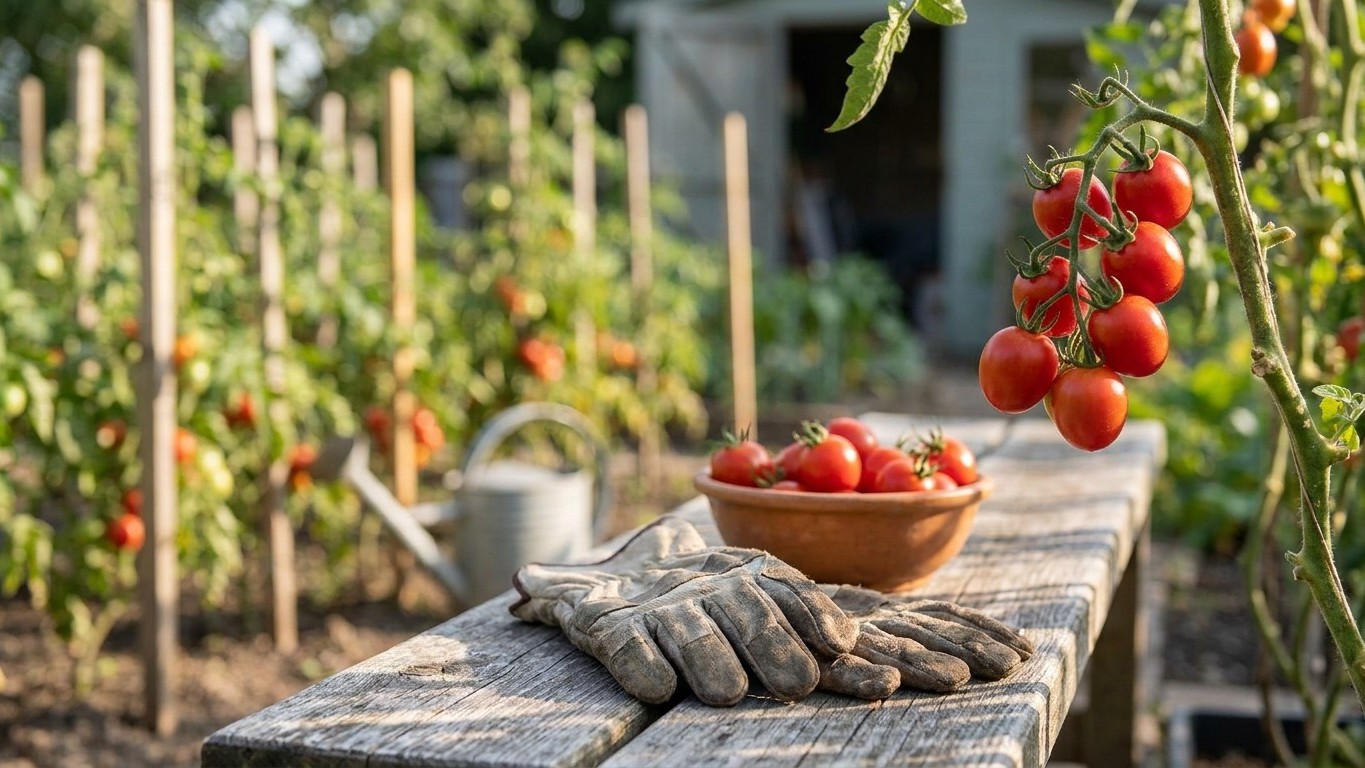

Mountain Magic is an indeterminate cocktail tomato bred for the home garden, producing red, 2 to 3 ounce fruit in loose clusters, and most seed catalogues list it at around 66 days from transplant to first ripe fruit. That figure assumes warm nights and a transplant that has already spent several weeks indoors, so it is a target, not a guarantee. The one thing to check before you order seed is your own region’s frost-free window at your nearest weather station, because that number, not the seed packet, decides whether this variety finishes.
What Mountain Magic actually is

Mountain Magic is an indeterminate plant, which means it keeps growing, flowering, and setting new fruit clusters right up until frost or disease stops it, rather than ripening in one bush-sized flush the way a determinate variety does. That habit decides how you grow it: it needs a sturdy stake or cage tall enough to hold a vine that can run five to six feet, and spacing generous enough that the foliage does not stay wet and shaded all summer. A determinate tomato you can more or less leave to sprawl in a short cage. This one cannot be treated that way without losing fruit to rot and disease pressure low in the canopy.
The fruit itself is what earns the “cocktail” label: round, red at full ripeness, running 2 to 3 ounces, and borne in clusters of six to eight rather than singly. It is bigger than a cherry tomato and smaller than a standard slicer, good for snacking whole, halving into salads, or roasting in batches, and it has a reputation among growers for resisting the cracking that ruins a lot of cocktail-sized fruit after a rain. On maturity, most seed catalogues put it at around 66 days from transplant, not from the day you sowed seed indoors. Add the six to eight weeks most gardeners spend growing a transplant before it goes in the ground, and the true span from seed packet to first ripe tomato runs closer to four months. That distinction matters most in the next section, where the difference between counting from transplant and counting from seed can be the difference between a crop and a loss.
What Mountain Magic is good for
The interior tells you what to do with the fruit. Mountain Magic has a juicy, smooth flesh with low acid and high sugars, which is a wet, tender structure rather than a dense, meaty one. Wet flesh releases its water as soon as heat hits it, so a saucepan full of these would mostly steam the fruit in its own juice rather than reduce into anything thick. Mountain Magic’s flesh is too juicy and high-water to cook down into sauce or paste, since there is no dry, low-water flesh to concentrate. What that same juiciness is built for is eating fresh, where you want moisture and sweetness on the tongue rather than a cooked-down texture.
Low acidity paired with high sugar also means the fruit does not need salt, dressing, or heat to taste balanced. That is why it works straight off the vine as a snack, and why halved fruit dropped into a salad needs nothing more than a drizzle of oil to be good. Because the fruit runs to cocktail size rather than cherry size, it is substantial enough to halve or quarter for a salad bowl instead of disappearing whole the way a true cherry tomato does, but it is still small enough to eat out of hand without a knife.
What this variety is not suited for is anything that depends on flesh structure holding up: it is not documented as a good candidate for thick sandwich slices, and nothing about drying, canning, or roasting yields has been published for it, so no claims should be made there. Treat it as a fresh-eating tomato, built for the bowl and the hand rather than the pot.
Where it ripens in time, and where it is a gamble
The maturity figure on the packet only means something once you set it against the local frost calendar, and the two rarely line up the same way twice across the country. The arithmetic a grower actually needs to do is simple: take the frost-free window between your area’s average last spring freeze and average first fall freeze, subtract roughly two weeks for the soil to warm enough to transplant safely, then subtract Mountain Magic’s 66 days to first ripe fruit. What is left over is the picking margin, the number of days between the first ripe tomato and the first fall frost. Under thirty days of margin means one flush of fruit, and a cool year takes even that.
Where the margin is tight
In Yukon, the station at Whitehorse supports setting transplants out around mid June with first ripe fruit expected around late August, but that leaves only about 1 day of margin before the average first fall frost. Further north still, Nunavut‘s Rankin Inlet station gives a similar shape of season, transplant in early July, first ripe by early September, and roughly 6 days of margin. In both places a single cool week at the wrong time erases the harvest, and the yearly heat sum is short enough on its own that a greenhouse or high tunnel is the only realistic way to grow this variety at all, a point the next section covers in more detail.
Moving south into somewhat longer seasons, Northwest Territories at Yellowknife shows about 36 days of margin, Alberta‘s Calgary station about 38 days, Manitoba‘s Winnipeg station about 42 days, and Saskatchewan‘s Saskatoon station about 43 days. All four are wide enough on paper to expect more than one flush, but all four are still rated for greenhouse or tunnel growing rather than open ground, because frost-free days and usable warmth are not the same measurement.
Where the margin is generous
At the other end of the scale, Nevada‘s Las Vegas station gives around 230 days of margin, with transplants going out from late January to mid February and first ripe fruit expected by late April, and Louisiana‘s New Orleans station gives around 232 days, transplanting early to late February for fruit by late April. That kind of margin means Mountain Magic finishes with months to spare, and the limiting factor stops being frost entirely. It becomes heat, which is the subject the frost table cannot show and the next section takes up directly.
The two ways a season goes wrong
A long frost-free window does not guarantee a good tomato season, and Mountain Magic runs into both of the limits a frost table cannot show, just in different regions.
Not enough accumulated warmth
In the cooler Territories, the problem is often not frost at all but the total heat the season delivers. Northwest Territories‘ Yellowknife station accumulates only around 905 degree-days across the year, Alberta‘s Calgary around 1171, and even with a wider frost window than the far north, that is short of what a tomato plant needs to push fruit through to ripeness reliably, which is why both are rated for greenhouse or tunnel growing regardless of the frost margin. Manitoba‘s Winnipeg station and Saskatchewan‘s Saskatoon station sit closer to the line, around 1832 and 1549 degree-days respectively, borderline enough that an early cultivar and black plastic mulch to warm the soil can tip the result toward a real harvest instead of green fruit at frost. Fruit will also fail to set once nights drop below 50F, which shortens the productive window further at the cool end of the season even before the First Frost arrives.
Too much heat
At the warm end, the limit is pollen going sterile once daytime temperatures climb past roughly 86F. In South Carolina‘s Charleston area that stretch runs from June through August, in Florida‘s Jacksonville area the same months, and in Texas‘s Houston area and Louisiana‘s New Orleans area it extends into September. Through those weeks flowers drop without setting fruit no matter how healthy the plant looks, which is why growers in those regions plant a spring crop and a separate autumn crop rather than expecting one continuous harvest.
For Mountain Magic specifically, its relatively fast 66 to 66 day maturity works in its favor in the hot territories: it can slip a full crop in before the mid-summer sterile stretch begins, and squeeze in a second planting once temperatures fall back below the threshold in autumn. A slower 85 to 90 day heirloom often cannot fit both windows in the same year. In the coldest territories, though, speed does not solve the deeper problem, since it is accumulated warmth rather than days on the calendar that runs short, and greenhouse or tunnel growing remains the more reliable route regardless of how fast the variety finishes.
What it resists, and what it does not
Mountain Magic carries genuine disease resistance, and it is worth naming exactly what each rating means rather than treating the packet’s resistance codes as a blanket guarantee. Its resistance to Late Blight is graded High, which is the rating that matters most in a wet year, since late blight is the disease capable of destroying a planting in days once conditions favor it. Its resistance to Verticillium Wilt is also graded High, useful in beds where tomatoes or related crops have been grown repeatedly and soil-borne wilts have built up.
Its resistance to Early Blight, by contrast, is graded Intermediate, and that distinction is worth taking seriously. Intermediate resistance slows early blight’s progress and reduces its severity, it does not stop the plant from getting it. In a humid summer with poor airflow you will still see the lower leaves develop the dark, concentric-ringed spots typical of the disease, and you still need to mulch, prune for airflow, and rotate beds as if the plant had no resistance at all. Treating an intermediate rating as immunity is the mistake that costs growers a crop they thought was covered.
The catalogue listing for Mountain Magic does not carry resistance codes for fusarium wilt, septoria leaf spot, or root-knot nematodes, so those remain ordinary risks in this variety exactly as they would be in a tomato with no resistance breeding at all. If your garden has a known history with any of those problems, plan for it separately rather than assuming the late blight and verticillium resistance extends any protection there. It does not.
Growing it without the usual mistakes
Because Mountain Magic is indeterminate, the growing plan differs from a compact determinate bush in almost every particular, starting with support. Set the cage or stake in the ground at transplant time, not weeks later, since a vine that has already sprawled is far harder to train upright without snapping stems or losing developing trusses. Space plants generously, since crowded indeterminate vines trap humidity in the lower canopy exactly where early blight and other foliar diseases take hold first.
Feeding and pruning
Ease off nitrogen once the first flower trusses set. A vigorous indeterminate that keeps getting fed heavily puts energy into new vine growth at the expense of ripening the fruit already on the plant, and Mountain Magic is vigorous enough that this mistake shows up fast as a tall, leafy plant carrying more green fruit than red. Light, regular pruning of suckers below the first fruit cluster keeps airflow up without stripping so much foliage that fruit sunscalds.
Timing the finish
Because it keeps setting new flower trusses all season, an indeterminate like this one will still be flowering when the season is running out of time to finish those flowers into ripe fruit. A few weeks out from your area’s expected first fall frost, pinch out the growing tip of each main stem. That stops new flowers from forming and redirects the plant’s energy into ripening the fruit already set, rather than wasting the last of the season on trusses that will never make it to red. This is a step a determinate variety never needs, since it stops flowering and sets its one flush on its own timetable. Anyone comparing habits across a range of cultivars, from a fast cocktail type like this one to a slower heirloom, can see the full spread on the Tomato Varieties page, and growers deciding between a resistant hybrid and a full-season heirloom for the same bed often compare Mountain Magic directly against something like the Brandywine Tomato or a bicolor heirloom such as Striped German, both of which run longer to maturity and carry none of the same disease resistance package.
Common questions
Is Mountain Magic determinate or indeterminate?
It is indeterminate. The plant keeps growing and setting new fruit clusters until frost or disease stops it, so it needs a tall stake or cage and benefits from pinching the growing tip a few weeks before your expected first fall frost to force it to finish the fruit already on the vine.
How many tomatoes does one Mountain Magic plant produce?
Catalogue descriptions describe it as a heavy producer for a cocktail-sized tomato, since it sets fruit in clusters of six to eight rather than singly, but no source gives a reliable per-plant count because yield swings with season length, spacing, and feeding. Expect a longer, steadier harvest than a determinate variety rather than one large single flush.
Can I grow Mountain Magic in a container?
You can, but its indeterminate, vigorous habit makes it a poor fit for a small pot. It needs a large container, at minimum the size typically recommended for full-size indeterminate tomatoes, plus a stake or cage tall enough to support several feet of vine, so a compact patio-bred determinate is usually the easier container choice.
Why are my Mountain Magic flowers dropping without setting fruit?
The two most common causes are temperature, either nights too cool or days too hot for pollen to remain viable, and irregular watering during flowering. Check your local conditions against both thresholds discussed above before assuming disease or a plant problem, since in most cases the flowers themselves are healthy and the weather is the cause.