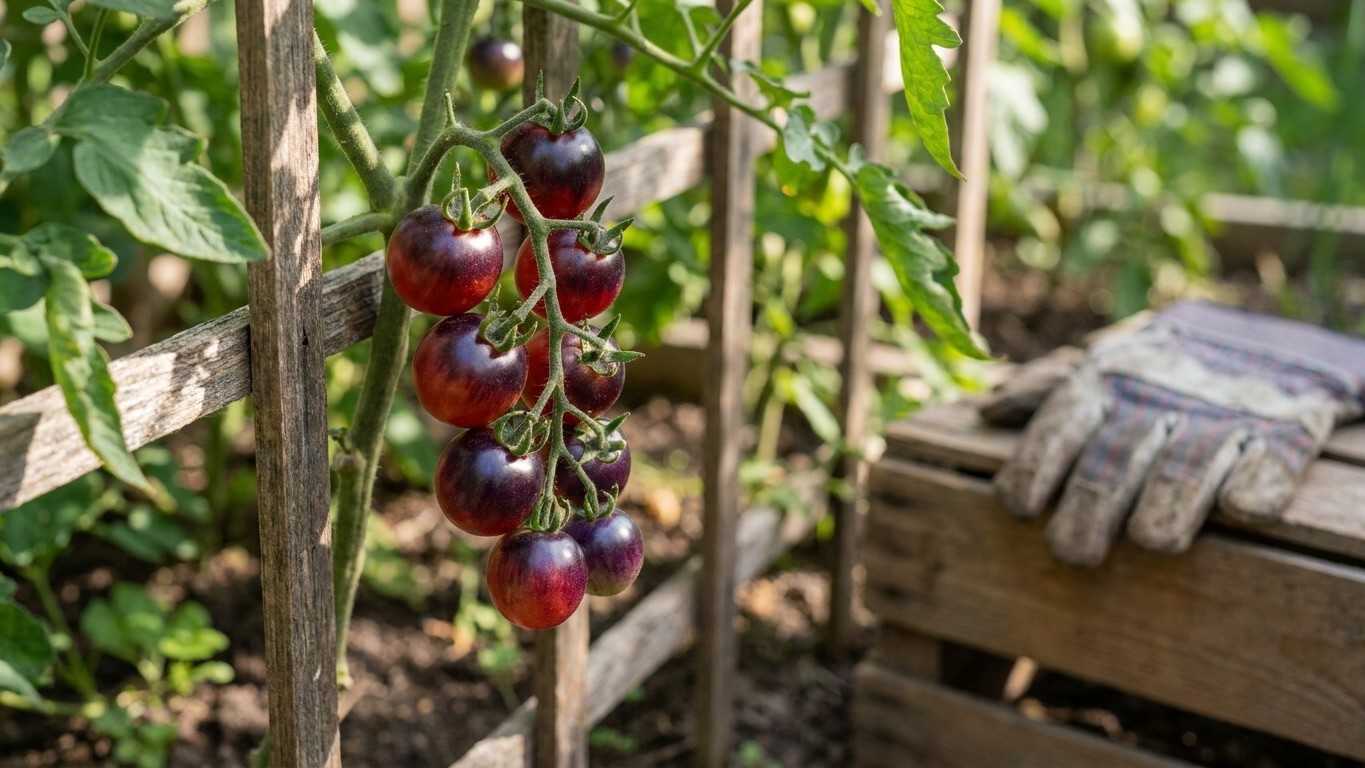

Indigo Cherry Drops is an indeterminate cherry tomato grown for small, round fruit that ripens deep red under a dark purple-black shoulder, and seed catalogues list it at about 71 days from transplant, not from the day you sow seed indoors. That maturity length is long for a cherry tomato, which is what makes the frost-window math below worth doing before you buy the seed packet. Pull up your region’s frost-free window from a local extension service first, then check it against the 75-day figure below rather than assuming any cherry tomato will fit.
What Indigo Cherry Drops actually is

Indigo Cherry Drops grows as an indeterminate vine, which means it keeps growing and setting new fruit clusters until frost or disease stops it, rather than ripening in one flush and quitting. That habit is the first thing to plan around: a determinate cherry tomato might finish its whole crop in a few weeks, but this one asks for a tall stake or cage and a full season of upkeep.
Catalogue listings put it at about 71 days from transplant to first ripe fruit. That figure is counted from the day a started seedling goes into the ground, not from seed, and it moves by a week or two either way depending on how warm and sunny the season runs. If you start seed indoors, add the weeks that plant spends under lights before it goes outside.
The fruit itself is small, round, and roughly an inch across, developing a dark purple-black cast on the shoulder while the rest of the skin colors up red as it fully ripens, a pattern caused by anthocyanin pigment that forms in direct sun. Fruit is eaten fresh, off the vine or in salads, and its thin skin means it does not hold for long once picked. That combination, a long maturity for a cherry type and an indeterminate habit, is what makes the frost-window question below more pointed than it would be for an early, determinate variety.
What Indigo Cherry Drops is good for
A cherry tomato’s whole culinary identity comes from its size, not its variety name. At about an inch across, each fruit is mostly skin and seed cavity relative to flesh, and that ratio is what decides how it gets used. There isn’t enough dense flesh in a fruit this small to reduce into a sauce or paste without cooking down a large batch to almost nothing, so this is not a tomato to plan a canning or sauce session around. What it is built for is eating raw: halved into a salad, tossed whole into a lunchbox, or eaten straight off the vine while you’re checking the plant, which is exactly the fate documented for it.
The red skin color and small round shape reinforce that use rather than argue against it. Fully red fruit at this size reads as ripe and sweet-leaning at a glance, which is part of why cherry types work as snacking food: little to no prep, no knife required beyond a halve for a salad bowl, and a burst of interior in one bite instead of a slice’s worth of texture spread over a fork.
No specific flavor profile for this variety is published, so it would be overstating things to promise a particular sweetness or acidity here. What can be said plainly, because it follows from the category itself, is that cherry tomatoes as a class are grown for fresh eating rather than cooking, and this one fits that pattern rather than breaking from it. If your kitchen use is salads, snacking, pasta finished with halved tomatoes tossed in raw, or a bowl left on the counter, that lines up with what this fruit is suited for. If your goal is a pot of sauce, a paste or slicing type built for higher flesh content is the better match, and this is not that tomato.
Where it ripens in time, and where it is a gamble
The arithmetic behind every one of these verdicts is the same. Take the frost-free window for your area, from the date it is safe to set plants out to the date the first fall frost is expected. Subtract Indigo Cherry Drops’ roughly 75-day catalogue maturity. What is left over is the margin, the number of days between the first ripe fruit and the frost that ends the season. Under thirty days of margin, you get one flush of fruit and a cool year takes even that.
Where the margin runs out
At the tight end, Yukon sets plants out around mid June at the Whitehorse reference station, and the 75-day count lands ripening near late August, about four days after the station’s average first frost. The margin is negative before you even account for a cool year, and Whitehorse’s accumulated seasonal heat, near 600 growing degree-days, is short of what a tomato needs to ripen fruit regardless of frost timing. This variety needs a greenhouse or high tunnel there, not an adjusted planting date.
Nunavut is only slightly better on paper. The Rankin Inlet station gives a single day of margin between first ripe fruit and first frost, and its seasonal heat accumulation, around 159 growing degree-days, is so low that the frost date barely matters. Cover is not optional there.
Move to Northwest Territories, Alberta, Manitoba and Saskatchewan and the frost-free window itself is long enough, margins running from about 31 to 38 days at the Yellowknife, Calgary, Winnipeg and Saskatoon stations. But accumulated heat is what limits these provinces, not frost. Calgary’s roughly 1,171 growing degree-days and Yellowknife’s 905 fall well short of a comfortable season for a 75-day cherry tomato, and even Winnipeg and Saskatoon, in the 1,500 to 1,800 range, call the result “just enough,” where an early plastic mulch to warm the soil and a season spent watching the sky matter as much as the calendar.
Where the margin is generous
Contrast that with Washington, where Seattle’s station shows about 155 days of margin after setting plants out from mid March to early April and ripening by mid June. That is comfortable, though Seattle’s accumulated heat, around 2,353 growing degree-days, still sits at the edge of what this variety wants, so an early transplant and dark mulch pay off even there.
Go further south and margin stops being the limiting factor at all. South Carolina, Florida, Texas, Nevada and Louisiana all show margins over 150 days, with the New Orleans reference station for Louisiana topping the list at about 227 days. In those places the frost table stops being useful and a different limit takes over, covered next.
| Territory | Reference station | Frost margin | Verdict |
|---|---|---|---|
| Yukon | Whitehorse | -4 days | Not viable outdoors |
| Nunavut | Rankin Inlet | 1 day | Cover required |
| Alberta | Calgary | 33 days | Greenhouse recommended |
| Manitoba | Winnipeg | 37 days | Just enough, use plastic mulch |
| Washington | Seattle | 155 days | Comfortable |
| Louisiana | New Orleans | 227 days | Comfortable, two cropping windows |
The two ways a season goes wrong
A long frost-free window does not guarantee a good crop, and a short one is not always fatal. Two limits sit underneath the frost date and a simple calendar calculation misses both.
In the north, the problem is accumulated warmth, not just the count of frost-free days. A tomato plant needs a running total of heat over the season, not just enough calendar days, to push a flower through to a ripe fruit. Calgary and Yellowknife can post a workable margin of thirty-plus days and still fall short on growing degree-days, which is why cover crops the difference there rather than an earlier planting date. On top of that, tomato flowers stop setting fruit reliably once nights drop below 50°F, so even a warm afternoon does not help if the nights alongside it are cold. For Indigo Cherry Drops specifically, with its 75-day season sitting on the longer side for a cherry tomato, this heat-accumulation limit matters more than frost timing across most of the northern half of the list above.
In the south, the limit runs the other way. Once daytime temperatures push past roughly 86°F, tomato pollen goes sterile and flowers drop without setting fruit at all, even though the plant itself keeps growing and looking healthy. South Carolina, Florida, Texas, Nevada and Louisiana all hit that ceiling for a stretch in the middle of summer, which is why growers in those states plant a spring crop and a separate autumn crop rather than expecting one plant to produce from a March transplant straight through to fall. Indigo Cherry Drops, being indeterminate, will sit through that gap and resume setting fruit once temperatures fall back below the threshold, so the loss there is a summer lull in an otherwise long season, not a wasted crop the way a short cold season can be in the north.
What it resists, and what it does not
Seed catalogues for Indigo Cherry Drops list no formal disease-resistance codes, unlike hybrids bred specifically for resistance and marked with letters such as V, F or N on the packet. This variety was developed for its anthocyanin coloring and cherry-tomato eating quality, not for disease tolerance, and treating it as resistant to anything because it looks vigorous early in the season is a mistake that costs a crop later.
That means it carries the same exposure to common tomato problems as any unprotected heirloom-type variety: early blight and septoria leaf spot moving up from the soil in wet weather, blossom end rot when watering is inconsistent during fruit set, and cracking after a heavy rain following a dry spell, made worse here by the thin skin typical of small cherry fruit. None of these are unique to Indigo Cherry Drops, but none of them are screened out by the plant either.
Practical management leans on cultural practice rather than genetics: mulch to keep soil-borne spores from splashing onto lower leaves, water on a steady schedule rather than a feast-or-famine one, and remove the lowest leaves as the plant grows to improve airflow. If disease resistance matters more to your garden than flavor or color, that is a reason to grow this variety alongside a resistant hybrid rather than instead of one, not a reason to avoid it outright.
Growing it without the usual mistakes
Because Indigo Cherry Drops is indeterminate, it needs a support plan built for a full season, not the one you would use on a determinate bush that ripens and quits. A single tomato cage sized for a compact plant will not hold this vine by midsummer.
Support and spacing
A tall stake, seven feet or more, or a sturdy cattle-panel trellis works better than a standard wire cage, since the plant will keep adding height and fruit clusters through the season. Give it the spacing recommended for indeterminate types rather than crowding it in with compact varieties, since dense foliage on a long-season plant traps the humidity that drives early blight.
Feeding and pruning
Feed at transplant and again as the first fruit sets, then taper off nitrogen once the plant is fruiting steadily. Extra nitrogen late in the season pushes leafy growth at the expense of fruit and is a common mistake with vigorous indeterminate types. Suckering, removing some of the side shoots that form in the leaf joints, keeps the plant more manageable and improves airflow, though a plant left unsuckered will still produce, just with a bushier, harder-to-stake result.
Watching the calendar
The mistake specific to this variety’s timing is treating it like an early cherry tomato and starting the harvest clock too soon. With a 75-day maturity, it ripens later than many cherry types gardeners are used to, and checking daily for color at day fifty will just waste attention. A few points worth keeping in mind through the season:
- Water consistently once fruit begins to size up, to reduce cracking on the thin skin.
- Expect the purple shoulder to stay purple even at full ripeness. Color change happens on the rest of the fruit, not there.
- Pick promptly once fruit colors up. The thin skin does not hold on the vine or the counter for long.
- In short-season areas, count backward from your first fall frost using the 75-day figure to judge whether a second flush is realistic at all.
If this is your first time growing an indeterminate variety after mostly working with compact types, the general staking and pruning guidance for tomato varieties as a whole is worth reviewing before transplant, since the habit changes more of the season’s work than the fruit itself does. Growers comparing options for a shorter season might also look at Estiva, a red slicer with a different maturity profile, or at Amalfi, a paste tomato bred to ripen its crop all at once rather than over a long season like this one.
Common questions
How many tomatoes does one Indigo Cherry Drops plant actually give me?
There’s no fixed number in the catalogue data, since yield depends heavily on season length and how much heat the plant gets, but as an indeterminate variety it keeps producing clusters through the season rather than finishing in one flush. A plant that reaches full maturity in a comfortable-margin area will out-produce one stopped early by cold in a marginal one.
Can I grow Indigo Cherry Drops in a container?
You can, but its indeterminate habit means it will outgrow a small pot fast and still need a tall stake even in a container. A large pot, at least the size recommended for full-size indeterminate tomatoes, with a stake driven down through the soil, works better than a hanging basket sized for a determinate cherry type.
Why are my Indigo Cherry Drops staying purple and not turning red?
That is likely normal. The purple-black shoulder from anthocyanin pigment persists even on a fully ripe fruit, especially on the side that faced direct sun. Check the rest of the fruit’s color and give it a gentle squeeze rather than waiting for the purple itself to fade.
Is Indigo Cherry Drops the same thing as Indigo Rose?
No, they are different named cultivars, both bred for anthocyanin coloring but with different fruit size, shape and maturity figures printed on their own seed packets. Check the specific catalogue listing for whichever one you are holding rather than assuming the numbers match.