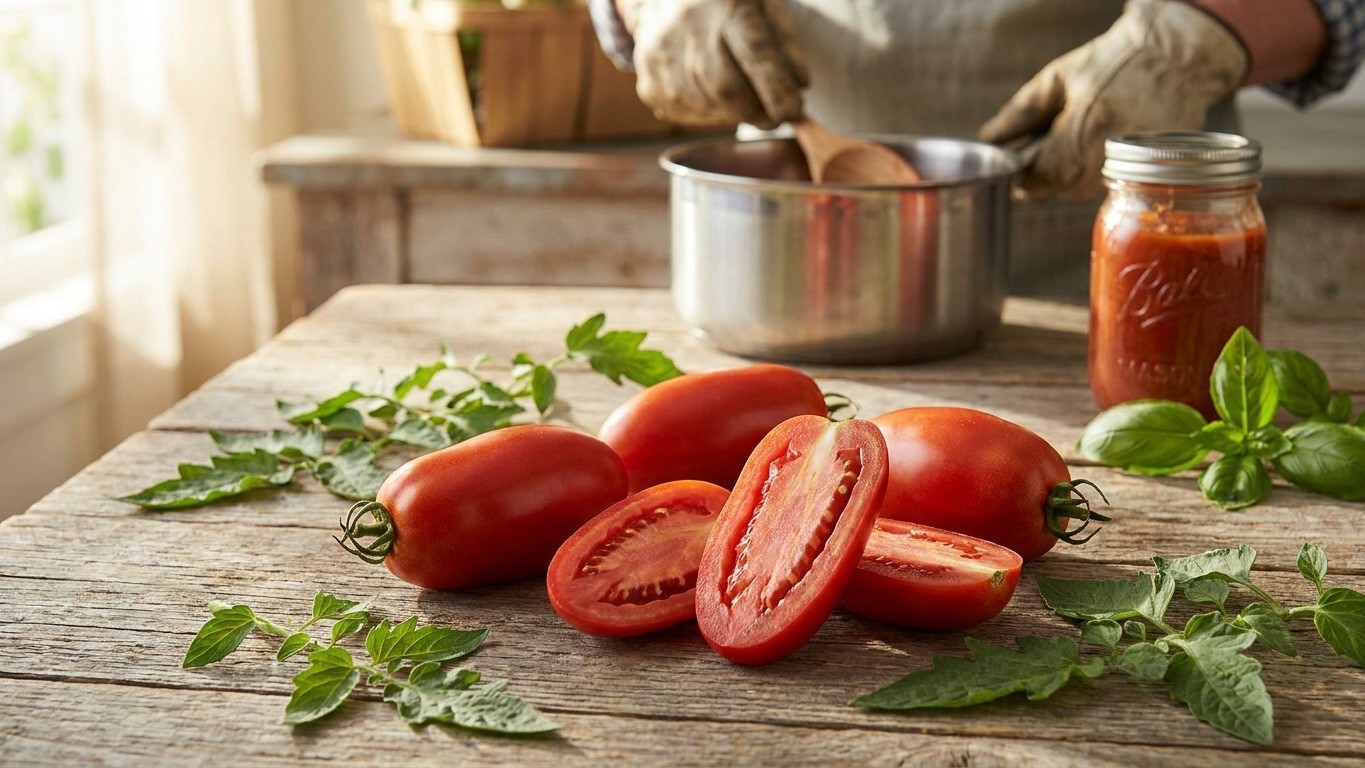

Paisano is a determinate paste tomato built for sauce and canning, with red 4-5 oz fruit and 68 days to maturity counted from transplant. That short, defined cropping window makes it a strong candidate almost everywhere in the country, but the arithmetic still matters: subtract soil warm-up time and the maturity count from your frost-free season, and you’ll know exactly how much picking time you actually get.
What Brandywine actually is
Paisano is a paste tomato, which tells you most of what you need to know about how it’s used before you even plant it: dense flesh, low water content, and fruit meant for the pot rather than the sandwich. The catalogue lists it as determinate, meaning the plant grows to a set size, flowers over a compressed period, and then ripens most of its crop in one main flush rather than trickling fruit out all summer. That habit shapes everything from staking to harvest planning, and it’s the single biggest fact to register before you buy seed.
The fruit itself runs 4 to 5 ounces, red-skinned, and described in catalogue terms as having good flavor with high solids, which is the trait that actually matters for sauce: less water to cook off, thicker results, faster canning sessions. Days to maturity is listed at 68, and that figure is counted from the day you set transplants in the ground, not from the day you sowed seed indoors. Confusing the two bases is a common way home gardeners overestimate how much season they have left. Sixty-eight days from transplant is on the faster end for a paste tomato, which is the detail that drives most of the regional discussion below.
Where it ripens in time, and where it is a gamble
The way to test any tomato variety against your own yard is simple arithmetic, and it works the same whether you garden in Vermont or Alabama. Start with your local frost-free window, the number of days between your average last spring frost and your average first fall frost. Subtract roughly two weeks, because tomato transplants shouldn’t go into ground that hasn’t warmed enough to support root growth; setting plants out too early just stalls them, which erases any head start. Then subtract the 68 days to maturity. Whatever remains is your actual picking window, the stretch where ripe fruit is coming off the vine rather than sitting green on a windowsill.
In a garden with a frost-free season around 140 to 160 days, common across much of the Mid-Atlantic and the lower Midwest, that math leaves a comfortable 60-plus days of harvest, plenty of room to let a determinate crop ripen its main flush and still have time for a second smaller round. Gardens in the Gulf Coast states and much of the Southeast, where frost-free stretches often run past 220 days, have even more slack, though as the next section explains, more days isn’t automatically more usable days once summer heat enters the picture.
The tighter cases sit in the northern tier: parts of northern New England, the Upper Midwest, and higher-elevation mountain valleys where the frost-free season can run closer to 90 to 100 days. Run the same subtraction there: 100 days, minus 14 for soil warm-up, minus 68 for maturity, leaves around 18 days of picking. That’s workable, but it’s tight, and it leaves almost no cushion for a cool, slow spring or an early fall frost. In those regions, this variety’s short maturity count is actually its biggest asset compared with slower paste tomatoes that need 75 or 80 days, since every day trimmed off the maturity count is a day added back to the harvest window. No official frost-date figures are cited here beyond these general regional patterns; gardeners in borderline zones should check their own average frost dates before committing bed space.
The two ways a season goes wrong
A long frost-free window on paper doesn’t guarantee a good crop, and two limits explain why. The first shows up in the north: even where the calendar gives enough days, the accumulated warmth during those days can be too thin. Tomatoes need consistently warm nights to set fruit, and when nighttime temperatures drop below 50°F, pollen doesn’t perform well and blossoms drop instead of forming fruit. A short, cool northern season can technically have “enough days” and still under-deliver because too many of those nights sit below that threshold.
The second limit runs the opposite direction, and it’s the one that matters more in the South. Once daytime temperatures push above roughly 86°F for extended stretches, tomato pollen becomes sterile and fruit set stalls out, even though the plant keeps flowering. This is why experienced growers in hot climates plan around two shorter crops, a spring planting that finishes before the worst of midsummer heat, and a fall planting timed to mature after temperatures ease back down, rather than expecting one continuous harvest all season.
For this variety specifically, the fast 68-day maturity count tilts the balance toward the southern heat limit mattering more than the northern cold-night limit. A determinate paste tomato that matures quickly is well suited to slipping in a spring crop ahead of the summer heat spike, finishing its main flush before pollen sterility becomes a problem. In cooler northern gardens, the same short maturity count reduces exposure to marginal nights simply by needing fewer of them.
What it resists, and what it does not
Catalogue data for this variety lists no published disease resistances. That’s worth stating plainly rather than glossing over, because it changes how the plant should be managed. Many modern hybrid tomatoes carry resistance codes for verticillium wilt, fusarium wilt, or nematodes, letters that tell a grower the plant has some built-in defense against soil-borne problems. This variety carries none of those listed codes, which means it gets no head start against the common soil pathogens that build up in tomato beds over time.
In practical terms, that puts more weight on garden management than on the plant’s genetics. Crop rotation, meaning not planting tomatoes (or peppers and eggplant, which share the same vulnerabilities) in the same soil year after year, becomes more important here than it would be with a resistant hybrid. So does watching for early blight and late blight symptoms on the lower leaves, since there’s no intermediate resistance rating buffering the plant’s response the way there is with some other paste varieties. An intermediate resistance rating on a seed packet means a plant slows a disease’s progress, not that it’s immune, and this variety doesn’t even have that buffer to lean on. That doesn’t make it a fragile plant, but it does mean sanitation and spacing carry more of the disease-prevention load than the tomato itself.
Growing it without the usual mistakes
Because this is a determinate variety, the whole growing plan should be built around one concentrated harvest rather than a season-long trickle. Determinate plants stay more compact than sprawling indeterminate vines, so a simple cage or a single stake with light tying is usually enough support, unlike an indeterminate paste tomato that needs a tall stake or trellis system to carry vines all summer. Space plants a bit closer than you would an indeterminate variety, since the plant’s final size is smaller and more predictable.
The timing mistake to avoid is treating this like a slow-ripening tomato and feeding it heavily all season. Determinate plants set nearly all their fruit in one window, so once that fruit set is underway, heavy nitrogen feeding mostly pushes leaf growth at the expense of the crop, and it doesn’t buy you a second flush the way it might with an indeterminate vine. Ease off supplemental nitrogen once fruit is sizing on the plant, and let the crop finish rather than trying to extend it.
The other planning detail is logistical rather than horticultural: because the harvest arrives concentrated rather than spread out, gardeners canning or saucing this variety should plan a processing day (or two) around the expected ripening window rather than assuming a steady weekly trickle they can handle in small batches. Picking a determinate paste tomato a little early and finishing ripening indoors, once fruit has started to blush, is a reasonable way to spread out an otherwise compressed harvest without losing quality.
Common questions
Is Paisano determinate or indeterminate?
It’s determinate, meaning it grows to a set size and ripens most of its crop in one concentrated flush rather than producing continuously through the season.
How many days does Paisano take to ripen?
Sixty-eight days, counted from the date of transplant into the garden, not from seed sowing.
Does Paisano resist common tomato diseases?
No disease resistances are published for this variety, so garden practices like crop rotation and plant spacing carry more of the prevention work than the plant’s genetics do.
What is Paisano best used for in the kitchen?
Sauce and canning. Its 4 to 5 ounce fruit has good flavor and high solids, meaning less water content and a thicker result when cooked down.