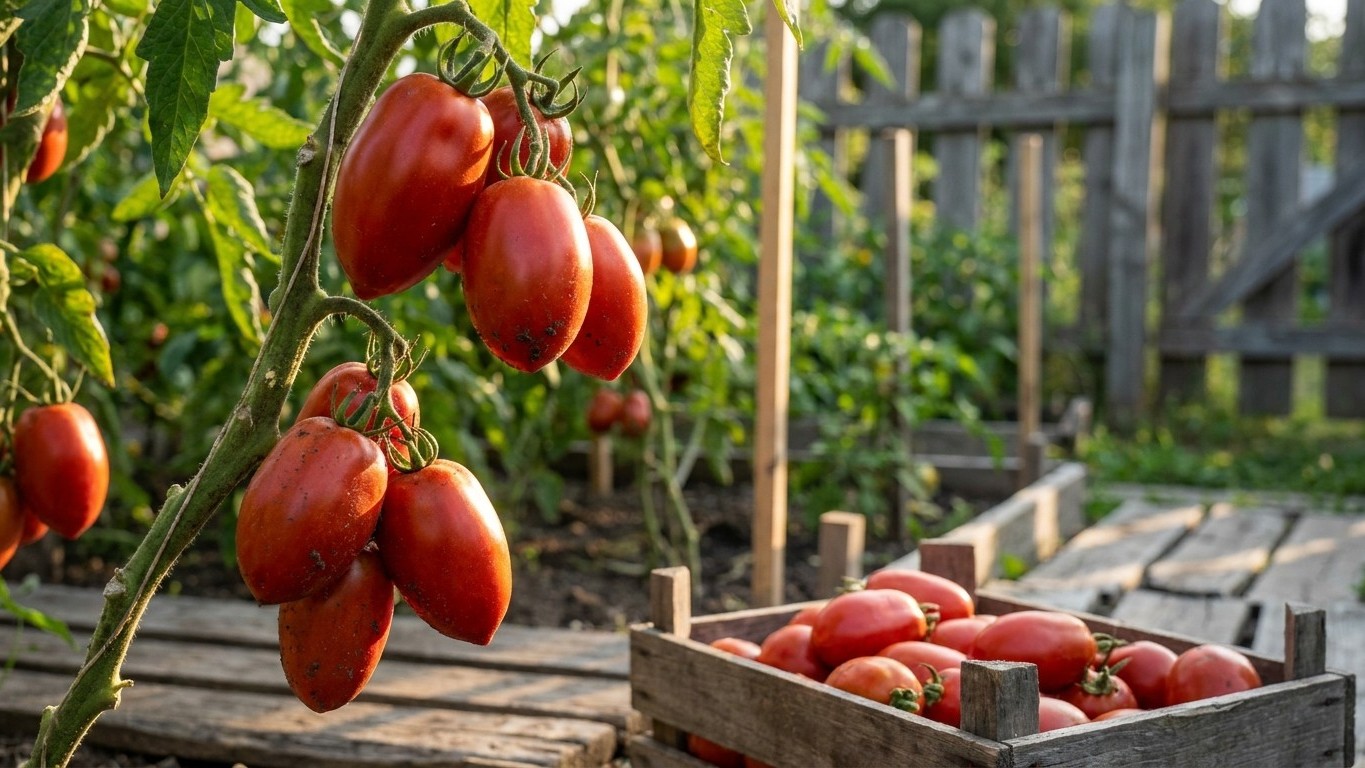

Amish Paste is a determinate, egg-shaped paste tomato that ripens in 73 to 80 days from transplant, and the answer to “does it fit my season” depends less on the tomato than on two numbers most gardeners never actually check: how many frost-free days their yard gets, and how many warm nights fall inside that window. Get those right, and the payoff is a single, canning-ready flush of dense, meaty fruit built for the sauce pot.
What Amish Paste actually is

Seed catalogues list Amish Paste at 73 to 80 days to maturity, and that count starts at transplant, not at the day the seed goes into a tray indoors. Plan around the later figure. A margin built on the early end of a published range promises a harvest a gardener may not actually get once a cool week or a cloudy stretch slows things down.
The plant is determinate, which means it sets its fruit over a short window rather than trickling out tomatoes from July to frost. For most vegetable gardeners that sounds like a limitation. For anyone planning a canning weekend, it is the whole point: the crop comes in together, ready to process in one push instead of a handful of tomatoes a day for two months.
The fruit itself runs about 3 inches long, egg-shaped, and bright red at full ripeness. This is a paste type, and that word describes a mechanism, not just a label. Paste tomatoes carry dense flesh and comparatively little water, so a batch of them cooks down into sauce without hours of simmering to boil off liquid. A slicing tomato does the opposite: mostly water and thin walls, great sliced on a sandwich, disappointing in a pot because it takes forever to reduce.
Where it ripens in time, and where it is a gamble
The arithmetic is simple, and any gardener can run it for their own yard. Take the number of frost-free days in a typical year, subtract roughly two weeks at the start because soil needs to warm before a tomato transplant will actually grow rather than just sit there, then subtract the tomato’s days to maturity, in this case 80. Whatever is left is the buffer, the number of days available for picking before an average first fall frost, and it also covers the slower, cooler stretches that push real-world ripening past the catalogue figure.
In short-season regions, the kind found around the northern Great Lakes, in northern New England, or at higher elevations in the Rockies, frost-free windows tend to run on the shorter side, sometimes closer to 100 to 120 days depending on the exact location. Run the math there and the buffer shrinks fast, sometimes to almost nothing once the two-week soil-warming setback and the 80-day maturity figure are both subtracted. That does not make Amish Paste impossible in those regions, but it does mean starting seed indoors early, transplanting the moment the soil has genuinely warmed rather than the moment the calendar looks tempting, and treating every extra day of buffer as insurance rather than slack.
Move into mid-latitude territory, the Mid-Atlantic, the Ohio Valley, or much of the Pacific Northwest west of the Cascades, and frost-free windows typically stretch longer, often into the 150-to-180-day range. That leaves a comfortable cushion after the 80-day count and the soil-warming subtraction, enough room for a slow spring or an early-August heat wave to shove the harvest date back without threatening the crop.
In long-season territory, the Gulf Coast, southern California, and much of the Deep South, frost-free windows commonly run past 220 days and sometimes well beyond that. There the constraint stops being frost altogether and becomes something else entirely, covered in the next section. Because exact frost-free windows shift from state to state, and from one year to the next, the smart move is checking the frost-free window for the nearest weather station or a local extension office rather than relying on a regional guess, and then running the same subtraction: frost-free days, minus two weeks, minus 80.
The two ways a season goes wrong
A frost table only tells half the story, and a long frost-free window does not guarantee a good tomato season. In the north, accumulated warmth can run short even when the calendar window between frosts looks generous, because tomatoes need consistently warm nights, not just the absence of freezing temperatures. Fruit will not set at all when night temperatures drop below 50°F, and a determinate variety that hits its short flowering window during a cool spell risks losing that entire flush, with no second wave of blossoms coming later to make up for it the way an indeterminate vine would.
In the south, the failure runs the opposite direction. Once daytime temperatures climb above roughly 86°F, tomato pollen goes sterile, and blossoms simply drop without setting fruit. That is why growers in hot climates split the season into a spring crop planted early enough to finish before that heat wall, and a fall crop started from transplants set out once the worst of the summer heat has broken, rather than expecting one tomato plant to produce steadily from May through October.
For Amish Paste specifically, given its 80-day run and its determinate, single-flush habit, the cool-night limit in northern gardens is the sharper risk. Because the whole crop sets in one window, a stretch of chilly nights right at flowering can cost the entire harvest rather than just delaying part of it. In hot southern regions, the fix is more forgiving: get the transplant in early enough that flowering and fruit set happen before the mid-summer heat wall, which a determinate variety’s short season actually makes easier than it would be for a slower indeterminate type.
What it resists, and what it does not
Catalogue listings credit Amish Paste with resistance to Verticillium wilt (V) and Fusarium wilt (F). Both are soilborne fungal diseases that infect through the roots and choke off a plant’s water supply, and both can persist in garden soil for years once established, which is why resistant varieties matter to anyone who has grown tomatoes in the same bed repeatedly.
Resistance is not immunity, and that distinction is worth taking seriously rather than treating as fine print. A resistant variety slows the disease and often keeps a plant productive despite low-level infection, but it does not guarantee the plant never encounters the pathogen or shows zero symptoms in badly contaminated soil. Rotating tomato beds every few years still matters even with resistant varieties in the ground.
Just as important is what is absent from that list. Amish Paste’s published resistances cover only Verticillium and Fusarium wilt. There is no catalogue-listed resistance to late blight, early blight, nematodes, or the various tomato viruses that circulate in humid regions. In practice, that means the usual precautions still apply here with no genetic backup: good airflow between plants, avoiding overhead watering that keeps foliage wet, and watching for the dark, spreading lesions of blight rather than assuming the plant is protected because it carries a resistance code.
Growing it without the usual mistakes
Because Amish Paste is determinate, it does not need the tall trellis and constant tying that an indeterminate slicing tomato demands. A single sturdy stake or a standard cage is usually enough to keep the plant upright through its one heavy fruit set, and spacing can run a bit tighter than it would for a sprawling indeterminate vine, since the plant stops growing taller once it starts flowering.
Feeding is where a lot of gardeners go wrong with determinate types. Heavy nitrogen late in the season pushes leafy growth at exactly the moment the plant should be putting its energy into ripening the fruit it has already set. Once fruit set is well underway, easing off high-nitrogen feeding lets the plant finish its single flush rather than chasing new vegetative growth it does not have time to use.
The timing mistake specific to this variety is treating it like an indeterminate vine that yields all season. Because the whole crop ripens in a compressed window, succession planting spread over several weeks does little good the way it would with a slicing tomato that trickles out fruit steadily. Instead, plant enough seedlings at the same time to cover an entire canning batch, and clear the calendar for the week the fruit actually comes in, because there will not be a second, staggered harvest to fall back on if that first weekend gets missed.
Common questions
Is Amish Paste the same thing as a Roma tomato?
No. Roma is a specific variety name, while “paste tomato” describes a category of dense, low-water fruit bred for sauce and canning. Amish Paste belongs to that same category, alongside Roma, but the two are distinct varieties with different maturity times and disease resistances.
Can Amish Paste be eaten fresh, in a salad?
It can, but the texture disappoints most people used to a juicy slicing tomato. The flesh is thick-walled and meaty with few seeds and little water, which is exactly what makes it good for sauce and disappointing on a sandwich.
Does Amish Paste need to be canned right away, or can it be frozen?
The fruit freezes well for later cooking, so a gardener overwhelmed by a single-flush harvest does not have to can everything in one weekend. Whole or chopped tomatoes can go into the freezer and get turned into sauce or paste whenever time allows.
Why did the fruit set stop when the weather turned hot?
Above roughly 86°F, tomato pollen becomes sterile and blossoms drop without setting fruit. That is a temporary, heat-driven pause rather than a sign of disease, and fruit set typically resumes once temperatures moderate.