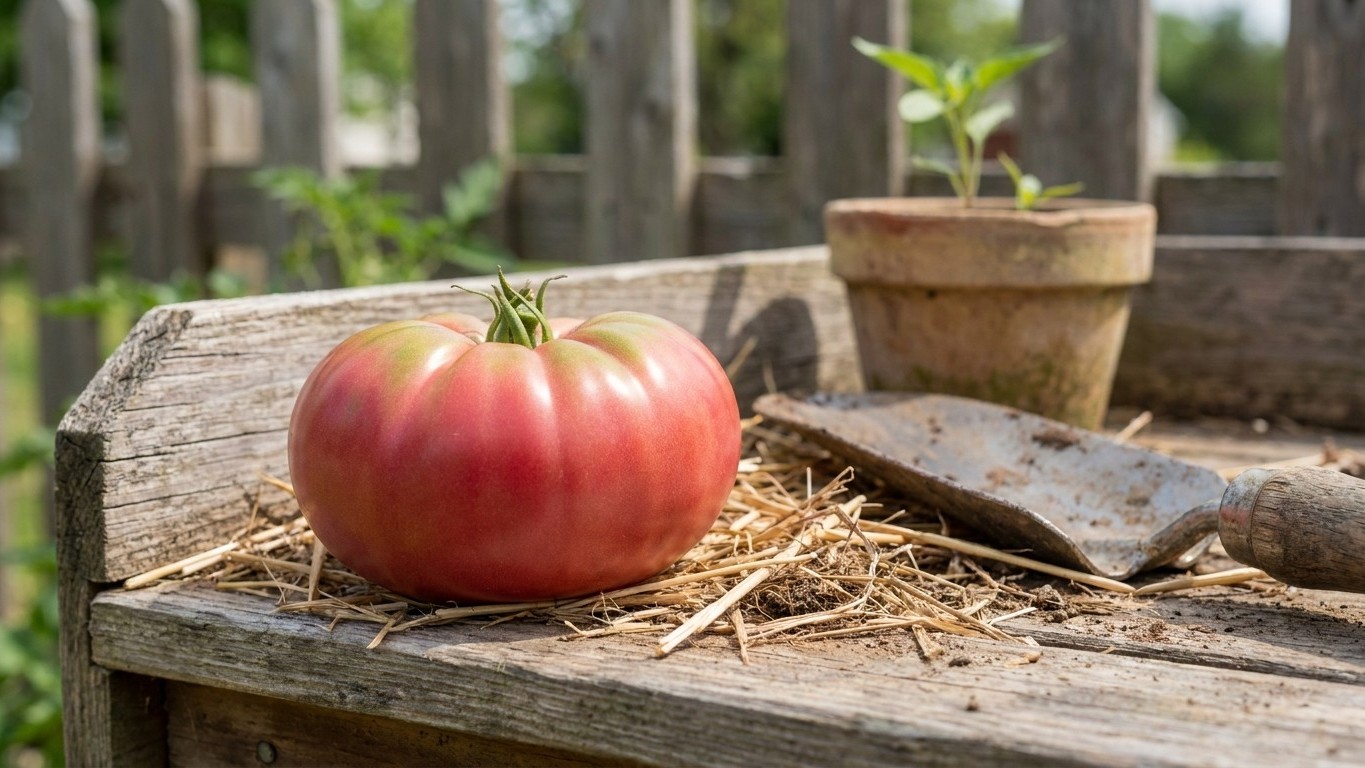

Brandywine is a large pink heirloom beefsteak tomato grown on a sprawling indeterminate vine with distinctive potato-leaf foliage, and most seed catalogs list it at roughly 78 days from transplant to first ripe fruit, one of the longest windows of any popular slicing tomato. That long clock is what decides everything else about growing it. Before you commit bed space to it, check your region’s frost-free window against that 80-to-100-day range, and if the arithmetic comes up tight, plan on a hoop house or a faster substitute instead of hoping the season stretches to fit.
What Brandywine actually is

Brandywine is an indeterminate heirloom, which means the vine keeps growing, flowering and setting fruit until frost or disease stops it, rather than ripening in one flush like a determinate bush type. That habit demands a tall, sturdy cage or a stake system built to last the whole season, not the flimsy wire rings sold for patio tomatoes. The foliage is the potato-leaf type: broad, smooth-edged leaflets that look more like a pea plant than a typical tomato, which is a useful identifying feature if you buy seedlings unlabeled at a swap.
Most seed catalogs put Brandywine at 78 days from transplant to first ripe fruit, and that figure is counted from the day the seedling goes into the ground, not from the day the seed is sown. It also shifts by a week or two either way depending on how warm the season runs, so treat it as a range rather than a promise. The fruit itself is a flattened, ribbed pink beefsteak that commonly reaches five to seven inches across on a well-fed plant, with a soft, meaty flesh better suited to slicing on a sandwich than to canning or long storage. As with tomato varieties generally, that maturity figure is the single number worth writing on your seed packet before you forget it.
What Brandywine is good for
The flesh is soft and meaty rather than dense, and it carries enough water that a knife through a ripe fruit leaves the cutting board wet. That combination is exactly what a sandwich or a salad wants: a slice thick enough to hold its shape but juicy enough to need no dressing, with seed cavities that stay small relative to the wall of flesh around them. It is why the catalog description calls this a slicing tomato rather than a paste or sauce type. Cook it down in a pot and that same water works against you, thinning the sauce and stretching the cooking time as it boils off, with a yield of solids that doesn’t reward the effort the way a drier, thick-walled paste tomato does.
The flavor claim attached to Brandywine is a specific one worth taking at face value rather than dressing up further: it won a head-to-head tasting contest against other tomatoes, which is a stronger claim than most varieties can make. Beyond that result, no further detail about sweetness, acidity, or aftertaste is documented here, so it isn’t repeated as fact. What can be said with more confidence comes from the category: heirloom varieties are open-pollinated, grown and kept for generations specifically because people liked eating them, and Brandywine’s reputation is a product of exactly that kind of long-running informal taste test rather than a breeding program aimed at shelf life or shipping durability.
That last point matters for the kitchen as much as the field. A tomato bred for eating fresh rather than for surviving transport is one you slice at the counter minutes after picking, not one you box up and mail. If the goal is a BLT, a caprese plate, or tomato on toast with salt and nothing else, this is that tomato. If the goal is jars of sauce for winter, look toward a paste variety instead.
Where it ripens in time, and where it is a gamble
The number that matters most here is the margin: the days left between the date the first fruit actually turns ripe and the date the first fall frost typically arrives. Brandywine’s long 80-to-100-day maturity eats deep into any frost-free window before a single tomato is even picked, so a season that would comfortably ripen a 60-day cherry can leave this variety racing the calendar.
The arithmetic, region by region
At the tight end, Yukon’s Yukon territory, measured at the Whitehorse station, sets tomatoes out in mid June and sees first ripe fruit only in early September, which lands 11 days after the average first frost. In Nunavut, at the Rankin Inlet station, the shortfall is smaller but still real: fruit ripening mid September misses the frost by about 6 days. In both places the frost date is only half the problem, and the other half, accumulated seasonal warmth, is covered below.
Northwest Territories, at the Yellowknife station, and Alberta, at the Calgary station, both clear frost with a margin of roughly 24 to 26 days, which means one flush of ripe fruit gets in before the season closes, and a cooler-than-average year erases it. Manitoba, at Winnipeg, and Saskatchewan, at Saskatoon, land in the 30-to-31-day range, workable but tight enough that most local growers treat Brandywine as a season-extender crop under plastic mulch or a low tunnel rather than a bet on open ground.
| Territory (reference station) | Set out | First ripe | Margin to frost | Verdict |
|---|---|---|---|---|
| Yukon (Whitehorse) | mid June | early September | -11 days | impossible outdoors |
| Nunavut (Rankin Inlet) | early July | mid September | -6 days | impossible outdoors |
| Alberta (Calgary) | early June | late August | 26 days | risky, one flush only |
| Manitoba (Winnipeg) | early June | late August | 30 days | greenhouse or tunnel advised |
| Washington (Seattle) | mid March to early April | mid June | 148 days | comfortable |
| Louisiana (New Orleans) | early to late February | mid May | 220 days | comfortable |
Once you cross into the milder tier, the picture flips entirely. Washington, at the Seattle station, sets out mid March to early April and sees first ripe fruit by mid June, leaving a margin of roughly 148 days, more than enough for Brandywine to produce a long, unhurried harvest. Louisiana, at the New Orleans station, has the widest margin of the group at around 220 days, set out in February with fruit ripe by mid May. A grower in a tight-margin region who wants a guaranteed crop rather than a gamble is usually better off pairing Brandywine with something faster, like the cherry tomato described in Jasper Tomato: When to Plant It, and What to Do With the Red Cherries, which ripens in a fraction of the time.
The two ways a season goes wrong
A long frost-free window is not the same thing as a good tomato season, and Brandywine’s slow clock exposes both of the ways it can fail.
Not enough heat, even with time to spare
In the north, the frost-free count can look workable while the total accumulated warmth still falls short. Yukon’s Whitehorse station logs roughly 600 growing degree-days across the year, Nunavut’s Rankin Inlet only about 159, and even Alberta’s Calgary station comes in around 1171, figures that describe cumulative heat rather than calendar days. Fruit does not set at all once nights drop below 50 degrees Fahrenheit, so a string of cool nights can shut down flowering regardless of how many frost-free days remain on the calendar. For a variety that needs a full 78 days of sustained warm growth to finish a beefsteak-sized fruit, this heat shortfall is usually the more decisive limit in the north, ahead of the frost date itself.
Too much heat in the middle of the season
In the deep south, the opposite problem takes over. Above roughly 86 degrees Fahrenheit, tomato pollen goes sterile and flowers drop without setting fruit, which is why South Carolina at Charleston, Florida at Jacksonville, Texas at Houston, Nevada at Las Vegas and Louisiana at New Orleans all run two separate tomato seasons, a spring crop and a fall crop, instead of one continuous run. Because Brandywine’s long fruit-set window keeps the plant flowering for months, it sits through the entire hot stretch no matter when it goes in the ground, so growers in these regions plan around a mid-summer gap rather than expecting a single harvest to carry through.
What it resists, and what it does not
Brandywine carries no listed disease resistance codes in standard seed catalogs, unlike the modern hybrids bred specifically with resistance genes for fusarium, verticillium or nematodes. That is typical of pre-hybridization heirlooms and it is worth saying plainly rather than assuming some baseline protection exists.
- Early blight (Alternaria solani): common on the lower leaves in humid weather, no built-in resistance
- Late blight (Phytophthora infestans): can move fast through a planting in cool, wet conditions
- Fusarium and verticillium wilts: soil-borne, no resistance to fall back on, crop rotation is the only real defense
- Fruit cracking: the thin skin splits readily after heavy rain following a dry spell
None of this makes Brandywine a bad choice, but it changes the maintenance plan. Air circulation and mulch matter more here than on a hybrid with built-in resistance, since the plant has nothing to fall back on if blight takes hold. Gardeners who want a small-space plant with a bit more built-in disease tolerance, especially where fusarium has been a problem in the same bed before, might compare it against the profile of Lucky Tiger Tomato: When to Plant It, and What to Do With the Green Tomatoes, a very different fruit but a useful contrast in how catalog resistance codes work.
Growing it without the usual mistakes
Because Brandywine is indeterminate, it needs a season-long support plan, not a one-time stake job. A single sturdy metal cage six feet tall or a stake-and-tie system refreshed every couple of weeks works better than the store-bought wire cones, which buckle under the weight of fruit that regularly reaches five to seven inches across. Space plants generously, since the vine is vigorous and sprawling and crowds itself into a tangle of poor air circulation if set too close to its neighbors.
Feeding and watering
Ease off nitrogen once the first fruit sets. A plant pushed hard with high-nitrogen feed late in the season puts its energy into vine growth instead of ripening the fruit already on it, and with a variety this slow to mature that lost time is hard to recover. Consistent moisture matters more for Brandywine than for most tomatoes, because the thin-skinned fruit splits readily when a dry spell is followed by a heavy watering or a hard rain. A layer of mulch that keeps soil moisture even does more good here than on tougher-skinned hybrids.
The mistake specific to this variety’s timing is starting it too late, or worse, pushing it out into cold soil too early to compensate for a short local season. Cold soil stunts a transplant for weeks without killing it outright, which quietly erases whatever frost margin the calendar gave you in the first place. Given how tight that margin already runs in a state like Alberta or Manitoba, an early but healthy transplant into warmed soil matters more for Brandywine than for almost any faster variety.
Common questions
Is Brandywine a determinate or indeterminate tomato?
Indeterminate. The vine keeps growing and setting new flowers until frost or disease stops it, which is why it needs tall, ongoing support rather than a small cage set once and forgotten.
Why are my Brandywine tomatoes splitting on the vine?
Splitting almost always follows uneven watering, usually a dry stretch broken by heavy rain or a sudden deep soak. Keeping soil moisture steady with mulch and a regular watering schedule cuts down on it, though the thin skin means some cracking is hard to avoid entirely in a wet year.
Can I grow Brandywine in a container?
Only in a very large one. This is a sprawling indeterminate vine that outgrows the small pots sold for patio tomatoes fast, so it needs the same generous root room and sturdy staking you would give it in open ground, just with more frequent watering to make up for the limited soil volume.
Why is my Brandywine not setting any fruit even though it’s flowering?
Temperature is the usual cause. Flowers drop without setting fruit when nights fall below roughly 50 degrees Fahrenheit or when days climb above roughly 86 degrees Fahrenheit, so a run of unusually cool or unusually hot weather during flowering will stall fruit set even on a healthy-looking plant.