
Set Tasmanian Chocolate out on the same weekend as your early slicers, and you’ll spend August staring at a six-foot vine still loaded with green fruit while the rest of the bed’s already been eaten. This is an 80-day tomato counted from transplant, not from seed, and it ripens late and slow rather than all at once. Plant it on a determinate schedule and frost gets to the crop before you do.
What Tasmanian Chocolate actually is

Tasmanian Chocolate is a heirloom, indeterminate beefsteak tomato grown for slicing, not for canning or salads. The vine keeps growing and setting fruit until frost or disease stops it, which means it needs a stake or cage tall enough to hold a plant that can top six feet by midsummer, and a season long enough to let that vine actually finish a crop.
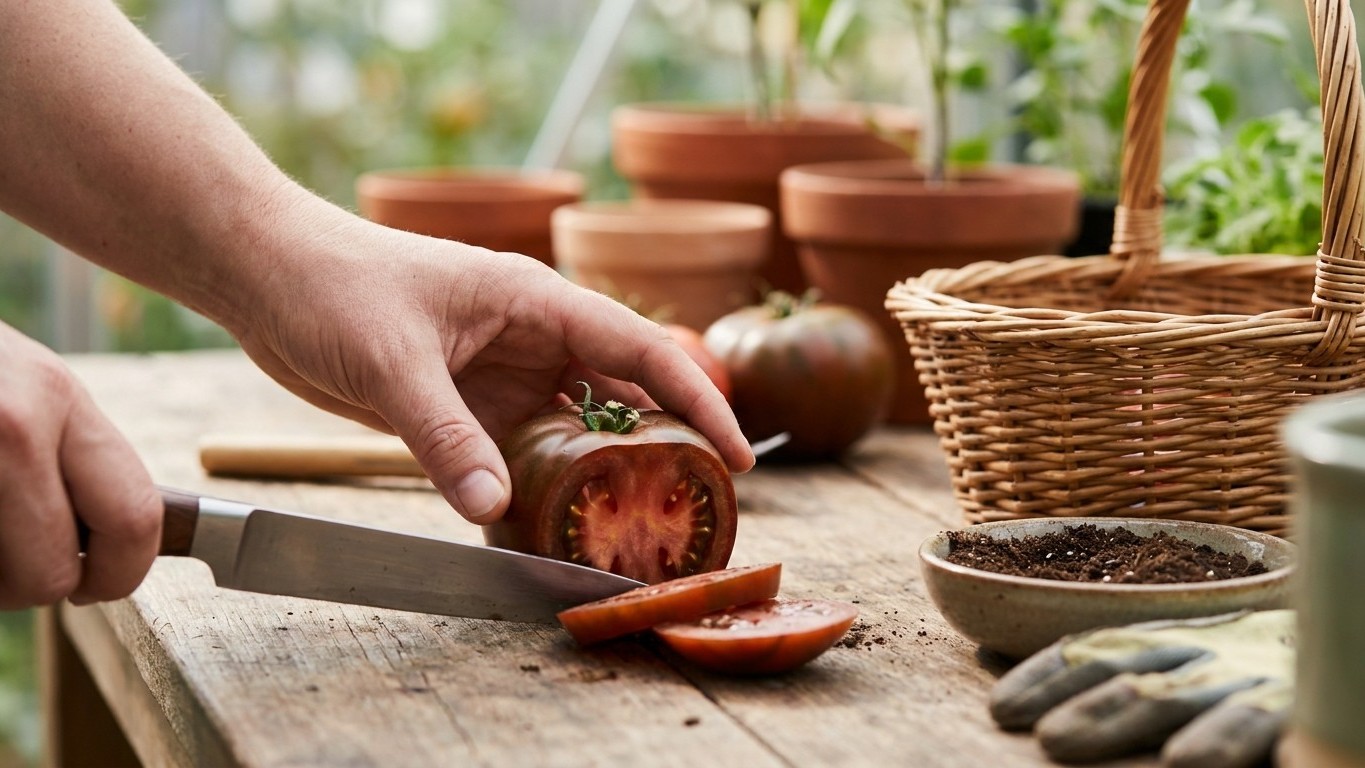
Seed catalogues list Tasmanian Chocolate at about 75 days from transplant to first ripe fruit, not from the day you sow the seed indoors. That is roughly three weeks slower than an early, determinate slicer such as Oregon Spring, which ripens all at once rather than over a long, staggered season. The fruit itself is what earns the name: large, round to slightly flattened Beefsteaks, dusky rose-brown to mahogany when ripe, with a dense, meaty flesh that holds up on a sandwich or a plate of sliced tomatoes with salt and oil rather than falling apart in a sauce pot.
Because the 80-day figure comes from seed company trial gardens, treat it as a starting point rather than a promise. Catalogue days-to-maturity numbers commonly run a week or two off in either direction depending on how warm and sunny the actual season turns out to be, so a gardener working close to a frost deadline needs to build in that slack rather than count on the printed number to the day.
What Tasmanian Chocolate is good for
The flesh is dense and holds relatively little free water, which is the actual reason it belongs on a plate rather than in a stockpot. Cut a slice and it keeps its edge; it doesn’t slump into juice the way a wet-fleshed tomato does. That firmness is what makes a slicing tomato a slicing tomato: the cell walls and pulp-to-gel ratio are built to stay intact under a knife, not to break down fast over heat. A paste tomato earns its name from the opposite trait, low water and collapsing flesh that reduces to sauce in minutes without needing to boil off a panful of liquid; put a slicer like this one in that pot instead and you spend an hour cooking down water that was never going to disappear on its own.
So the plain use here is sandwiches, burgers, and a platter of sliced tomatoes with salt, oil, maybe basil, where the point is to taste the tomato itself rather than something it’s been reduced into. The chocolate-brown color adds nothing to how it cooks, but it does mean slices look different from the usual red on a plate, which matters if presentation is part of why you’re growing it.
On taste, what’s documented is that this variety is described as carrying strong, concentrated flavor for its heirloom type, the kind of statement seed growers make about intensity rather than a specific balance of sweet and acid. Nothing more precise than that has been published, so don’t expect a breakdown of how tart or sugary it runs compared to other chocolate-colored heirlooms. What the slicing category tells you reliably is texture and use, not the exact flavor profile, and that’s as far as the facts will take you before you grow it and taste it yourself.
Where it ripens in time, and where it is a gamble
Start with the frost-free window a local weather station actually records, then work backward. Subtract roughly two weeks after the last frost date before it is safe to set transplants out, since Tasmanian Chocolate is a tender crop with no cold tolerance. Subtract the 75 days to maturity from what is left. Whatever remains is the margin: the number of days between the first ripe tomato and the first fall frost, and the only stretch you actually get to pick a crop rather than just watch one ripen.
Short-season country: the Arctic and near-Arctic
That arithmetic breaks badly in short-season country. In the Yukon, using Whitehorse as the reference station, transplants go out in mid June and the first fruit would not color until early September, roughly eight days after the average first frost. Tasmanian Chocolate does not ripen outdoors there at all without protection. Nunavut, measured at Rankin Inlet, comes up three days short by the same math, and both territories accumulate far too little seasonal heat for an 80-day beefsteak to finish even where the frost date allows a few more weeks, so the only path to a ripe fruit is a greenhouse or a poly tunnel.
Move south and the numbers turn from impossible to merely tight. The Northwest Territories, at Yellowknife, gives about 27 days of margin after transplants go out in early June, and Alberta, measured at Calgary, gives about 29 days after an early-June set-out. Both counts describe a single flush of fruit with no room for a cool August to push ripening later, which is exactly the kind of year that leaves the crop unfinished on the vine. Manitoba (Winnipeg) and Saskatchewan (Saskatoon) land in the low thirties for margin, borderline enough that growers there commonly reach for black plastic mulch to warm the soil faster and shave a few days off the wait, or start the crop under a low tunnel.
Long-season country: where margin isn’t the limit
Further south, the margin stops being the limiting factor at all. Washington, measured at Seattle, and Texas, at Houston, both carry well over four months of slack between first ripe fruit and first frost, and Louisiana (New Orleans) and Nevada (Las Vegas) run even wider. In none of those places does the calendar threaten the crop. What threatens it there is heat, covered in the next section.
| Territory (station) | Set out | First ripe | Margin to frost | Verdict |
|---|---|---|---|---|
| Yukon (Whitehorse) | Mid June | Early September | -8 days | Not possible outdoors |
| Nunavut (Rankin Inlet) | Early July | Mid September | -3 days | Not possible outdoors |
| Northwest Territories (Yellowknife) | Early June | Late August | 27 days | Risky, one flush only |
| Alberta (Calgary) | Early June | Mid August | 29 days | Risky, one flush only |
| Manitoba (Winnipeg) | Early June | Mid August | 33 days | Greenhouse or mulch helps |
| Saskatchewan (Saskatoon) | Early June | Mid August | 34 days | Greenhouse or mulch helps |
| Texas (Houston) | Mid February to mid March | Late May | 186 days | Comfortable, watch summer heat |
| Louisiana (New Orleans) | Early to late February | Early May | 223 days | Comfortable, watch summer heat |
The two ways a season goes wrong
A frost-free window long enough on paper does not guarantee a crop, and Tasmanian Chocolate is slow enough at 75 days that both failure modes below matter more for it than for a quick 55-day cherry tomato.
Too little heat, even with enough time
In the northern territories above, the frost-free window can look adequate while the total warmth the plant receives over that window stays short. A tomato needs a running total of warm days, not just a string of days above freezing, to push a flower into a ripe fruit, and in Northwest Territories and Alberta that seasonal heat total runs low enough that even a plant which technically has the calendar days to reach 80 will ripen its fruit late or not at all in a cool year. Fruit set has its own separate threshold too: pollen does not shed well once night temperatures drop into the high 40s Fahrenheit, so a run of chilly nights right after transplant can cost a grower the earliest flush of blossoms before the heat problem ever comes into play.
Too much heat, in the wrong months
Above about 86 degrees Fahrenheit, tomato pollen turns sterile and blossoms drop without setting fruit, which is why growers in South Carolina, Florida, Texas, Nevada and Louisiana describe two tomato seasons a year, spring and fall, rather than one long one. For an 80-day variety like Tasmanian Chocolate that matters more than for a fast cherry tomato, since the plant needs to clear its full maturity window before the hottest stretch of summer arrives, or it needs to be timed so its second flush finishes after the heat breaks in early fall. Either way, the wide margins in the table above are a calendar allowance, not a guarantee that every one of those days is usable for fruit set.
What it resists, and what it does not
Tasmanian Chocolate is an heirloom, and heirlooms are rarely bred for the disease-resistance codes printed on hybrid seed packets. Seed catalogues list no disease-resistance codes for this variety, unlike a modern hybrid carrying letters such as V, F or N for verticillium, fusarium and nematode tolerance. That absence is worth stating plainly rather than glossing over, because a gardener who assumes an heirloom carries the same built-in protection as a hybrid slicer is the one who loses the crop to a disease a resistant variety would have shrugged off.
Where the real risk lies
In practice that means Tasmanian Chocolate is as exposed as most other open-pollinated beefsteaks to early blight, late blight, and the soilborne wilts, verticillium and fusarium, that build up in soil where tomatoes or their relatives have grown repeatedly. None of those are guaranteed, and plenty of home gardens grow this variety for years without a serious outbreak, but the plant has no genetic fallback if conditions favor the disease.
The practical response is cultural rather than chemical: rotate tomatoes and their relatives (peppers, eggplant, potatoes) out of the same soil for a few years where space allows, stake the vine well clear of the ground so lower leaves are not sitting in splashed soil, and remove the lowest leaves as the plant grows to keep air moving through the canopy. None of that makes the plant resistant. It reduces the odds the disease finds the plant in the first place, which for a variety with no resistance built in is the only lever a grower actually has.
Growing it without the usual mistakes
Because Tasmanian Chocolate is indeterminate, it needs a completely different plan from a determinate variety like Oregon Spring, which sets one flush of fruit at a fixed height and stops. This vine keeps growing all season, so a small tomato cage will not hold it past midsummer. Plan on a sturdy stake driven deep at planting time, or a heavy-gauge cage built for a six-foot plant, and commit to tying the main stem up as it grows rather than trying to add support after the vine has already sprawled.
Spacing, pruning, and feeding
Give each plant more room than a compact variety needs, since a sprawling indeterminate vine with poor airflow around it is exactly the setup that invites the early blight and wilts covered above. Prune the suckers below the first flower cluster to channel the plant’s energy into the main stems, but do not strip the plant bare. A completely leafless vine in July sunburns its own fruit.
Feed generously with nitrogen early to build the vine, then cut nitrogen back once the first fruit sets. A Tasmanian Chocolate plant that keeps getting heavy nitrogen through midsummer puts on vine and leaf at the expense of the fruit it is supposed to be ripening on an already slow 80-day clock, which is the single most common mistake with a long-season beefsteak like this one.
- Water evenly rather than letting the soil dry out and then soaking it, since irregular watering cracks the thin skin these dusky beefsteaks are known for.
- Mulch to hold soil moisture steady through the stretch of summer when the fruit is sizing up.
- Start seed indoors early enough that the transplant is a sturdy six to eight weeks old by set-out time, since this variety has no speed to spare once it is in the ground.
Anyone new to growing tomatoes at all benefits from reading a general guide to tomato varieties before choosing a slow beefsteak like this one as a first attempt, since the spacing, staking, and feeding habits that suit a fast cherry tomato or a compact Harvest Moon plant will not suit this one.
Common questions
Is Tasmanian Chocolate the same as Black Krim?
No, they are separate heirloom varieties that share a similar dusky brown-red color and a broadly similar Eastern European lineage, but they are distinct cultivars with their own seed lines. Do not substitute one for the other and expect identical days to maturity or fruit size.
Can I grow Tasmanian Chocolate in a container?
Not comfortably. It is a tall, sprawling indeterminate vine that wants a deep root run and a sturdy stake, and a container large enough to support that growth for a full season is bulkier than most patio growers want to manage. A determinate or dwarf variety suits a pot far better.
Why are my Tasmanian Chocolate tomatoes cracking?
Cracking on this variety is almost always uneven watering, a dry spell followed by a heavy soak or a hard rain, rather than a disease. Keep soil moisture steady with mulch and a regular watering schedule and the cracking largely stops.
How many plants do I actually need?
Two to three plants supply plenty of slicing tomatoes for an average household across the season, since each indeterminate vine keeps producing fruit in waves rather than delivering everything at once. Growers canning or preserving in bulk plant more, but for fresh eating a small number of well-supported vines outperforms a crowded row of stressed ones.