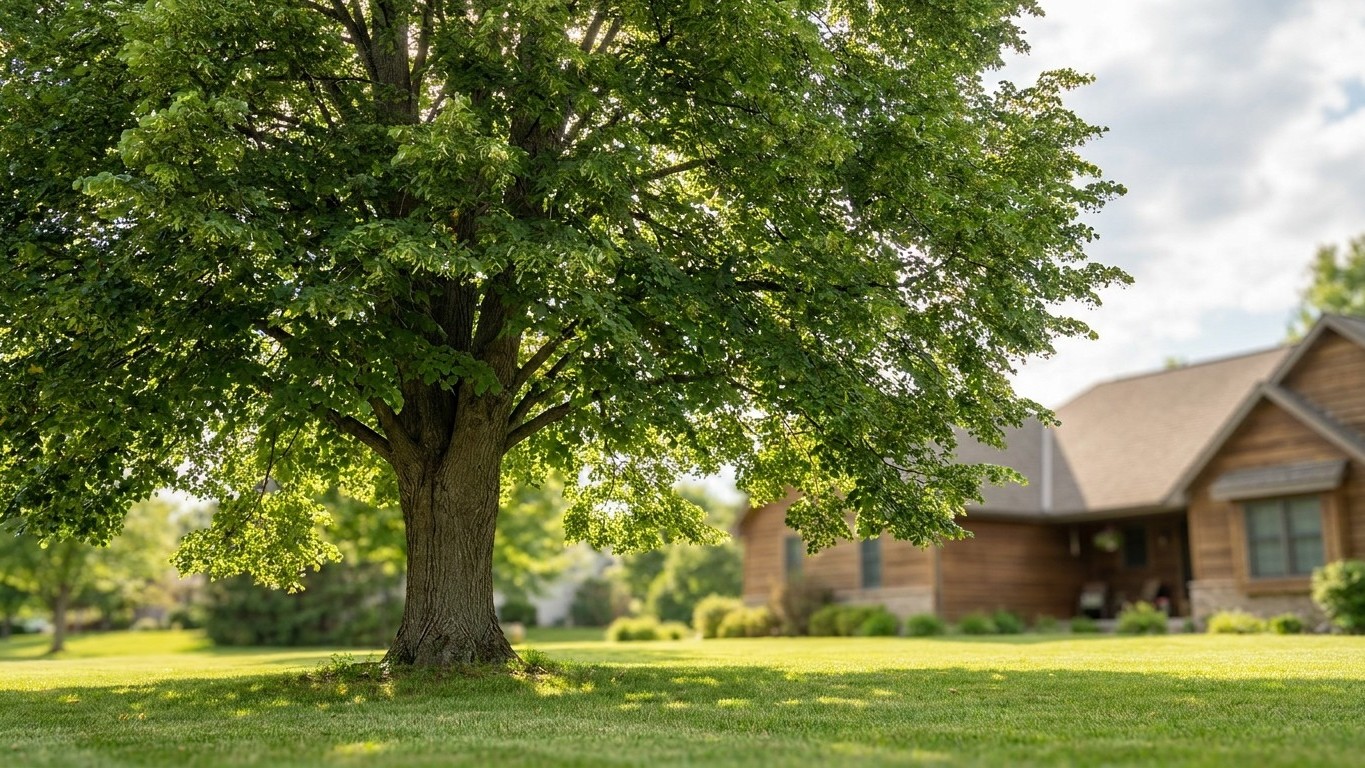

Tilia americana, better known as American basswood, American linden, or simply basswood, is a large deciduous shade tree hardy across USDA zones 3a through 8b. At maturity it spans anywhere from 24 feet to more than 60 feet wide, depending on habit and growing conditions, which means the real question for most homeowners isn’t whether it will grow. It’s whether the spot they have in mind can hold it.
Where it will and will not survive

The USDA hardiness range for this tree runs 3a to 8b. Below the bottom of that range, winter temperatures drop past what this tree’s wood and root system can reliably survive. Above the top, summer heat and a longer, more humid growing season push conditions outside what the species tolerates over time.
A hardiness range describes survival, not comfort. A tree rated to the coldest edge of its zone may survive there but never put on the vigorous growth it would show three or four zones warmer. The same logic applies at the hot end: surviving zone 8b summers isn’t the same as thriving in them. If your site sits right at either edge of this range, treat the tree as a candidate that needs watching in its first several winters and summers, not a sure thing.
None of this tells you which zone you’re actually in, and guessing is where most planting mistakes start. Hardiness zones shift by county, sometimes by elevation within the same county, and a five-mile drive can move you from one zone to the next. Check your specific location against the hardiness zone guide on this site before you commit a planting spot to this tree.
The source behind this tree’s growing data is the North Carolina Extension Gardener Plant Toolbox. The USDA hardiness range itself is a national standard, so citing 3a-8b here is accurate no matter where you garden. But that same source also classifies this tree as a “Native Plant,” and in its terminology that specifically means native to the southeastern United States, not native everywhere it happens to survive. A tree can be hardy across eight zones and still be an introduced species outside the region it evolved in, a distinction worth keeping in mind if you’re planting with regional ecology in mind.
The mistake that costs the most: space
The source gives space at maturity for this tree as two figures, not one: 24 to 60 feet, or more than 60 feet. That’s not a typo. It reflects real variation in how this tree grows depending on habit, and both are documented outcomes for it. Either way, you’re planning for a canopy that can eventually rival a small house in width.
Here’s why this is the expensive mistake, more expensive than picking the wrong soil or watering wrong the first summer. A tree planted too close to a structure doesn’t show the problem right away. It looks fine at year two, still fine at year five, maybe a little tight by year eight. Then somewhere around year ten to fifteen, roots are lifting a walkway, branches are scraping a roofline, or the canopy has grown into overhead lines. At that point the fix isn’t a prune. It’s often removal, which costs far more than the extra ten feet of clearance would have cost in planning time.
Before digging, run through these checks:
- Look up: note any overhead utility lines and how far the mature canopy width would reach toward them.
- Call before you dig to mark underground utilities, then measure how close the planting hole sits to any buried line.
- Measure the distance to the nearest wall, foundation, or driveway, and compare it to half the mature spread, since canopy and roots extend roughly that far from the trunk in each direction.
- Check for a septic field or leach line anywhere within that same radius.
- Walk the site at different times of day and note which direction a full-grown canopy would cast shade, especially onto vegetable beds, a neighbor’s yard, or windows you rely on for winter light.
None of this rules the tree out. It just means the planting spot needs enough open ground in every direction, not just enough space for the sapling you’re holding.
The site it actually wants
This tree isn’t fussy about a single ideal soil. Rather than one preferred condition, it tolerates a spread of light levels, textures, and pH values. Treat the table below as what it accepts, not what it demands.
| Condition | What this tree tolerates |
|---|---|
| Light | Full sun (6+ hours direct) or partial shade (2-6 hours direct) |
| Soil texture | Clay, loam (silt), or sand |
| Soil pH | Acid (below 6.0), neutral (6.0-8.0), or alkaline (above 8.0) |
| Drainage | Good drainage, consistently moist, or occasionally dry |
That’s a wide window. Clay and sand sit at opposite ends of how soil drains and holds nutrients, and this tree is listed as accepting both, along with the loam in between. Same story with pH: acid, neutral, and alkaline soils are all on the list.
You don’t need a lab test to get a working read on your own site. For drainage, dig a hole about a foot deep, fill it with water, let it drain once, then fill it again and time how long it takes to empty. Water gone within a few hours points to sharp drainage; standing water after a full day points to heavy, slow-draining soil. For soil texture, grab a handful of moist soil and squeeze it: sand won’t hold a shape at all, clay forms a slick ribbon that holds together, and loam falls somewhere in between.
If your results land toward standing water for more than a day, that’s the one condition worth addressing before planting, since the source lists occasionally dry and moist as acceptable but doesn’t include waterlogged. Raising the planting area slightly or shifting the spot a few feet uphill solves this more reliably than amending the soil in place.
Planting it so it establishes
Getting a young tree through its first year or two matters more than almost anything you do afterward, and most failures trace back to a handful of avoidable errors at planting time.
- Pick the planting season using the frost-timing guidance in the hardiness zone guide for your area rather than a fixed calendar month.
- Dig the hole wide, roughly two to three times the width of the root ball, but no deeper than the root ball itself.
- Find the root flare, the point where the trunk widens out into the roots, before you set the tree in the hole.
- Set the tree so that root flare sits right at, or very slightly above, the surrounding soil grade.
- Tease out or cut any roots that are circling the inside of the root ball, so they grow outward instead of continuing to wrap around the trunk.
- Backfill with the same native soil that came out of the hole, without swapping in amended or bagged soil that creates a texture change at the root ball’s edge.
- Water deeply right after planting, then continue watering deeply but infrequently rather than a light daily sprinkle, so roots are encouraged to grow down and out.
- Spread mulch in a wide, shallow ring out to the drip line, keeping it several inches clear of the trunk itself.
Two mistakes account for most young tree deaths. Planting too deep, so the root flare ends up buried under soil, smothers the tree slowly over several seasons. Piling mulch up against the trunk keeps bark constantly damp and invites rot right at the base.
One more point worth being direct about: this tree’s tolerance for occasionally dry soil applies to an established plant with a root system that’s had years to spread. A first-season tree hasn’t built that root system yet, and needs regular deep watering through its first one to two growing seasons regardless of what the mature plant can handle later.
What it resists, and what it does not
Resistance means a documented tendency to hold up better against a particular stress, not a guarantee it will never show damage. A tree described as resistant to something can still be affected under extreme or prolonged conditions, whether that’s a record drought, a hard freeze, or a bad wind event.
The source’s data points to tolerance across several stress categories, including drought, dry soil, wind, fire exposure, and pollution. Here’s what that means in practical terms:
| Stress | What resistance means here | What you’d actually see |
|---|---|---|
| Drought (established tree) | Holds up through dry stretches better than a moisture-dependent species | Less leaf scorch or wilting during a dry summer, once roots are established |
| Dry soil | Tolerates soil that dries out between waterings | No need for constant irrigation on well-drained sites |
| Wind | Structurally holds up to routine wind loads | Fewer broken limbs after typical storms |
| Pollution | Tolerates roadside or urban air conditions reasonably well | Suitable near streets without unusual dieback |
Growth rate for this tree is listed as medium, and maintenance as low. A medium grower reaching over 60 feet wide still means real growth every year, so a “low maintenance” rating describes routine care, not the eventual size of the job if it’s planted somewhere the canopy has to be cut back to fit.
It’s also worth noting what this tree draws in: bees, butterflies, other pollinators, small mammals, and songbirds are all listed as attracted to it. The “Bee Tree” common name isn’t incidental, this species has a real reputation for heavy bee activity during bloom.
Common questions
Is American basswood the same tree as linden?
Yes. Linden, American linden, basswood, and lime tree are all common names used for Tilia americana in different regions. None is the official or primary name; the botanical name is what stays consistent across all of them.
Can you eat any part of this tree?
The source notes that dried flowers are used to make tea, though over-use is flagged as potentially causing heart damage. Sweet sap can be tapped for syrup, honey from the tree’s flowers is prized for flavor, and young leaves are sometimes used in salads. These are the source’s own claims, not a recommendation to forage without further guidance.
What does the fruit look like, and is it edible?
It’s described as a small, round, downy, hard, dry, cream-colored nutlet about the size of a pea, hanging from a stalk attached to a wing-like bract that helps it travel on the wind. Nothing in the source suggests the nutlet itself is eaten.
How fast will it fill in once planted?
Growth rate is listed as medium, so don’t expect a dramatic change in the first year or two. Given enough years, though, medium growth on a tree that can exceed 60 feet wide still adds up to a full-size shade tree well within a homeowner’s lifetime in that yard.