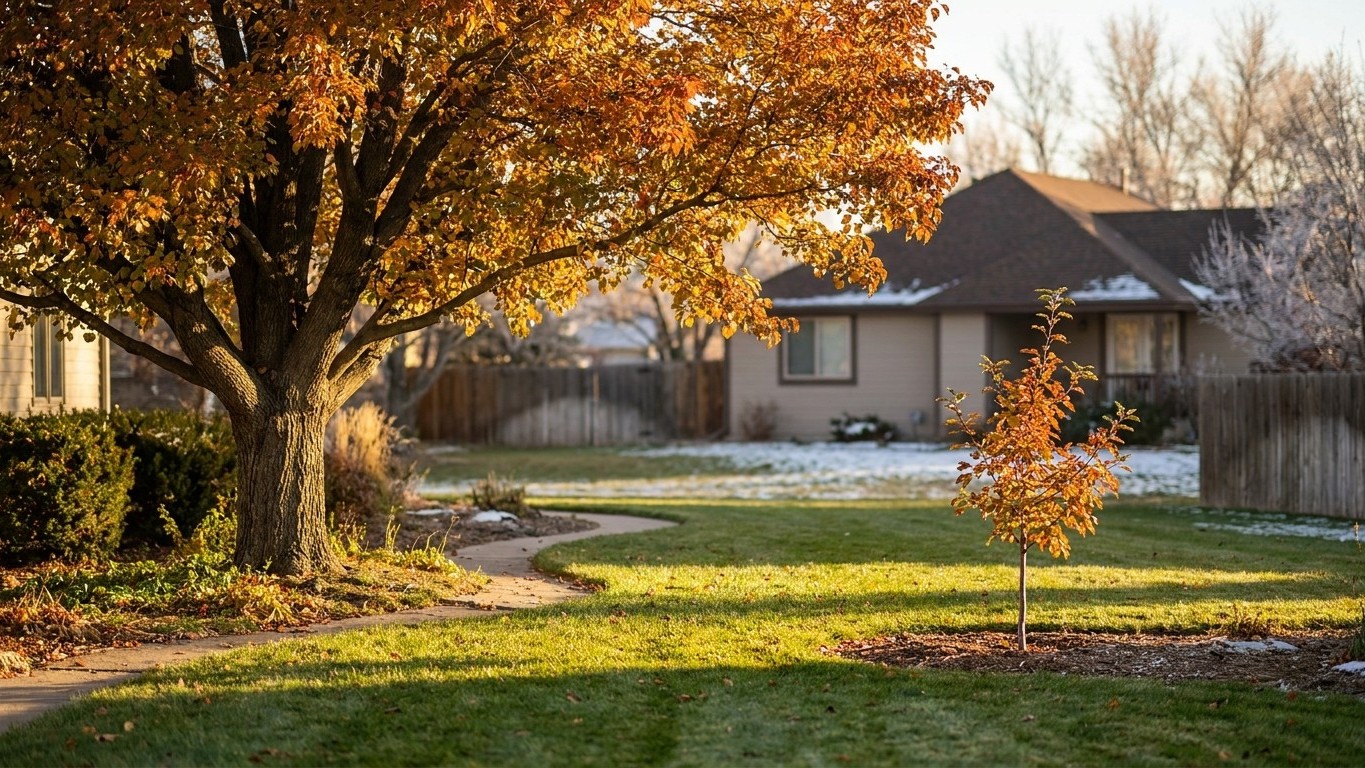

Two filters decide whether a tree, shrub, or perennial belongs in your yard: hardiness and mature size. Hardiness tells you whether the plant survives your coldest winter nights. Mature size tells you whether it fits the spot you have in mind, not just this year but in fifteen. Get both right before you fall for a plant’s flowers or fall color, and the rest of the decision gets much easier.
The limit that decides everything

Every plant profile lists a hardiness range, usually written as something like “Zones 5 to 8.” The temptation is to read that as a promise: this plant will thrive here. Read it the other way instead. It’s a boundary that tells you where the plant will not survive, because the winter gets colder than its roots or bark can handle. That’s the useful direction, because a gardener who ignores it loses a young tree to a single hard freeze, often in its second or third winter, right when it looked established.
The USDA Plant Hardiness Zone Map divides North America into zones based on the average annual minimum winter temperature recorded over a multi-decade period. Each numbered zone spans a 10-degree Fahrenheit band, and each zone splits into an “a” and “b” half, five degrees apart. That letter half matters more than gardeners usually assume. A property sitting at the cold edge of Zone 7a behaves differently than one at the warm edge of 7b, even though both get lumped into “Zone 7” in casual conversation. If a plant’s range starts at 7b, planting it in a 7a garden is a real gamble, not a rounding error.
Zones shift with elevation, with distance from large bodies of water, and with how exposed or sheltered a specific spot is. A valley that collects cold air can run a full zone colder than a hillside a mile away. That means the zone printed on a regional map is a starting point, not a verdict for your exact yard. The U.S. Department of Agriculture maintains an interactive version of the map where you can enter a ZIP code and get your specific zone, and that’s the number worth writing down before you buy anything woody or perennial.
One caution worth stating plainly: a hardiness range describes survival, not comfort. A plant at the cold edge of its range may live through most winters but sulk, produce fewer flowers, or die back to the ground each year and regrow from the roots. If you want a plant that performs reliably rather than one that merely limps through, aim for the middle of its range, not the outer edge of it.
And the one people discover too late
Hardiness gets checked, soil gets checked, and then a plant goes into the ground eight feet from the house because that’s where there was room. Ten or fifteen years later, a tree canopy is scraping the roofline, roots are lifting a walkway, or a shrub has swallowed the front steps. That’s the cost of skipping the second filter: size at maturity. Unlike a hardiness mistake, which usually shows up in a year or two, a spacing mistake takes a decade to become obvious, and by then the fix is removal rather than a light pruning.
The nursery tag or the young plant in front of you is not a reliable guide to its future footprint. A tree that looks modest at five feet tall can reach forty or sixty feet with a canopy just as wide, and a shrub sold in a one-gallon pot can eventually need the space of a small room. Before digging, it pays to run through a short list of checks against the plant’s documented mature height and spread, which individual plant guides should state directly rather than leaving you to guess.
- Overhead utility wires and any structures a tall canopy could eventually reach.
- Distance to the house foundation, a driveway, or a walkway that roots or low branches could disrupt.
- What runs underground, including water, sewer, or gas lines that root systems can find over time.
- The eventual canopy width, measured from where the trunk will stand, not from the pot’s current edge.
- Which direction the mature shade will fall, and whether that shade will land on a garden bed, a patio, or a neighbor’s yard.
Notice that none of those checks involve a specific number of feet here, because that number belongs to the plant, not to a general rule. A columnar shade tree and a wide-spreading one can carry wildly different mature spreads even within the same species group, and the individual guide for each plant is where that figure lives. Treat the mature size listed there as the real distance to plan around, not the size of the plant sitting in the nursery pot.
Choosing, in the order that works
Most people choose a plant first, based on a photo or a memory of one growing somewhere else, and then try to make their yard accommodate it. That order causes most of the regret described above. Working the other direction, starting from the site and ending with the plant, filters out the mismatches before you’ve spent a season nursing something that was never going to work where you put it.
- Light. Note whether the spot gets full sun, partial shade, or full shade across a typical day, since this rarely changes without removing something else nearby.
- Drainage. Watch the spot after a hard rain. Standing water an hour later signals heavy or compacted soil, and amending drainage across a large planting area is expensive and often only partly effective.
- Space. Measure the actual distance to structures, wires, and property lines. This one cannot be changed at all once the plant is committed to that spot.
- Zone. Confirm your USDA zone and check it against the plant’s hardiness range, aiming for the middle of that range rather than its edge.
- Availability. Only now look at what fits all four conditions above and is realistically available to you.
That sequence is ordered by how expensive each factor is to change after the fact. Light and drainage can sometimes be adjusted, by removing a competing tree or improving a bed, but rarely cheaply and rarely completely. Space cannot be adjusted at all short of moving a structure. Zone is fixed by geography. Availability is the only variable with real flexibility, which is exactly why it belongs last. A plant chosen first, before the site is understood, has to be forced into whatever conditions are left over, and that’s the arrangement that produces the size and hardiness problems described above. The individual plant guides on this site are built to be checked against your site conditions in that order, not browsed as a wish list.
What is on this site
This hub sits above three groups of individual plant guides: trees, shrubs, and perennials. Each guide is built around the same two filters covered here, stating the plant’s USDA hardiness range and its mature height and spread up front, so you can check it against your zone and your site before reading any further. That structure is intentional. The hub explains the reasoning once; the individual guides apply it to one plant at a time, so you’re not re-deriving the logic of hardiness and siting for every species you consider.
The tree guides cover species suited to home landscapes at a range of mature sizes, from smaller ornamental trees to larger shade trees, each with its own documented hardiness range and canopy spread. The shrub guides follow the same pattern for woody plants smaller than trees but still permanent fixtures once established, where mature spread matters just as much relative to a foundation or a walkway. The perennial guides cover herbaceous plants that die back and return each year, where hardiness still governs winter survival even though there’s no woody trunk at stake.
One point worth stating plainly about where this data comes from. Much of the underlying plant information referenced across these guides originates from university extension sources, and North Carolina State Extension’s plant database is a common reference point in the horticulture field. Its USDA hardiness range for a given plant is a national figure and applies wherever you garden in the United States. Its regional growing advice, though, is written from a southeastern U.S. perspective, and when that source or others like it describe a plant as a “native plant,” they typically mean native to the southeastern United States specifically, not to North America as a whole. Worth checking against your own region’s native plant resources if that distinction matters to your planting goals.
A related caution applies to two phrases that show up often in plant descriptions: “deer resistant” and “drought tolerant.” Deer resistant means deer tend to avoid a plant when other food is available, not that the plant is deer proof, and a hungry deer population in late winter will eat almost anything. Drought tolerant almost always describes an established plant, one that’s had at least a full growing season to build out its root system. A newly planted specimen still needs regular water regardless of what its mature drought tolerance rating says.
Common questions
What’s the difference between a hardiness zone and a growing zone?
They’re generally the same thing in casual use, both referring to the USDA Plant Hardiness Zone Map. Some seed catalogs also reference heat zones, which measure summer heat tolerance rather than winter cold, and that’s a separate figure worth checking in hot southern climates.
Can I plant something one zone outside its listed range if I give it extra care?
Sometimes, particularly at a warm-edge microclimate against a south-facing wall, but it’s a gamble rather than a strategy. A single unusually cold winter can undo several years of otherwise successful growth, and there’s no reliable way to protect a large, established tree’s root system from an extreme cold snap.
How do I find the mature size of a specific plant before buying it?
Check the individual plant guide or a university extension plant database rather than relying on the nursery tag alone. Mature height and spread are usually listed as a range, and it’s worth planning around the top of that range rather than the average.
Does mature size change based on where I plant it?
Yes, to a degree. Available light, soil quality, and competition from nearby plants can all affect how large a plant ultimately grows and how quickly it gets there, though the genetic ceiling for its size stays roughly the same. Full sun and good drainage tend to produce fuller, sometimes larger growth than a shaded or compacted site.
Guides by state
- Acer rubrum
- Acer saccharum
- Amelanchier canadensis
- Betula nigra
- Carpinus caroliniana
- Cercis canadensis
- Cornus florida
- Ginkgo biloba
- Juniperus virginiana
- Lagerstroemia indica
- Liquidambar styraciflua
- Magnolia grandiflora
- Nyssa sylvatica
- Picea abies
- Pinus strobus
- Platanus occidentalis
- Quercus alba
- Quercus rubra
- Thuja occidentalis
- Tilia americana
- Acer rubrum: Hardiness, Size at Maturity and Where to Plant It
- Acer saccharum: Hardiness, Size at Maturity and Where to Plant It
- Amelanchier canadensis: Hardiness, Size at Maturity and Where to Plant It
- Betula nigra: Hardiness, Size at Maturity and Where to Plant It
- Carpinus caroliniana: Hardiness, Size at Maturity and Where to Plant It
- Cercis canadensis: Hardiness, Size at Maturity and Where to Plant It
- Cornus florida: Hardiness, Size at Maturity and Where to Plant It
- Ginkgo biloba: Hardiness, Size at Maturity and Where to Plant It
- Juniperus virginiana: Hardiness, Size at Maturity and Where to Plant It
- Lagerstroemia indica: Hardiness, Size at Maturity and Where to Plant It
- Liquidambar styraciflua: Hardiness, Size at Maturity and Where to Plant It
- Magnolia grandiflora: Hardiness, Size at Maturity and Where to Plant It
- Nyssa sylvatica: Hardiness, Size at Maturity and Where to Plant It
- Picea abies: Hardiness, Size at Maturity and Where to Plant It
- Pinus strobus: Hardiness, Size at Maturity and Where to Plant It
- Platanus occidentalis: Hardiness, Size at Maturity and Where to Plant It
- Quercus alba: Hardiness, Size at Maturity and Where to Plant It
- Quercus rubra: Hardiness, Size at Maturity and Where to Plant It
- Thuja occidentalis: Hardiness, Size at Maturity and Where to Plant It
- Tilia americana: Hardiness, Size at Maturity and Where to Plant It