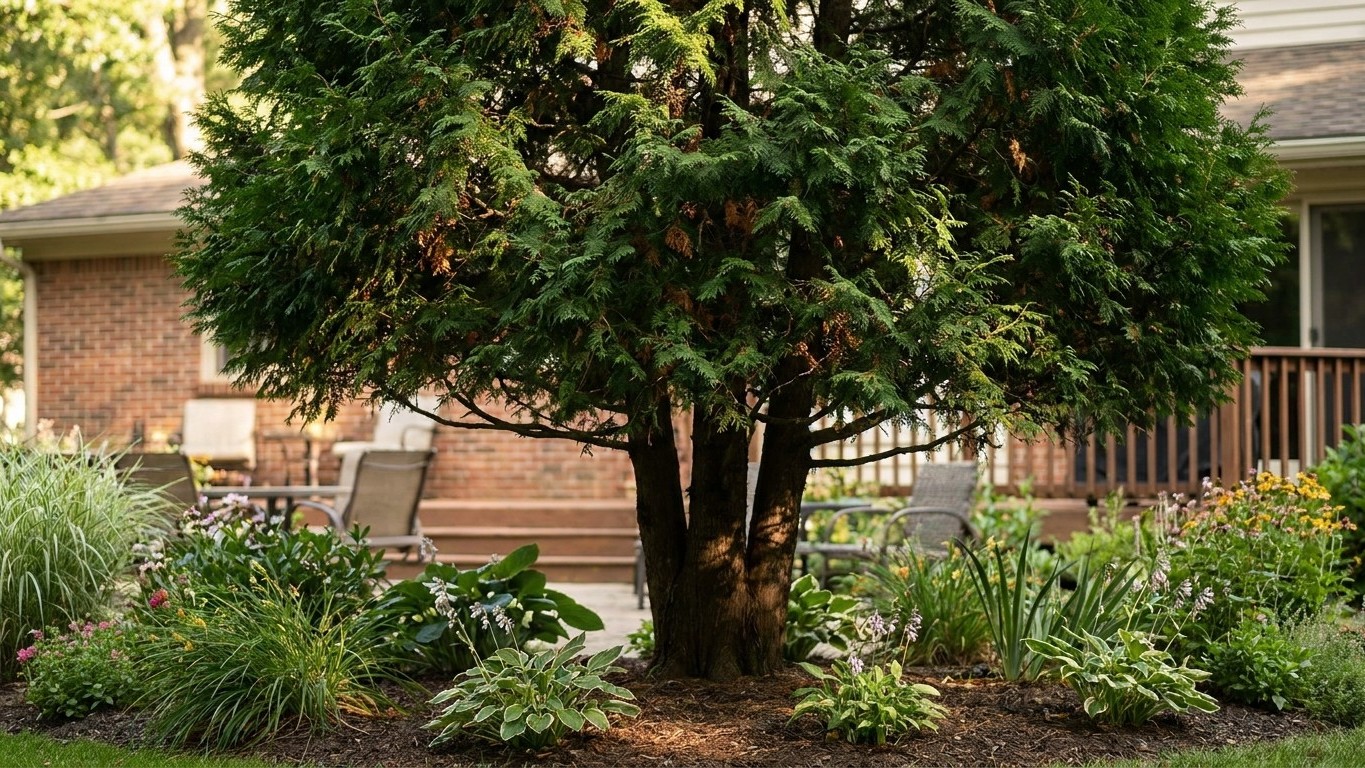

American Arborvitae, Eastern White-Cedar, and Northern White-Cedar all describe the same needled evergreen: Thuja occidentalis. None of those three names is official, and one is misleading, since this tree isn’t a true cedar at all. It survives USDA hardiness zones 3a-7b, grows slowly into a dense, pyramidal tree, and needs 24 to 60 feet of width at full size. That last number is the one that gets skipped at planting time, and it’s the one that costs the most to undo later.
Where it will and will not survive

The USDA range for this tree is zones 3a-7b, and that’s the number worth building a decision around, not the mailing address. Below the bottom of that range, in winter cold the species hasn’t adapted to, the tree dies outright rather than just sulking. Above the top of it, the plant will often still root and leaf out, but the range describes survival, not comfort. A specimen planted at the warm edge of 7b works harder through summer heat and humidity than one at 5a, and that stress tends to show up as thinner, browner interior foliage over time.
Rather than guess which side of that line a property sits on, look it up directly. The hardiness zone guide on this site breaks the range down by state, and in some cases by county.
The data behind these figures comes from the North Carolina Extension Gardener Plant Toolbox, and the USDA hardiness range is universal for this species. That source classifies the tree as a Native Plant, but the word carries a regional footnote: in that Toolbox, Native Plant means native to the southeastern United States, not necessarily anywhere else.
One more detail worth carrying into the yard for identification: the cones on this species are oblong and light brown at maturity, running 1/3 to 1/2 inch long, starting out yellow before they age and dry. If cones nearby don’t match that description, it may not be Thuja occidentalis at all. “White-cedar” suggests kinship with true cedars, the genus Cedrus, but there isn’t one.
The mistake that costs the most: space
Space at maturity for this species runs 24 to 60 feet, not the footprint of a small foundation shrub. The habit is dense and pyramidal, which is exactly why it gets planted close to a house or property line in the first place, for the screen or windbreak. What often goes unpictured is that same cone shape thirty or forty feet across, still growing and still casting a widening triangle of shade.
The trouble with a slow, dense evergreen is timing. This species carries a slow growth rate, so the gap between “looks fine right where it is” and “is now touching the siding or blocking a window” can run a decade or longer. By the time the mismatch is obvious, pruning won’t fix it, since cutting back into old wood leaves a permanent bare patch. At that point removal is the only real fix, and it costs far more than the few minutes it takes to measure a site correctly before digging.
Before putting a shovel in the ground, run through a short checklist:
- Look up, not just at the planting hole. Overhead utility lines or a roofline within the eventual 24-to-60-foot spread will end up tangled in mature growth.
- Know what runs underground before you dig. Septic lines, water service, and buried cable often sit closer to the surface than expected, and roots follow them.
- Pace off the mature width in every direction from the planting spot, using the 60-foot end of the range if unsure, and mark it on the ground.
- Check the eventual height against nearby structures, since the dense, pyramidal habit blocks light on the shaded side of a bed for good.
- Note which way the canopy will shade a vegetable garden, a solar panel, or a neighbor’s window as the tree closes in on its full spread.
None of that takes long. Skipping it is what turns a tree planted with good intentions into the one a homeowner is paying to have removed fifteen years later.
The site it actually wants
The North Carolina Extension Gardener Plant Toolbox lists a range of conditions this species tolerates, not one narrow recipe.
| Condition | What it tolerates |
|---|---|
| Light | Full sun (6 or more hours of direct sun) or partial shade (2 to 6 hours) |
| Soil texture | Clay or loam (silt) |
| Soil pH | Alkaline (above 8.0) or neutral (6.0 to 8.0) |
| Drainage | Good drainage, moist soil, or soil that runs occasionally dry |
Read across that table and the pattern is tolerance, not a single preference. This tree accepts heavy clay and silty loam alike, alkaline and neutral soil alike, and ground that stays evenly moist about as readily as ground that dries out between rains. Flattening that into “plant it in rich, well-drained loam” throws away the useful part: how much latitude the species actually has.
Checking a site doesn’t require lab equipment. For drainage, dig a hole about a foot deep, fill it with water once and let it drain, then fill it a second time and time how long that fill takes to disappear. Gone within a few hours points to fast, sandy-leaning drainage; still standing after eight hours or more points to heavy, slow soil, which this species can handle better than most evergreens.
For pH, a basic home soil test kit or a sample sent to a local extension office gives an actual number; guessing from soil color or nearby plants isn’t reliable enough for a planting meant to last decades. If a test comes back strongly acidic, well outside the neutral-to-alkaline range this species tolerates, that’s the one condition it doesn’t cover, and it’s worth amending the soil or choosing a different spot.
Planting it so it establishes
Getting a young Thuja occidentalis through its first year comes down to a handful of steps, done in order.
- Pick the season using frost-date guidance for your area rather than a fixed month.
- Dig the hole wide, not deep: two to three times the width of the root ball, no deeper than the root ball itself.
- Find the root flare, the point where the trunk widens into roots, and set it at or very slightly above the surrounding soil grade.
- Tease out any circling roots by hand, since roots wrapped from too long in a nursery pot keep circling underground for the tree’s whole life if left alone.
- Backfill with the same soil that came out of the hole. Heavily amending just the planting hole creates a soft-sided pocket that holds water or discourages roots from exploring native soil.
- Water deeply and infrequently rather than a little every day, so moisture reaches the full depth of the root ball instead of just the top inch.
- Mulch two to three inches deep, pulled back from the trunk itself.
Two mistakes account for most of the young trees that fail to establish. Planting too deep, so the root flare ends up buried under grade, suffocates roots slowly and is a common reason a newly planted evergreen declines over its first two seasons without an obvious cause. Piling mulch against the trunk does something similar from the outside in, trapping moisture against bark and inviting rot at the base.
It’s also worth saying plainly: the drought tolerance sometimes attached to this species describes an established plant, one that’s had at least a full season or two to grow roots into the surrounding soil. A tree in its first year hasn’t done that yet and needs regular, deep watering regardless of how tolerant the mature version will eventually be.
What it resists, and what it does not
Resistance, on a plant label, is a tendency, not a guarantee. A species listed as resistant to wet soil can still struggle if water never drains at all; it’s a matter of degree.
| Challenge | What resistance means here | What you’d actually see |
|---|---|---|
| Wet soil | Tolerates periods of soggy, poorly drained ground better than many evergreens | Roots hold up through a rainy stretch or a low spot that stays damp, rather than quick dieback |
| Pollution | Tolerates exposure to air and soil pollutants common near roads and developed sites | Foliage holds its color and density in a roadside or urban planting rather than thinning early |
| Black walnut | Tolerates juglone, the compound black walnut roots release into surrounding soil | Can grow within a black walnut’s root zone without the stunting or dieback many other species show there |
Growth rate for this species is listed as slow, and maintenance as low, a combination that reads as easygoing but carries its own consequence. A slow grower takes its time revealing problems: a poorly sited tree won’t announce the space mistake covered above quickly, but simply keeps closing the gap toward a wall or window a few inches at a time until the mismatch is impossible to ignore. Low maintenance here means infrequent pruning and no unusual feeding regime once established, not that the siting decision made on day one stops mattering.
The dense, pyramidal form also draws small mammals and songbirds looking for cover, worth factoring in if the site sits close to a feeder or vegetable bed they might raid.
Common questions
Is Thuja occidentalis the same plant as arborvitae?
Yes. American Arborvitae is one of its common names, alongside Eastern White-Cedar and Northern White-Cedar, even though it isn’t a true cedar in the botanical sense.
How fast does Thuja occidentalis grow?
Its growth rate is classed as slow, which means the space mistake covered above can take a decade or more to become obvious rather than showing up in the first few years.
Does it need full sun to grow well?
No. It tolerates both full sun (6 or more hours of direct light) and partial shade (2 to 6 hours), according to the growing-condition data for the species.
How far from a house should it be planted?
Measure roughly half the mature width, using the upper end of the 24-to-60-foot range if the eventual size isn’t known, out from the planting spot toward any wall, drive, or line, rather than relying on how small the tree looks at planting time.