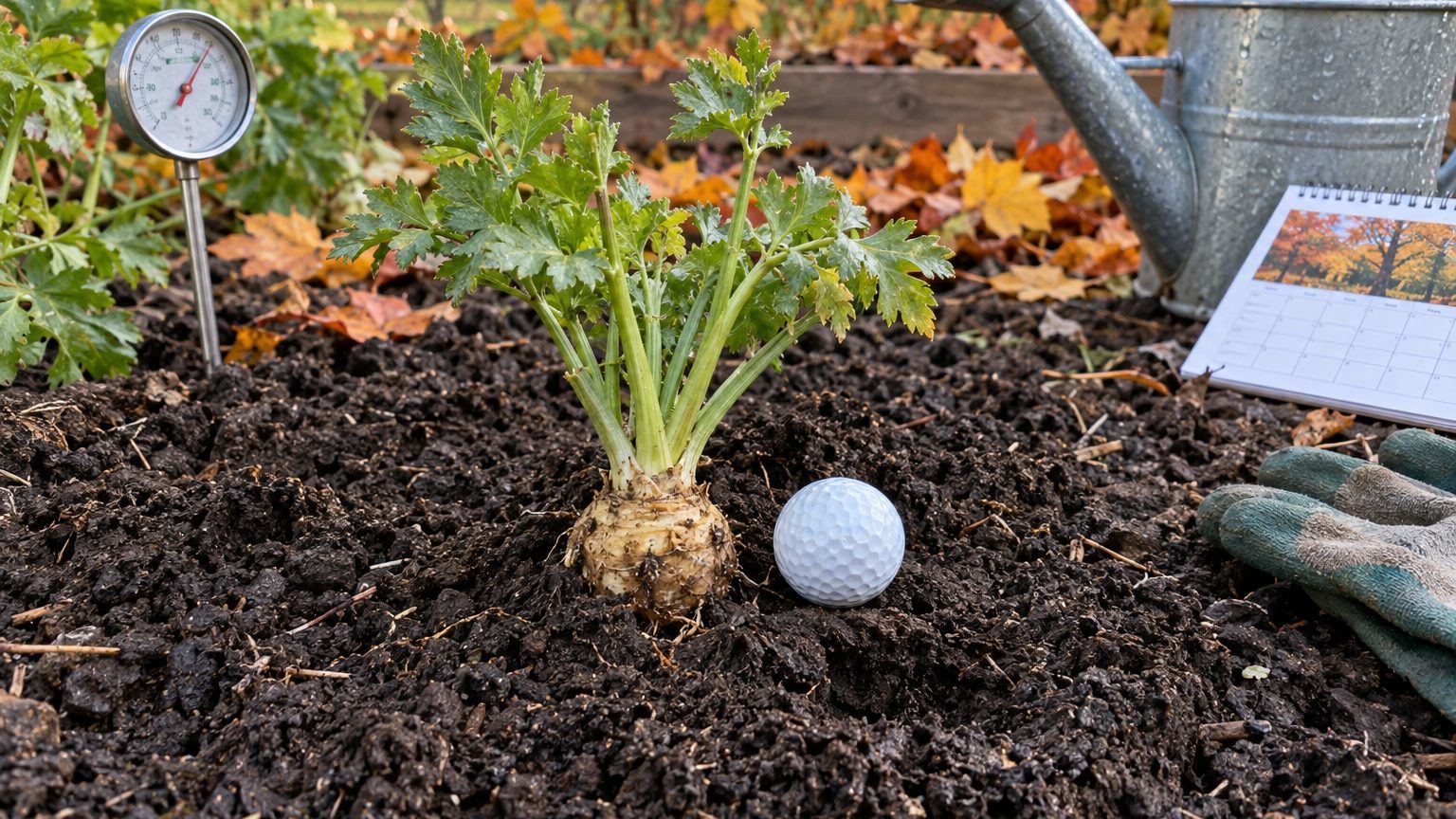

A celeriac that stays the size of a golf ball by October is rarely a bad-seed problem. Almost every time, it traces back to one of four things: a late or cold start, a bolting-inducing chill in spring, uneven watering, or a root crown buried too deep. Celeriac (Apium graveolens var. rapaceum) is the slowest member of the group covered in Celeriac, Kohlrabi, Horseradish and Jerusalem Artichokes, and it punishes shortcuts more than the others do.
Its wild ancestor grows in wet, salty marshes, and the cultivated root still behaves like it. It wants a long season, cool but not cold nights, constant moisture and plenty of food. Miss on two of those and you get a knob that’s more bark than bulb.
The calendar problem: celeriac needs about 200 days
Seed to harvest runs roughly 200 days, give or take, and that number surprises people who are used to a radish that finishes in a month. Plan on about 100 to 120 days in the ground after transplanting, plus eight to ten weeks indoors beforehand. Count backward from your average first fall frost and the seed-starting window lands in February or early March for much of the country.
Starting late is the most common reason for a small root. A gardener in Minnesota who sows seed in mid-April has already lost the race, because the plant needs the cooling nights of late summer and early fall to do much of its bulking. Cut the early weeks short and the crop reaches frost with leaves but little root.
Germination is slow too. Seed needs light to sprout, so press it onto the surface of the mix instead of burying it, and keep the tray around 60 to 70°F. Two to three weeks of waiting is normal. Seedlings then sit at a pace that tests your patience, and that’s fine. Nudging them with heavy fertilizer at this stage tends to produce leggy, weak transplants rather than faster ones.
Gardeners in the South have the opposite problem. In zones 8 and warmer, summer heat stalls the root, and a spring planting that sulks through July is typical. Many growers there treat celeriac as a fall crop, setting transplants out in late summer so that the root swells through the cooler months. Northern growers get the long runway; southern growers get the mild winter. Either works when matched to the right planting date.
A cold snap in spring can ruin the crop before it starts
Celery relatives are biennials. Their instinct is to grow leaves in year one, then flower in year two. A long chill in the seedling stage, generally a week or more below about 50°F, can convince young plants that winter has come and gone. The result is bolting: a flower stalk shoots up in the first summer and the root turns tough, woody and stringy.
Once a plant bolts, there’s no reversing it. Pull it and move on.
Prevention is mostly about timing and protection:
- Harden seedlings off gradually over seven to ten days, and keep them away from temperatures near 50°F during that period.
- Wait until nighttime lows sit consistently above 50°F before transplanting, even if the last-frost date has technically passed.
- Keep row cover or a few cloches on hand for a surprise cold night in May.
- If your spring is long and cool, choose a bolt-resistant variety listed as such in seed catalogs, rather than guessing.
Bolting is easy to confuse with simple lack of swelling, but the two look different. A bolted plant sends up a thick central stem and the root feels light and fibrous. An underperforming plant stays squat, and the root is firm but small.
Water, food and the soil underneath
Celeriac drinks. Aim for about 1 to 1.5 inches of water a week, and more in sandy soil or a hot stretch. The trouble isn’t just dryness. It’s the swing between dry and soaked. When the soil dries out and then gets a deluge, the root can crack, grow hollow or pithy in the center, and stall for weeks while it recovers. A 2 to 3 inch layer of straw, shredded leaves or grass clippings (untreated with herbicide) holds moisture steady and keeps the shallow feeder roots cooler.
Soil matters as much as water. Celeriac does best in loose, humus-rich ground with a pH around 6.0 to 7.0. Heavy clay compacts around the swelling root and slows it, so work in several inches of finished compost before planting. In very sandy beds, add compost to hold water, since the root can’t swell evenly if it’s constantly parched.
The plant is a heavy feeder, but the type of feeding counts. Mix compost in at planting and side-dress with a balanced organic fertilizer partway through the season. Too much nitrogen, especially late, pushes big leafy tops and a modest root. A soil test through your state’s cooperative extension office costs little and tells you whether you’re short on potassium or phosphorus, which both feed root development.
Another culprit worth checking is boron. Members of the celery family are sensitive to low boron, which shows up as brown, corky or hollow patches inside the root. It’s most common in alkaline or sandy soils and in dry spells that limit uptake. A soil test will flag it, and you shouldn’t add boron blindly, because the margin between too little and too much is thin.
Planting depth and the side roots
Here’s a mistake that looks harmless. Many gardeners plant celeriac the way they’d plant a leek or a tomato, burying the stem deep. The swelling part of the plant is the base just at the soil surface, and burying it can produce a smaller, more irregular root with a lot of thin side roots reaching out. Set transplants so the crown sits at or just barely above soil level, at about 12 inches apart in rows roughly 18 to 24 inches apart.
Celeriac also grows a beard of fibrous roots from its sides. Many growers pull back a bit of soil in midsummer and snip off those lateral roots with scissors, taking care not to wound the main bulb. It tidies the root and makes it easier to clean in the kitchen, though the evidence that it increases size is mostly anecdotal. Do it gently, or skip it.
Pests, disease and crowding that hold roots back
A few outside factors can look like a swelling problem. Carrot rust fly maggots tunnel into celeriac as well as carrots, leaving brown, rotted channels, and covering the bed with fine insect netting from planting time is the dependable fix. Celery leaf miner leaves pale, blotchy trails in the foliage, and leaf spot diseases such as Septoria cause brown speckling that reduces the leaf area feeding the root. Remove badly affected leaves, water at soil level rather than overhead, and rotate the bed so celery relatives, including parsley, parsnips and carrots, don’t return to the same ground for at least two or three years.
Crowding is quieter but just as limiting. Plants set at 6 inches apart will compete for water and nutrients, and the roots will top out smaller than those given a full 12 inches. Weeds are the same story. Celeriac is shallow-rooted and slow in its early weeks, so it loses badly to anything that grows faster beside it.
Reading a stunted crop and deciding what to do
When a bed disappoints, work through the evidence before blaming the variety. A thick flowering stalk points to bolting from a cold spell. Healthy foliage with a tiny root suggests too little time, too much nitrogen or too little water. Cracked or hollow roots point to uneven moisture or boron. Tunnels and rot at the base point to rust fly. Notes kept in a garden journal, even a few lines on transplant date and weather, make next year’s diagnosis far faster.
A small root is still food, though. Roots of 2 to 3 inches across peel and cook the same way as larger ones, and they’re less likely to be pithy in the center. Most gardeners aim for 3 to 4 inches, roughly the size of a baseball or a little larger, and anything beyond that is a bonus. Harvest timing also matters because the plant keeps working into the cool weather. Roots can tolerate light frost, and a flush of late growth is common, so check Which of These to Leave Out for the Frost before deciding when to dig. Pulling too early forfeits that last stretch of bulking.
If the long haul isn’t working for your climate or schedule, there’s an easy fallback. Kohlrabi: The Fastest Crop Here, and a Stem Not a Root matures in a fraction of the time and fits into a short season or a gap left by a failed bed. Many gardeners run both, with kohlrabi as the quick win and celeriac as the patient project.
One last nuance that saves a few frustrated seasons: nursery transplants, where available, skip the slowest and riskiest stage entirely. Buying a half-dozen healthy starts in late spring costs far less than a failed tray, and it still gives the root a full summer to swell, as long as they go in the ground after the cold nights have passed.