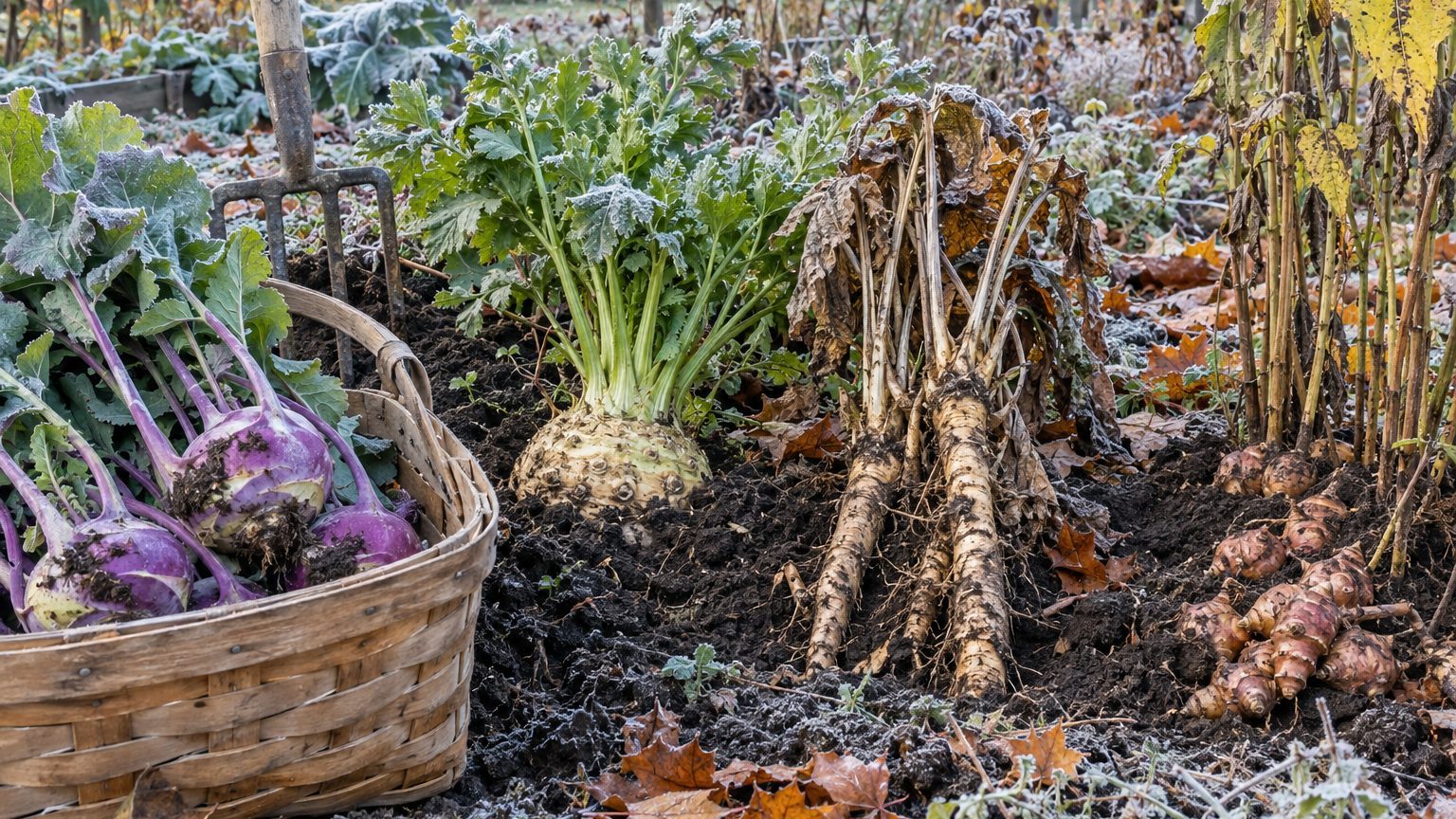

Leave horseradish and Jerusalem artichokes in the ground. Lift kohlrabi before a hard freeze. Celeriac sits in between: it shrugs off light frost, but it should come out before temperatures sink into the mid-20s or the soil starts to stiffen. That’s the quick version of how frost and harvest timing work for unusual roots, and the reasons behind it are worth knowing, because they change when you pick up the fork.
If you’re new to this group of crops, the overview in Celeriac, Kohlrabi, Horseradish and Jerusalem Artichokes covers what each one is and how it grows. This page deals with one narrow question: what to do as the first cold nights arrive.
The quick sort: stay, go, or wait
Each of the four roots has a different relationship with cold, and treating them as one batch is how people lose crops or dig things far too early.
- Jerusalem artichokes: leave in the ground all winter and dig as needed.
- Horseradish: leave in the ground until the tops are frosted, then dig through late fall or wait for early spring.
- Celeriac: tolerates light frost, so wait, but lift before a hard freeze.
- Kohlrabi: harvest before a hard freeze, and sooner if the bulbs are already large.
Early October is a good moment to sort this out. In northern Minnesota, Maine and much of the Upper Midwest, the first frost often shows up by late September or the first days of October. In Pennsylvania or Ohio it usually lands mid-October to early November, and in Georgia or the Carolinas it can hold off until November. Your local extension office publishes average first-frost dates for your county, and that date is a better planning tool than anything on a seed packet.
Horseradish and Jerusalem artichokes: let the cold work for you
These two are perennials by temperament, and cold is part of their normal year. Horseradish is hardy through USDA zones 3 to 9 and Jerusalem artichokes (also sold as sunchokes) are hardy through roughly zones 3 to 9 as well. Neither needs rescuing.
Jerusalem artichokes are the easiest decision on the list. The tall, sunflower-like stalks die back after a hard frost, and that browning is your signal that the tubers are done growing. Storage is the real reason to leave them put. The tubers have thin skins, and once dug they tend to shrivel within a week or two in a refrigerator. Underground they stay firm and crisp for months. Many gardeners also find them sweeter after a few weeks of cold, because the tuber stores its carbohydrate as inulin and cold exposure is generally credited with converting some of it to simpler sugars. (Inulin is also the compound behind the infamous digestive complaints, so a frosted, sweeter tuber is a friendlier one for many people. Start with a small serving either way.)
The one practical problem is frozen ground. In Wisconsin or upstate New York, soil can turn to concrete by January, and a tuber you can’t dig is a tuber you can’t eat. Spread 6 to 8 inches of straw or shredded leaves over the patch before the ground freezes, and you’ll keep a section diggable much deeper into winter. Cut the stalks to about 6 inches first, so they’re easy to find under the snow.
Horseradish follows similar logic with a different payoff. The roots are at their most pungent in cool weather, and the standard advice is to dig them after frost has blackened the leaves, from late October onward in most of the country. You can keep digging as long as the ground allows. Many growers also dig in early spring, before new leaves emerge, and the roots are still in good shape. A hard freeze doesn’t hurt the root. It can only slow your shovel.
Horseradish carries a warning that Jerusalem artichokes share: neither stays where you put it. Any piece of root or tuber left in the soil will sprout next year. That’s a gift if you want a permanent patch and a headache if you’ve planted next to a bed of something else. Dig deliberately, and decide ahead of time whether you’re leaving pieces behind on purpose.
Celeriac and kohlrabi: how cold is too cold
These two are biennial vegetables grown as annuals, and their tolerance is real but limited. Both are cool-season crops that handle a light frost (a night in the upper 20s to 32°F) without much harm. A killing freeze, generally 28°F or colder, is where the trouble starts, and the difference between the two roots is how far they can be pushed.
Celeriac
Celeriac is the tougher one. Its leaves may look beaten up after a frost, but the swollen root underneath is protected by soil. Many gardeners deliberately leave it until a few light frosts have passed, since cool autumn weather is when it does its final bulking. The practical limit is somewhere around the low-to-mid 20s, and it comes with a condition: if the soil itself freezes around the root, you risk damage and a very difficult harvest.
A fork’s worth of straw or leaf mulch piled around the shoulders buys a few extra degrees and a few extra weeks. Pull the plants on a dry day, trim the leaves to an inch or so above the crown, and brush off the soil without washing it. The roots then go into cold storage, which is its own topic, covered in Keeping These Roots Through the Winter.
If the roots you’re lifting turn out small, hollow or stubbornly bulbless, the cause is usually earlier in the season and has nothing to do with frost. That problem has its own page: Celeriac That Never Swells.
Kohlrabi
Kohlrabi is the earliest to leave. The bulb grows above ground, so it takes the cold directly, with no soil insulation. Young bulbs handle a light frost fine and may taste a bit sweeter afterward, as many cool-season brassicas do. A hard freeze can split or soften the flesh, and the bulbs don’t recover.
Size matters here too. Kohlrabi is at its best at roughly 2 to 3 inches across, and the large storage varieties can reach several times that without turning woody. Past their prime, the bulbs get fibrous no matter what the weather does. So if a forecast shows a night near 25°F and your bulbs are already big, harvest. Twist or cut the plant at the base, trim the roots and leaves, and refrigerate. Stored cold and humid, kohlrabi generally holds for a few weeks, and late storage types can last a couple of months.
Reading the forecast instead of the calendar
Dates are a rough guide, and the real decision comes from the forecast for the next few nights. A few habits make it easier.
Watch the overnight low, not the daytime high. A 55°F afternoon means nothing if the low is 24°F. The National Weather Service issues frost advisories and freeze warnings, and a freeze warning is your cue to lift anything above ground or shallow, which means kohlrabi first. Celeriac can stay if it’s mulched and the warning is for a single night, but not if a week of hard cold is lined up behind it.
Soil temperature changes the picture. Dense, wet soil holds its heat longer than dry, sandy ground, and mulched beds stay warmer than bare ones. Anyone with raised beds should plan an earlier harvest, since the soil in a raised bed cools and freezes faster than the surrounding ground. A simple soil thermometer, a few dollars at most garden centers, tells you more than a guess does.
Plan for the order of work too. A sensible sequence in a northern garden runs like this: kohlrabi comes out first, in late September through mid-October. Celeriac follows after a couple of light frosts, before the ground firms up. Horseradish gets dug as needed once the tops are blackened. Jerusalem artichokes wait until you want them, under mulch.
Finally, remember that “leave in the ground” is a storage method with limits. Rodents like voles will happily tunnel through a mulched Jerusalem artichoke bed over winter, and wet, poorly drained soil can rot roots in a mild spell. If your garden floods in spring or hosts a lot of voles, dig more of the crop in fall and store it cold instead.
One last nuance for horseradish: the roots you dig in fall can be ground and mixed with vinegar right away, but the heat of fresh horseradish fades fast once it’s prepared. Many cooks grate only what they’ll use within a few weeks and leave the rest of the roots in the ground until they need them.