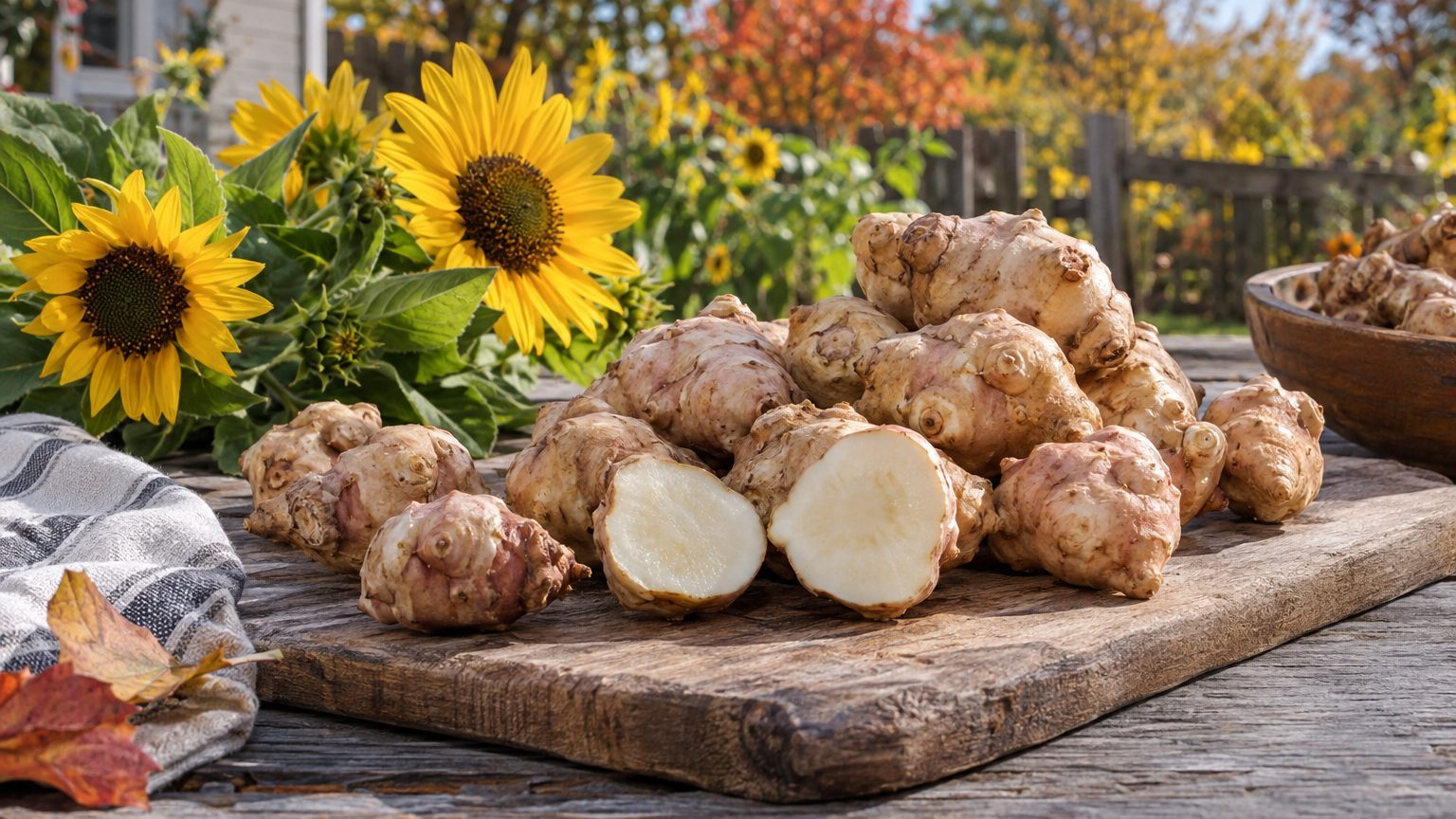

Jerusalem artichokes cause gas and bloating because the tuber stores its energy as inulin, a chain of fructose molecules that human digestive enzymes cannot break apart. The inulin travels intact to the large intestine, where gut bacteria ferment it and release gas. Nothing is wrong with the vegetable, and nothing is wrong with you. It is a mismatch between what the plant stores and what our small intestine can handle.
That mismatch has earned the tuber a few unflattering nicknames, and “fartichoke” is the one gardeners repeat most. The reputation is deserved, but it is also more manageable than most people assume. How much you eat, how it was stored, and how it was cooked all change the outcome.
What is actually in the tuber
Most root vegetables, potatoes and parsnips included, bank their energy as starch. Jerusalem artichokes (Helianthus tuberosus, a native North American sunflower relative) do it differently. They pack their tubers with inulin, a type of fructan. Published analyses commonly put inulin at roughly 15 to 20 percent of the fresh weight, which makes it the dominant carbohydrate in the tuber by a wide margin.
Inulin is built from fructose units linked together with a bond (called a beta 2-1 linkage) that our bodies have no enzyme to cut. Starch is the opposite story: we make amylase, and it dismantles starch into glucose in the small intestine within an hour or two. Inulin skips that step entirely.
Here is a detail that surprises people. Standard nutrition databases list Jerusalem artichokes as having only a gram or two of fiber per 100 grams, which makes them look mild. That number undercounts the problem, because older lab methods for “dietary fiber” did not capture all of the inulin. The label says gentle. The tuber behaves otherwise.
The same compound shows up elsewhere in your life. Chicory root, a common ingredient in “high fiber” snack bars and some protein bars, is a commercial source of inulin. Onions, garlic, leeks, and wheat contain related fructans in smaller amounts. If a fiber-fortified bar ever left you gassy, you have already met this compound.
What happens after the first bite
Because the small intestine cannot absorb inulin, it reaches the colon largely untouched. There, bacteria such as Bifidobacterium feed on it. Fermentation produces hydrogen, carbon dioxide, and in some people methane, along with short-chain fatty acids like butyrate, which colon cells use as fuel. Those fatty acids are the reason inulin is called a prebiotic and gets studied for gut health. The gas is the price of admission.
Timing matters, and it explains why people blame the wrong meal. Food takes hours to reach the colon, so symptoms usually show up four to twelve hours after eating, not during dinner. A lunch of roasted sunchokes can announce itself at bedtime, or overnight.
There is a second mechanism, and it adds to the discomfort. Fructans are osmotically active, meaning they pull water into the intestine. Combined with gas, that stretches the gut wall. In people with a sensitive gut, the stretching is felt as cramping and pain rather than just pressure. This is why two people can eat the same serving and report completely different experiences.
Who feels it most, and how much is too much
Dose drives nearly everything. Clinical studies on inulin supplements generally find that a few grams a day is tolerated by most healthy adults, while intakes in the range of 10 grams or more increase gas and bloating in a meaningful share of people. Do the math with the tuber: a modest side dish of around 5 ounces could deliver more than 20 grams of inulin, by the commonly cited range. That is well past the point where many people notice effects.
Some groups react at far smaller servings:
- People with irritable bowel syndrome, for whom fructans are among the best-documented dietary triggers.
- Anyone following a low-FODMAP diet, where Jerusalem artichoke is classed as high in fructans and is typically avoided during the elimination phase.
- People with fructose malabsorption or small intestinal bacterial overgrowth (SIBO), where fermentation begins too early in the gut.
- Anyone whose normal diet is low in fiber, because their gut bacteria have not adapted.
That last point is the hopeful one. Gut microbes adjust to what they are fed. People who eat fructan-rich foods regularly, and ramp up slowly, often report that symptoms ease over a couple of weeks. The evidence for adaptation is stronger for inulin supplements than for the whole vegetable, so treat it as a reasonable expectation rather than a promise.
True allergy to Jerusalem artichoke exists but is uncommon, and it looks different: itching in the mouth, hives, swelling, or breathing trouble. Those symptoms call for medical attention, not a smaller portion. Severe or persistent abdominal pain, blood in the stool, or unexplained weight loss are also reasons to see a doctor rather than blame the vegetable.
Ways to make them easier on the gut
Start small. A quarter cup of sliced tuber, mixed into a dish of other vegetables, is a sensible first trial. Wait a full day before judging the result, given that delayed timeline, and increase only if you feel fine.
Storage helps more than most cooks realize. Inside the tuber, enzymes slowly shorten the inulin chains into smaller fructose pieces during cold storage, which is why tubers left in a cool place for weeks taste sweeter than ones dug that morning. Shorter chains are usually easier on the average stomach. The caveat is real, though: free fructose is itself a problem for people with fructose malabsorption, so storage swaps one trigger for another in those cases.
Cooking has a similar, modest effect. Long, slow heat, especially with a little acid, can break down some inulin into fructose. Since inulin dissolves in water, boiling tubers and discarding the water may also remove a portion, though soup eaters get it all back. Research on how much cooking reduces symptoms in actual people is thin, so think of these methods as tilting the odds rather than solving the problem. Peeling does not matter much, since the inulin is distributed throughout the flesh and not concentrated in the skin.
Fermentation is a traditional route worth knowing about. Pickled or lacto-fermented sunchokes are common in some food traditions, and the bacteria involved can consume part of the fructan before it ever reaches your plate. Again, results vary with the method and the length of fermenting, so a first jar deserves the same small-portion caution as a first roast.
Some cooks pair the tuber with ingredients that dilute it, such as potatoes, which add familiar starch and cut the fructan load per bite. Mashing half sunchoke with half potato is a common way to introduce the flavor, which is nutty and slightly sweet, without committing to a full serving of inulin.
What the garden can change, and what it cannot
Growers sometimes ask whether a particular variety is gentler. Cultivars differ in shape, skin color, and how knobby they are (smoother types are easier to clean), but inulin is the species’ signature, and no variety escapes it. Picking a smooth-skinned type makes prep easier. It does not change the chemistry.
Timing is the lever you do control. Inulin content shifts through the season as the plant moves sugars into its tubers, and tubers dug late, after the stalks have died back, tend to be the most inulin-rich. Tubers left in the ground over winter and dug in early spring have had months for enzymes to convert some of it. If you want to experiment, our guide to Lifting Four Different Kinds of Root covers when and how to dig each crop, and Planting Dates for Four Different Crops helps you plan the season so the harvest lands when you want it.
For readers weighing the whole family of oddball roots, it helps to know that the digestive reputation belongs mainly to this one. The wider group, covered in Celeriac, Kohlrabi, Horseradish and Jerusalem Artichokes, does not rely on inulin as its main storage carbohydrate. Celeriac and kohlrabi are far less notorious for the problem, though any vegetable can bother a very sensitive gut. Horseradish is eaten in such small amounts that quantity rarely comes up.
One last practical point for the garden itself: Jerusalem artichokes spread aggressively from any tuber left in the soil, so a patch you plant for a trial serving can become a permanent resident. A single plant produces a dozen or more tubers by autumn. If your digestion votes against them, you will be harvesting and giving away more than you eat, and that is a fine reason to plant them in a contained bed or large container from the start.