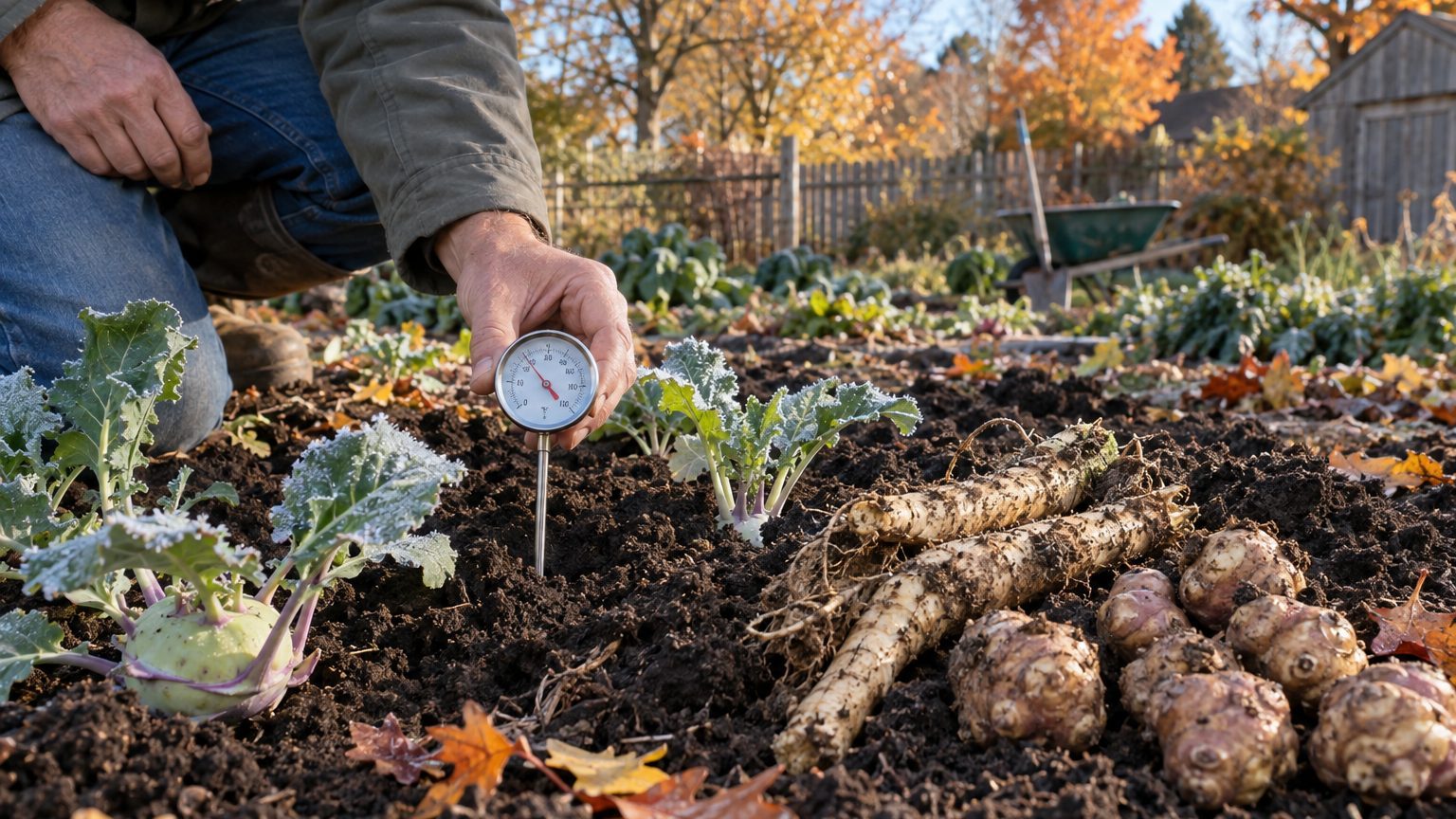

Kohlrabi goes in first, about two to four weeks before your last spring frost. Horseradish roots and Jerusalem artichoke tubers follow as soon as the soil can be worked. Celeriac comes last outdoors, but it starts earliest: seeds go in flats indoors in late winter, and seedlings move out two to three weeks after the last frost. Four crops, four different clocks. Match each one to it and you avoid the usual failures: woody kohlrabi, bolted celeriac, thin horseradish.
This page covers timing only. For the bigger picture on all four crops, start with Celeriac, Kohlrabi, Horseradish and Jerusalem Artichokes.
Start with two dates, not a calendar
Planting charts that say “plant in April” are useless across a country where April means frozen ground in Minnesota and tomato season in Georgia. What works is counting backward or forward from your average last spring frost and first fall frost. Your county extension office publishes both, and most state extension websites have a lookup tool by ZIP code. Treat those dates as averages, though. In roughly half of years, a frost arrives after the “average” last frost date.
A soil thermometer is the second tool worth the few dollars. Push it 2 to 4 inches down at mid-morning for several days in a row. Kohlrabi seeds germinate once soil reaches about 45°F, and they do best between 60°F and 80°F. Horseradish and Jerusalem artichokes are less picky because they sprout from stored energy in a root or tuber, not from a seed, but they still sulk in saturated, cold ground. If your soil stays soggy into April, the soil these roots want matters as much as the date does, since a tuber sitting in cold mud rots before it grows.
To make the numbers concrete, the examples below use a last frost of April 15 and a first fall frost of October 15. That roughly describes central Ohio, southern Pennsylvania, or the Kansas City area (USDA zones 6 to 7). Shift everything earlier or later by the number of days your own dates differ.
Kohlrabi: two windows a year
Kohlrabi is a cool-season brassica, a close relative of broccoli and cabbage, and it behaves like one. The swollen stem is ready about 45 to 60 days after sowing. Heat is the enemy. Bulbs that mature in a hot spell turn fibrous and bitter, and the plant may bolt, so the goal is to schedule maturity for cool weather on either side of summer.
For the spring crop, sow seed directly in the garden two to four weeks before your last frost. In the April 15 example, that means roughly March 18 to April 1. Seedlings handle light frost fine. Sow a short row every ten days or so through early May instead of the whole packet at once, because a full row of kohlrabi tends to ripen in the same week and then turn tough in the field. Stop sowing when daytime highs are regularly pushing into the 80s.
The fall crop is usually the better one. Sow six to eight weeks before your first fall frost, which puts the October 15 example at about August 20 to September 3. The seedlings emerge in warm soil, then mature as the days cool and the flavor sweetens. Kohlrabi tolerates frost into the upper 20s, so a hard freeze is the finish line, not a light frost. Gardeners in zones 8 and 9 across Texas, the Gulf Coast, and the Southeast can sow from September through November and harvest in winter, then try again in late winter for a short spring window.
Horseradish and Jerusalem artichokes: plant early, plant once
These two are perennials in practice, and both are planted from pieces of the plant, not seed. Timing is forgiving. Still, there are better and worse moments.
Horseradish
Plant root cuttings (sold as “sets” or “crowns,” usually 8 to 12 inches long and about as thick as a pencil) in early spring, as soon as the ground thaws and is workable. In the April 15 example, late March through mid-April is ideal. Lay each cutting at a slight angle with the thicker top end up, about 2 to 4 inches below the surface, spaced roughly 18 to 24 inches apart. Fall planting also works in most of the country if you get sets in the ground about a month before the soil freezes.
The wait is the surprise. Horseradish needs a full growing season to build roots worth grating, and the harvest comes after several hard frosts in late October or November, when the tops are blackened and the roots are at their sharpest. Plenty of gardeners wait through the first winter and dig the following spring, before new growth starts. An old rule says to dig only in months with an “r” in them, which covers fall through April and is not a bad guide. Horseradish is hardy in zones 3 to 9 and has no trouble with a Minnesota winter.
Jerusalem artichokes
Plant tubers in early spring, once the soil is workable and no longer waterlogged. Cut or leave whole, aiming for pieces with at least two or three eyes, and set them 4 to 6 inches deep and 12 to 18 inches apart. Rows should be about 3 feet apart, because the stalks will climb 6 to 10 feet by August. A late-fall planting, a few weeks before the ground freezes, also works well, and the tubers wake up when the soil warms.
The plant tells you when to dig. Flowers (small yellow sunflower-like blooms) arrive in late summer or early fall, and the tubers are best after the foliage has been killed back by frost, usually late October onward. Cold converts some of the starch-like inulin into sugars, which gives frosted tubers a sweeter, nuttier taste. Because they store poorly once dug (the skin is thin and they shrivel within a couple of weeks), many growers leave them in the ground and dig as needed until the soil freezes solid, or all winter with a heavy mulch of straw or leaves in colder states.
Celeriac: the slow one
Celeriac is where timing earns its keep. It needs a long season, typically 100 to 120 days from transplant, and that long runway is why you start it indoors. Seeds are tiny, slow, and need light to germinate, so press them onto the surface of moist seed-starting mix and don’t bury them. Expect two to three weeks before anything shows, and keep the tray warm, around 70°F.
Count back eight to ten weeks from your last frost. For an April 15 last frost, that is roughly February 4 to February 18. Starting too early is a mistake as well as starting too late, because seedlings that sit in cramped cells for months get stressed.
Transplanting is the delicate step. Wait until two to three weeks after the last frost, when nights stay reliably above 50°F. Extended cold at the seedling stage can trick celeriac into thinking a winter has passed, so it bolts to flower in its first year and the root never swells. In the example, that points to May 1 to May 10. Space plants 8 to 12 inches apart and set them at the same depth they grew in the pot, with the crown not buried.
Harvest starts in fall, when roots reach about 3 to 4 inches across. Celeriac handles light frost, and a thick mulch will protect roots in the ground through temperatures into the 20s. Pull them before the soil freezes hard. In warm-winter regions (zones 8 and 9), shift the whole schedule: sow in late summer, transplant in fall, and harvest through winter and early spring before heat arrives.
One calendar, four crops
Here is how the April 15 / October 15 example lays out, with a few weeks of wiggle room on either side:
- Early to mid February: sow celeriac seed indoors.
- Late March to mid April: sow kohlrabi outdoors, and plant horseradish sets and Jerusalem artichoke tubers.
- Early May: transplant hardened-off celeriac.
- Late August to early September: sow fall kohlrabi.
- October to November: harvest celeriac, then Jerusalem artichokes and horseradish after hard frosts.
Colder regions compress this squeeze. In zone 4 or 5 (the northern Plains, Upper Midwest, northern New England), celeriac gets very little margin, so start it a bit earlier, move it to a larger pot once before transplanting, and pick a variety with a shorter maturity listed on the packet. A fall kohlrabi sowing there may need to happen in late July. Warmer zones swap the logic: spring windows close earlier, and fall and winter do most of the work.
Once the digging starts, what to actually do with these four covers storage and cooking, since harvest timing and kitchen use are linked more than most people expect.
One last nuance on dates: for Jerusalem artichokes and horseradish, a missed planting window costs little, but a missed digging is the real risk. Any tuber or root fragment left behind will sprout the next spring, and both plants can take over a bed within a few seasons. Many gardeners give them a dedicated corner or a sunken container barrier for exactly that reason.