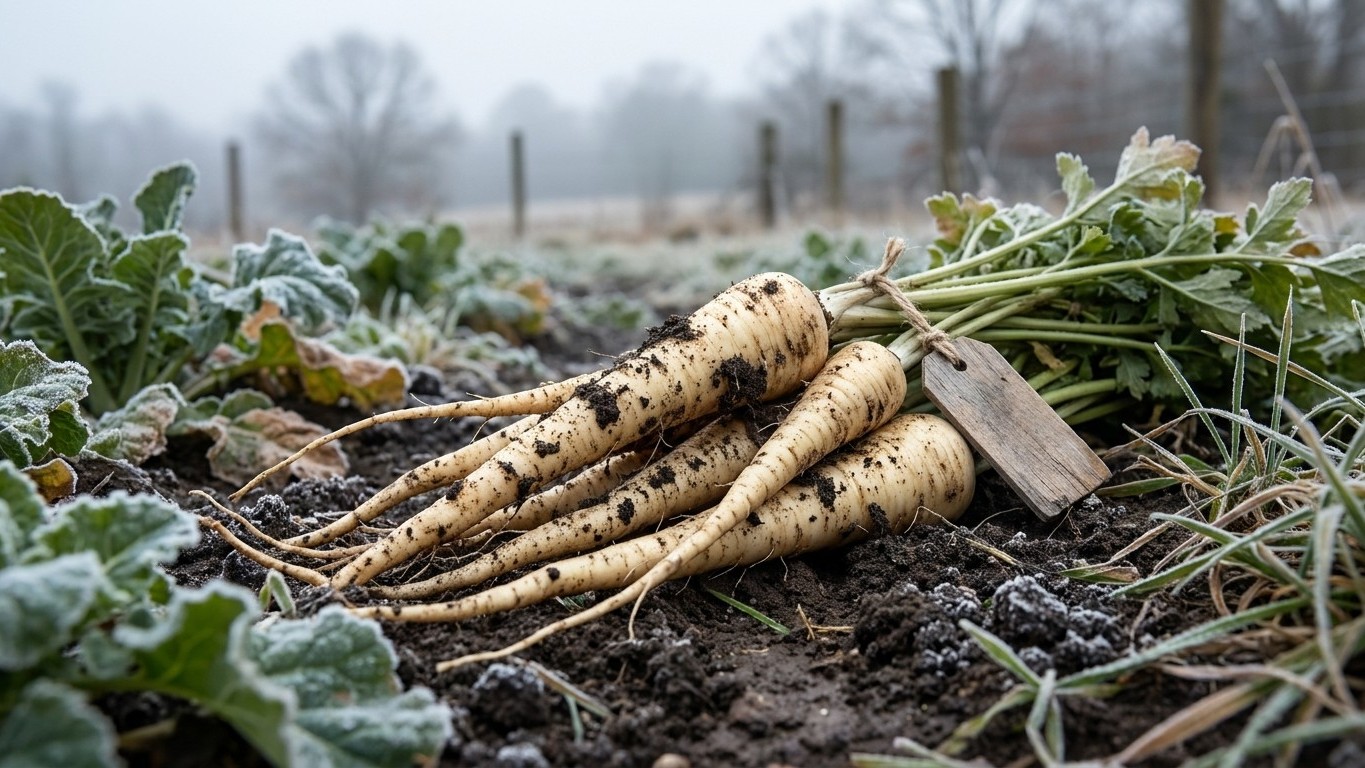

Growing parsnips in Georgia isn’t the problem. Sweetening them is. Most of the state’s soil and season length let the root reach full size without much trouble, but the frost exposure that turns stored starch into sugar is thin here, especially around Atlanta and the coastal plain. North Georgia’s mountains, which freeze earlier and harder, are the better bet if sweetness is the goal.
The short answer
Does this territory deliver several frosty weeks in a row? That’s the question that decides everything else, and for most of Georgia the answer is a soft no. The reference station in Atlanta shows a mean daily minimum of 35.6°F for the coldest month, according to NOAA NCEI Climate Normals covering 1991 to 2020. That figure isn’t a record low and it isn’t a monthly average temperature swinging up and down. It’s the typical low point on a typical night during the coldest stretch of the year, and 35.6°F sits above freezing.
That matters because parsnip sweetening depends on exposure to frost, not on a comfortable hardiness zone rating. A zone tells you whether a plant survives the winter. It says nothing about whether the roots sitting in the ground actually get cold enough, often enough, to convert their stored starch into sugar. In much of Georgia, and especially in and around Atlanta, nights dip below 32°F often enough to matter, but the average doesn’t stay there. Some winters will deliver a decent cold run. Others will barely touch freezing on a regular basis. Utah State University Extension notes that parsnips taste best after several weeks of cool, frosty weather, and “several weeks” is the operative phrase. One or two hard freezes followed by a mild stretch doesn’t do the same job.
So the honest answer for a gardener in metro Atlanta or anywhere on the coastal plain is that the parsnip will grow just fine, size up, and store well, but it may finish the season more starchy than sweet. North Georgia and the mountains are a different story. The same NOAA data notes that region freezes several weeks earlier in fall than the Atlanta airport station used as reference, and it runs colder through winter. A gardener working that higher, cooler ground has a real shot at the sustained cold spell that Utah State’s guidance calls for. A gardener on the coastal plain, where winters run milder still, has the weakest case of all three.
None of this means parsnips are a bad crop for Georgia. It means the sweetening step is the part to manage deliberately, through timing and harvest choices, rather than something that happens automatically just because the calendar says winter.
Does the season fit?
Parsnips are sown directly in place, never transplanted, and Utah State University Extension puts the full run at 100 to 120 days from seeding, with sowing timed 2 to 3 weeks before the last spring frost. Here’s how that arithmetic lines up against Georgia’s frost window.
- The last spring frost at the Atlanta reference station falls between March 11 and March 29, per NOAA NCEI’s 1991-2020 freeze probability data. Sowing 2 to 3 weeks ahead of that puts seed in the ground somewhere between mid-February and mid-March.
- Parsnip seed is slow. Germination takes 14 to 21 days, so seedlings won’t break the surface until roughly early March at the earliest, later if the soil is still cold.
- Count 100 to 120 days forward from the seeding date, not from germination. A late-February sowing points to roots reaching maturity sometime in June. A mid-March sowing pushes that into July.
- The first fall frost at the same reference station arrives between November 13 and December 1. That leaves a gap of roughly four to five months between a mature parsnip crop sitting in the ground in June or July and the first real frost of autumn.
- That gap is the key finding here: Georgia’s frost-free window is generous enough that the 100 to 120 day season fits comfortably, with plenty of room to spare. The crop is never in a race against the calendar the way it would be in a state with a short growing season.
- The trade-off is that a parsnip mature by midsummer has no frost to sweeten it yet. The practical move is to let the roots sit in the ground well past maturity, right through the fall and into the first cold snaps of the coldest month, rather than harvesting the moment they size up.
North Georgia gardeners working the mountain counties should expect that fall frost several weeks sooner than the Atlanta window states, which shortens the wait for that sweetening period. Coastal plain gardeners should expect the opposite, a later and gentler frost onset than the reference dates above.
What goes wrong here
- Forked roots in heavy or stony ground. Georgia’s clay-heavy soils, common but not universal across the state, resist the long, straight taproot a parsnip wants to send down. Utah State University Extension recommends deep, sandy soil, and where the native ground is heavy clay, double digging to at least a foot deep before sowing is the fix. Working in stones and clumps ahead of planting matters more for this crop than for almost anything else in the vegetable patch.
- Forked roots from overwatering. This is a separate cause from heavy soil, not the same problem in disguise. A root sitting in soil kept too wet branches and splits just as readily as one fighting through clay. Even loose, well-drained soil can produce forked roots if watering is heavy and frequent rather than deep and occasional.
- A mild coldest month that never delivers the sweetening. With Atlanta’s coldest-month mean minimum sitting at 35.6°F, above the freezing line, some winters simply won’t hand over the sustained cold spell parsnips need. The remedy is patience rather than technique: leave the roots in the ground as long as the soil stays workable, through the coldest stretch on record for that year, rather than harvesting on a fixed date. Mulching over the row also helps hold soil temperature steady so a cold snap has more time to do its work before the ground itself insulates the roots from it.
- Treating the state soil type as a given. A general description of Georgia soil is a starting point for planning, not a diagnosis of any one backyard. A raised bed, a garden built on fill dirt, or a plot with decades of compost worked in can behave nothing like the clay commonly associated with the region. A simple dig-test before sowing, checking how easily a shovel breaks through a foot of soil, tells a gardener more than any statewide generalization.
Common questions
Can parsnips survive a Georgia winter left in the ground?
Yes, in most of the state the ground doesn’t freeze hard or stay frozen long enough to damage the roots. The bigger question isn’t survival, it’s whether enough cold accumulates to sweeten them, which the mild coldest-month averages in and around Atlanta make less certain than in the mountains.
When should parsnip seed go in the ground for a Georgia garden?
Aim for 2 to 3 weeks before the last spring frost, which falls between March 11 and March 29 at the Atlanta reference station. That puts sowing somewhere in the mid-February to mid-March range, adjusted earlier for warmer coastal areas and later for cooler mountain counties.
Why did my parsnips come up forked instead of straight?
Two separate causes produce the same result. Heavy or stony soil deflects the taproot as it grows, and overwatering does the same even in loose soil. Double digging the bed and watering deeply but less often address each cause on its own.
Is north Georgia better than metro Atlanta for sweet parsnips?
Based on the freeze-date patterns in this data, yes. The mountain counties freeze several weeks earlier in fall and run colder through winter than the Atlanta airport reference station, giving the crop a better chance at the sustained frosty stretch that converts starch to sugar.