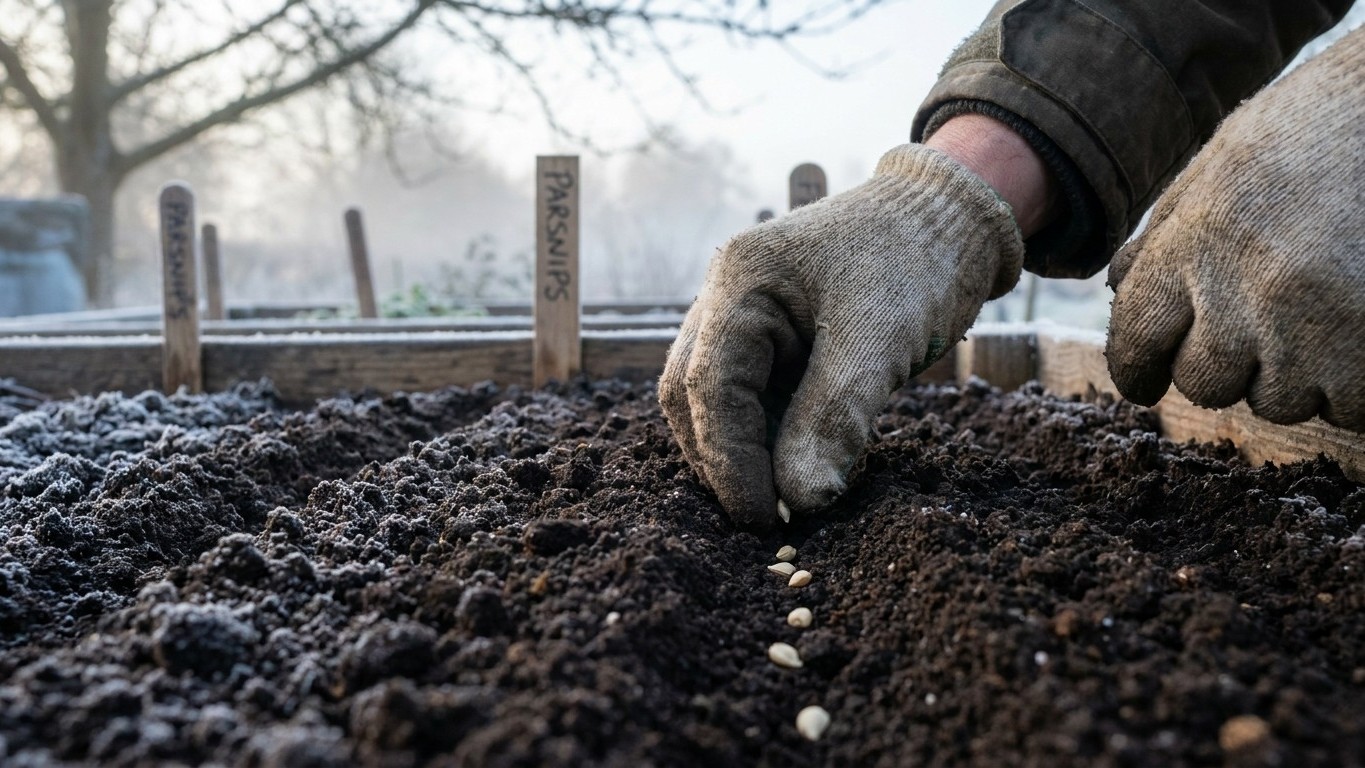

Parsnips go in the ground in Georgia about 2 to 3 weeks before the last spring frost, which falls between March 11 and March 29 across most of the state (Atlanta reference station). That puts the sowing window around late February through mid-March, earlier in the coastal plain, later in the mountains. The season leaves plenty of room to reach the 100 to 120 days parsnips need, but whether the roots actually turn sweet is a separate question entirely.
The short answer
Here’s the question that actually decides this: does Georgia give a parsnip root several weeks of real frost exposure before it comes out of the ground? That’s not the same as asking whether the state can grow the crop. Almost anywhere in Georgia can grow a parsnip. Sweetening it is a different matter.
The coldest month at the Atlanta reference station has a mean daily minimum of 35.6°F, based on NOAA NCEI 1991-2020 Climate Normals. That’s the average low across the coldest stretch of winter, and it sits just above freezing. It doesn’t mean frost never happens. It means that on a typical night in the coldest month, temperatures hover right around that line, with some nights colder and plenty of nights warmer. That’s a mild winter climate, not a string of hard, sustained frosty weeks.
Utah State University Extension is clear on the mechanism: parsnips taste best after several weeks of cool, frosty weather, because that cold converts the starch stored in the root into sugar. A parsnip pulled from warm or barely-frosted ground grows into a perfectly normal-looking root. It just won’t have that sweetness gardeners in colder climates rave about. The starch stays starch.
So a Georgia parsnip, grown almost anywhere in the state, will grow fine. Whether it sweetens depends heavily on where in Georgia and how long the roots stay in the ground once winter arrives. North Georgia and the mountains freeze several weeks earlier in fall than the Atlanta reference station suggests, and they hold onto cold longer, which gives roots left in the ground a better shot at real frost exposure. The coastal plain runs milder still than Atlanta, which stacks the odds further against a proper sweetening. This isn’t about hardiness zones. A zone tells you whether a plant survives winter. It says nothing about whether cold soaks into a root long enough to change its chemistry. Those are two different measurements, and mixing them up is the single most common mistake gardeners make when they plan a fall harvest around a zone map instead of actual frost data.
The practical takeaway: gardeners in the mountains and the upper Piedmont have a genuine shot at sweet parsnips if they leave roots in the ground through several cold snaps. Gardeners in Middle and South Georgia should treat the sweetening as a bonus, not a guarantee, and plan the harvest date around what the ground is doing, not around a calendar.
Does the season fit?
Parsnips are sown directly in the ground, not transplanted, and the clock starts at seeding, not at germination. Utah State University Extension puts full maturity at 100 to 120 days from that sowing date. Laid against Georgia’s frost calendar, the arithmetic works out with real room to spare.
- Start with germination. Parsnip seed is slow. Expect 14 to 21 days in the ground before seedlings even break the surface. Keep the bed consistently moist through that stretch, because bare, cracked soil at day 10 doesn’t mean the seed failed. It means it’s exactly on schedule.
- Set the sowing date. Two to three weeks before the last spring frost (March 11 to March 29 at the Atlanta reference station) puts seeding at roughly February 19 through March 15, earlier in the coastal plain, later at higher elevations where spring arrives later.
- Add the 100 to 120 days. From the earliest sowing date, 100 days lands around May 30. From the latest sowing date, 120 days lands around July 13. Either way, that’s a maturity window sitting deep in late spring or midsummer.
- Compare against first fall frost. The first fall frost at the Atlanta reference station arrives between November 13 and December 1. That leaves roughly four to six months of slack between when the roots reach full size and when the first real cold hits.
- Read the gap correctly. That much slack means the season fits comfortably, with margin left over. It also means a gardener can afford to sow later than the earliest window, or simply let mature roots sit in the ground through fall, using that leftover time for the frost exposure the crop needs to sweeten rather than rushing to dig at day 100.
That last point matters more in Georgia than in a short-season climate. Where summers are brief, hitting the 100 to 120 day mark before frost is the whole game. Here, reaching maturity is rarely the problem. Getting the roots enough cold afterward is.
What goes wrong here
- Forked roots from heavy or stony ground. Georgia’s clay soils are dense and compact, and a parsnip root pushing down through rocks or clay lumps will split or fork instead of growing straight. Utah State University Extension notes parsnips do best in deep, sandy soil, and recommends double digging heavy ground before sowing to loosen it well below where the taproot will travel.
- Forked roots from overwatering. This is a separate cause from soil texture, not a variation on it. Too much water encourages the root to branch as it searches for oxygen, even in soil that isn’t particularly heavy. The fix is steady, moderate moisture rather than heavy soaking, especially once the root has sized up.
- A winter too mild to sweeten. In the coastal plain and much of South Georgia, the coldest stretch of the year may never deliver the sustained frosty weeks parsnips need to convert starch to sugar. There’s no fix that changes the local climate, but leaving roots in the ground as long as possible through whatever cold does arrive, rather than harvesting at the earliest maturity date, gives them the best chance available.
- Slow, patchy germination read as failure. Because parsnip seed can take 14 to 21 days to emerge, gardeners sometimes assume a bad seed lot and re-sow too early, ending up with two overlapping plantings competing for space. Mark the sowing date and wait out the full three weeks before judging a row a failure.
Common questions
What month should I sow parsnips in Georgia?
Late February through mid-March fits most of the state, based on a sowing date 2 to 3 weeks ahead of the March 11 to March 29 last-frost window at the Atlanta reference station. Mountain gardens should lean toward the later end of that window, since spring arrives later at elevation.
Can parsnips grow in Georgia’s clay soil?
They can, but heavy clay increases the risk of forked roots. Utah State University Extension recommends deep, sandy soil where possible, and double digging heavy ground to loosen it well below the depth the taproot will reach.
Do parsnips need frost in Georgia to taste good?
They need several weeks of cool, frosty weather to convert stored starch into sugar. Because the coldest month at the Atlanta reference station averages a daily minimum of 35.6°F, sweetening is more reliable in North Georgia and the mountains than in the milder coastal plain.
How long do parsnip seeds take to germinate in Georgia?
Expect 14 to 21 days, according to Utah State University Extension. Keep the seedbed evenly moist during that stretch rather than assuming a lack of visible sprouts means the seed failed.