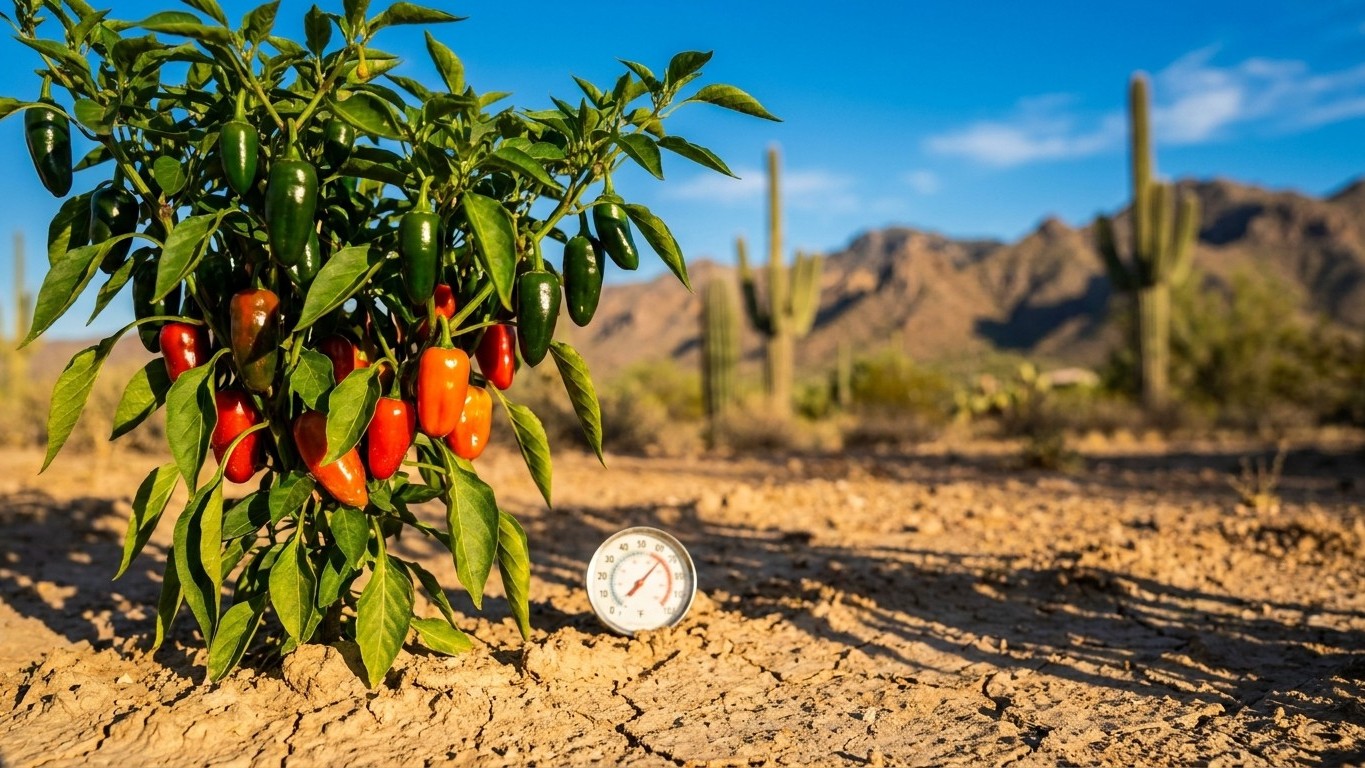

Phoenix racks up an average of 168.9 days a year at or above 90 F. That single number explains why pepper timing in Arizona has almost nothing to do with the last spring frost and everything to do with the calendar window before summer heat shuts fruit set down. Nights under 55 F stop it too, but this site does not track summer night lows, so watch your own thermometer.
The short answer

Start with the heat side, because in the low desert it is the whole story. The reference station for Phoenix averages 168.9 days a year at 90 F or hotter, based on NOAA NCEI Climate Normals for 1991 to 2020. Pepper flowers abort once daytime temperatures push consistently past that 90 F line, and in a place that spends nearly half the year up there, the plant only gets a real fruit-set window in spring and again in early fall, once the heat breaks. Growers who transplant too late in spring often watch their peppers flower right into the wall of summer heat and drop every bloom for weeks. For a closer look at exactly why this happens, see Why Peppers Fail to Set Fruit in Arizona.
The cool end of the equation matters too, and it is easy to overlook in a state known for warmth. Pepper fruit set also fails when nights drop below 55 F, which can still happen in the shoulder seasons even where daytime highs feel plenty warm. This site carries days-above-90 figures by territory, but it does not carry summer night minima for any location. That is not a small caveat. A stretch of nights in the low 50s during a cool spring snap, or an early fall cold front, can knock blossoms off a plant that looks otherwise healthy and well-watered.
Do not guess at those night lows from latitude or from how far south you are on the map. Desert nights cool fast once the sun goes down, and elevation, wind exposure and even how close you are to pavement or a wash can shift a night’s low by several degrees from what a regional average would suggest. If you want a real answer for your own yard, put a min-max thermometer out during bloom season and read it yourself for a week or two. That single habit will tell you more about your fruit-set risk than any statewide chart.
So the short answer has two halves. On the hot side, count on roughly 169 days a year where daytime highs will stall pepper flowering, concentrated across the heart of summer. On the cool side, watch your own nights during the shoulder seasons rather than trusting an assumption, because that threshold is every bit as real as the heat and this site simply does not have local night data to hand you. If you want to work with the season you actually have, it helps to review When to Start Pepper Seed in Arizona Pepper Varieties That Ripen in a Arizona Season before you commit to a planting plan.
When to start seed here
The math for timing pepper seed starts is the same everywhere: work backward from your transplant date. What differs in the low desert is which limiting factor actually sets that transplant date, and it is not frost.
- Confirm your frost risk is nearly zero. At the Phoenix reference station, a freeze reached 32 F in only 6 of the last 30 spring seasons, and NOAA lists the frost-free season there at 365 days. When a cold snap does bring 32 F, it lands between late December and mid January, well before pepper planting season even starts. That means frost is not your planning constraint here the way it would be almost anywhere else.
- Wait for soil to reach 60 F. Even with frost off the table, transplanting into cold soil stunts pepper roots and delays the whole season. Check soil temperature at a 4-inch depth with a simple probe thermometer rather than guessing from air temperature, since soil warms more slowly.
- Count back 8 to 10 weeks for your indoor seed start. Once you have a target transplant date built around 60 F soil, subtract 8 to 10 weeks and that is your seed-starting date indoors under lights or on a warm windowsill.
- Cross-check against the heat side of the calendar. Because the low desert logs an average of 168.9 days a year at 90 F or above, a transplant date that is technically fine for soil temperature can still be too late if it pushes flowering into that heat window. Aim to get transplants in the ground early enough that plants can flower and set an initial round of fruit before daytime highs settle in above 90 F for the season.
- Plan for a second window in early fall. Many low-desert growers get a spring crop, lose fruit set through the hottest stretch, then pick it back up as days above 90 F taper off. If you want a fall harvest, that means a second, later seed-starting cycle timed the same way: count back 8 to 10 weeks from a transplant date that lands after the worst heat has passed.
Do this arithmetic for your own county rather than borrowing a date from a neighbor two hundred miles away. Elevation shifts both the soil-warming schedule and the length of the above-90 F season considerably across Arizona, even though the underlying math stays the same.
What goes wrong here
- Blossom drop in a hot spell. Pepper flowers abort once daytime temperatures climb well past 90 F, and a stretch of consecutive hot days will strip a plant of blooms with no fruit to show for it. There is no fix for the heat itself once it arrives, so the real remedy is timing: get plants flowering before the hottest 168.9-day stretch settles in, and expect a lull until temperatures ease.
- Blossom drop from a cool night. The opposite failure looks similar from the outside but comes from nights dropping below 55 F, which can still happen during shoulder-season cold snaps even in a hot state. Track your own overnight lows with a simple thermometer during bloom season rather than assuming warmth just because daytime highs feel mild, and hold off on early transplanting if a cool night stretch is forecast.
- Sunscald on exposed fruit. Where sun intensity is strong and consistent, fruit left uncovered by foliage can develop pale, papery patches on the side facing the sun. Keep plant canopy full rather than pruning leaves aggressively, and consider light shade cloth over exposed rows during the peak of the hot season.
- Blossom-end rot. Irregular watering, which is common where irrigation has to fight fast evaporation, disrupts calcium uptake and shows up as a dark, sunken patch on the bottom of developing fruit. Even, consistent soil moisture through mulching and a steady watering schedule addresses this far more reliably than adding calcium products after the fact.
Checking this against your own county
Everything above is built around a single reference station, and Arizona’s terrain runs from low desert to high country within a few hours’ drive. Soil temperature dates, the length of your above-90 F stretch, and how many nights dip below 55 F during bloom season will all shift depending on where in the state you garden.
The University of Arizona Cooperative Extension keeps county-level offices with staff who track local soil and planting conditions directly, and that is the right place to confirm dates before you commit a season’s worth of seedlings to a guess. A quick call or visit to your county office will tell you whether your local numbers track close to the Phoenix reference figures used here, or diverge enough to shift your calendar by a few weeks in either direction.
Common questions
Do I need to worry about frost when planting peppers in the low desert?
Barely. The Phoenix reference station saw 32 F in only 6 of 30 spring seasons, and NOAA lists a 365-day frost-free season there. Heat, not frost, is the real constraint on your calendar.
How many days a year will heat stop my peppers from setting fruit?
The reference station averages 168.9 days a year at or above 90 F, which is the temperature threshold where pepper flowers commonly abort. That does not mean every one of those days is a total loss, but it marks the bulk of the season where fruit set stalls.
Can I just plant early since there’s no frost to wait for?
Only up to a point. You still need soil at 60 F before transplanting, and pushing too early risks stunted roots. Planting too late, on the other hand, walks your flowering plants straight into the above-90 F stretch, so the real target is a narrow window in between.
Why are my peppers dropping blossoms even though it isn’t that hot yet?
Check your overnight lows. Fruit set also fails below 55 F at night, and a cool front can pass through even in a state known for heat. This site does not track nightly minima, so a min-max thermometer in your own yard is the fastest way to rule this in or out.