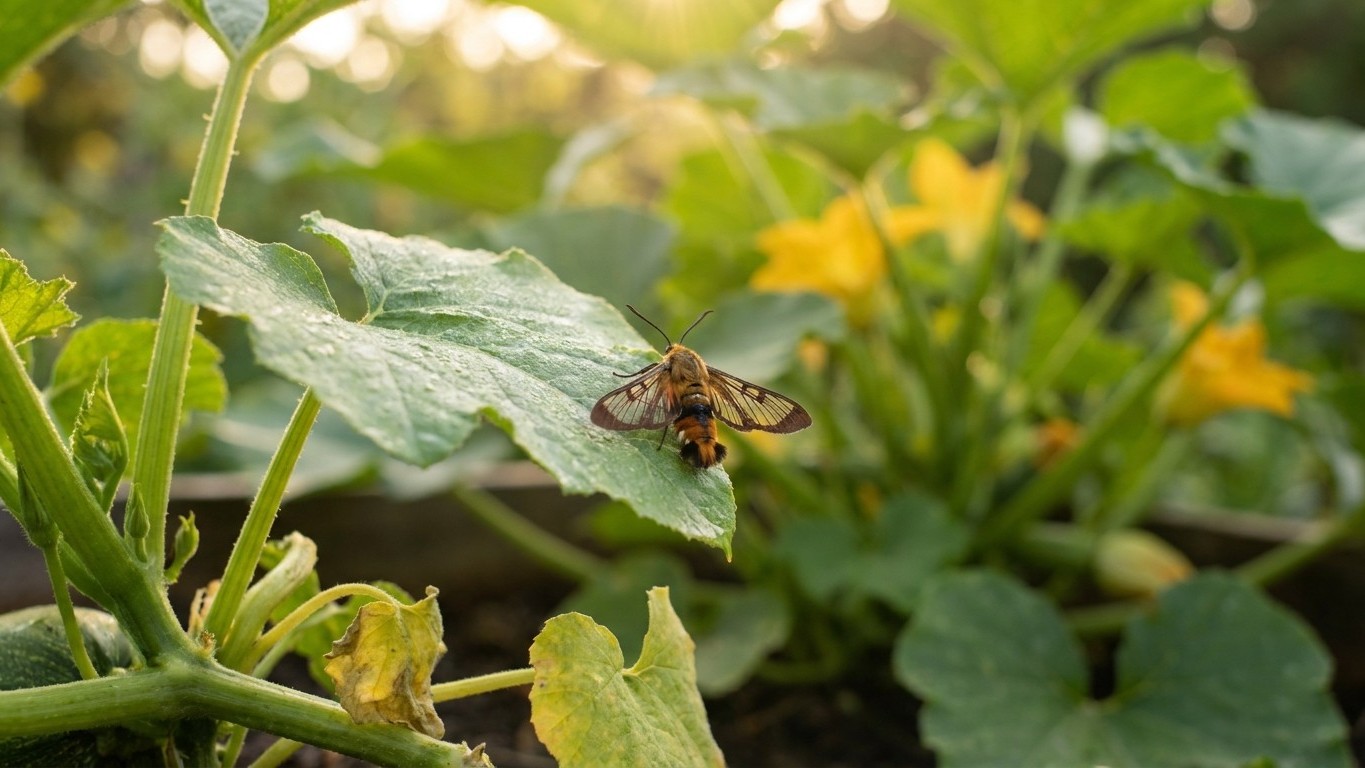

Squash vine borer moths start flying in Georgia as early as mid-May in the southern part of the state and typically show up by early June farther north. That timing matters because the moth itself does no damage; it’s the larvae that hatch a week or two later and tunnel into stems that kill plants. Once you see wilting leaves on an otherwise healthy-looking squash plant, the borer has usually already been feeding inside the stem for several days, and by that point, mechanical and chemical controls work far better as prevention than as rescue.
When Squash Vine Borer Season Starts in Georgia

Georgia’s climate splits into roughly three zones for garden pest timing: the mountains and foothills around Blue Ridge and Dahlonega, the Piedmont belt running through Atlanta and Athens, and the Coastal Plain stretching from Macon down to Valdosta and the coast. Squash vine borer overwinters as a larva or pupa in the soil, usually just an inch or two below the surface near where last year’s vines grew. Warmer soil wakes them up sooner, so the Coastal Plain sees adult moths emerging weeks ahead of the mountains.
In south Georgia, growers often deal with two full generations per season, one in late May through June and a second wave in August. That second flight catches a lot of gardeners off guard because they assume the danger passed once spring squash matured. North Georgia, by contrast, usually gets just one generation, with peak moth activity from mid-June into July. If you garden anywhere between Macon and the Florida line, treat August as seriously as June.
The moth itself is easy to misidentify. It flies during the day, unlike most moths, and has a wasp-like build with an orange abdomen ringed in black and iridescent green-black wings. Gardeners frequently swat at it thinking it’s a wasp and never realize it just laid eggs at the base of their zucchini.
How to Spot the Damage Before the Plant Collapses
The first visible sign is almost always sudden wilting of individual leaves or entire runners, even after a good watering. Squash plants wilt for plenty of reasons in Georgia’s humid summers, from bacterial wilt to simple heat stress, so the wilting alone isn’t proof. Check the base of the stem where it meets the soil for a small, wet-looking hole surrounded by a yellow-green, sawdust-like frass. That frass is the tell. It looks like coarse wet sawdust and it’s essentially the larva’s droppings pushed out of its tunnel.
Split the stem lengthwise near that hole with a sharp knife and you’ll often find a cream-colored larva, up to an inch long, with a brown head capsule. A single female moth can lay 150 to 200 eggs over her lifetime, scattered individually along stems rather than in clusters, which is why one infested plant can host four or five larvae at once. Summer squash and zucchini get hit hardest because their stems are hollow and soft. Butternut and other Cucurbita moschata varieties have solid, fibrous stems that borers struggle to tunnel through, which is why extension agents across the Southeast routinely recommend them for gardeners who’ve lost patience with yellow crookneck squash.
Why Georgia’s Long Growing Season Makes Monitoring Harder
A 90-day frost-free window in the mountains stretches to 250 days or more along the coast. That extended season lets gardeners plant squash in March, June, and again in August in southern counties, which sounds great until you realize each planting overlaps with a different borer generation. Succession planting, a strategy that works beautifully against many pests, actually increases exposure risk here because there’s rarely a clean gap when no susceptible plants are in the ground.
What Actually Stops Squash Vine Borer in Georgia Gardens
Prevention beats rescue with this pest, and timing prevention around Georgia’s specific moth flights makes the difference between a wasted afternoon and a saved crop.
Floating row covers, the lightweight fabric kind sold at most garden centers, block moths from reaching stems entirely. Put them on at transplanting and seal the edges with soil or landscape staples. The catch is that squash needs pollinators to set fruit, so covers have to come off once flowering starts, usually four to six weeks after planting. Some Georgia growers thread the needle by hand-pollinating female flowers each morning during the uncovered window, using a small paintbrush or the male flower itself, then keeping the cover on for the rest of the season. It’s tedious, but it works especially well for gardeners running just two or three squash plants.
Wrapping the lower six to eight inches of stem in aluminum foil or a section of nylon stocking at transplant time physically blocks egg-laying at the exact spot borers prefer. This costs almost nothing and takes maybe two minutes per plant, though it needs monitoring since stems that swell can outgrow a tight wrap.
Insecticide timing depends entirely on catching adult moths before they lay eggs, since sprays don’t reach larvae once they’re inside the stem. Yellow sticky traps or a shallow pan of water with a bit of yellow dye set near plants will catch adults and give a rough sense of when the flight has started locally. Once moths show up in traps, a labeled insecticide applied to the base of stems and undersides of leaves every seven to ten days for two to three weeks covers the egg-laying window. Products containing spinosad or permethrin are commonly used for this purpose in home gardens, applied in the evening when bees have finished foraging for the day to limit pollinator exposure.
For plants already showing frass, the surgical option still salvages a lot of squash. Slit the stem carefully along its length near the entry hole, pull the larva out with tweezers or a bent wire, then mound moist soil over the wounded section. Squash stems root readily where they touch soil, and a plant with two or three of these repairs often keeps producing through the rest of the season.
Choosing Varieties That Give Georgia Gardeners an Edge
Butternut, cheese pumpkin, and other moschata-type squash resist borer damage far better than zucchini, yellow crookneck, or acorn squash, which fall in the more vulnerable Cucurbita pepo and maxima groups. This doesn’t mean moschata varieties are immune, egg-laying still happens, but the solid stem tissue makes tunneling much harder for young larvae, and plants often outgrow minor damage that would kill a zucchini outright.
End-of-Season Cleanup Breaks the Cycle for Next Year
Every larva left in a dead vine at the end of the season is a moth waiting to emerge next spring. Pulling and destroying squash vines immediately after harvest, rather than leaving them to decompose in place, removes a huge share of the overwintering population. Composting isn’t reliable disposal unless the pile reaches sustained high temperatures; burning or bagging for trash pickup is safer if you’ve had a heavy infestation.
Tilling the soil around former squash beds in fall or winter exposes overwintering pupae to birds and cold, and Georgia’s mild winters mean that exposure matters more here than in northern states where frozen ground does some of that work automatically. Rotating squash to a different bed each year, ideally 30 feet or more from the previous location, also cuts down on adults finding host plants right where they emerged.
Gardeners who’ve fought this pest for a few seasons in Georgia tend to land on a combination approach rather than a single fix: resistant varieties for the main crop, row covers on anything more vulnerable, weekly stem checks starting the week local moths appear in traps, and aggressive vine removal each fall. No single tactic here reaches 100 percent, but stacked together they usually keep losses to a handful of plants instead of an entire bed.
Related guides
- Squash vine borer in Alabama: When It Shows Up and What Stops It
- Squash vine borer in Tennessee: When It Shows Up and What Stops It
- Squash vine borer in Illinois: When It Shows Up and What Stops It
- Squash vine borer in Indiana: When It Shows Up and What Stops It
- Squash vine borer in South Carolina: When It Shows Up and What Stops It
- Squash vine borer in New Hampshire: When It Shows Up and What Stops It