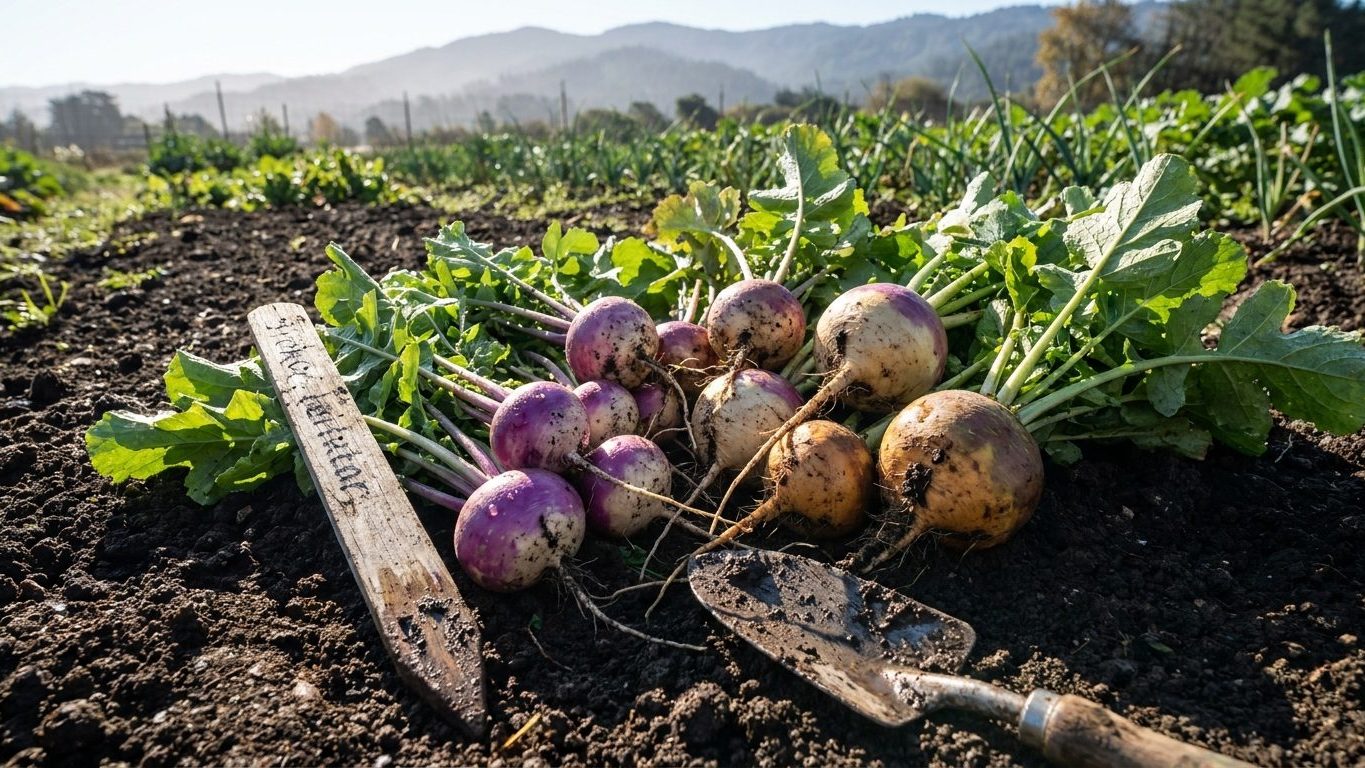

Georgia’s long frost-free stretch favors fast turnips over slow bulking rutabaga in most counties, but the right pick still depends on where in the state you garden. Quick 30- to 45-day turnip varieties are the safe, flexible choice almost everywhere; rutabaga and the slower 55- to 60-day turnips need a fall planting timed carefully against each region’s frost dates.
The short answer for Georgia
Start with the calendar, not the seed catalog. The reference station used for Georgia’s freeze data (Atlanta) shows the last spring frost falling somewhere between March 11 and March 29, and the first fall frost arriving between November 13 and December 1. That’s a wide frost-free window by national standards, and it’s the single fact that should drive variety choice here.
Fast turnip varieties, the kind that size up in 30 to 45 days, fit into that window almost without effort. You can direct-sow them in early spring right after the last frost risk passes, harvest before summer heat turns the roots woody, then sow a second round in late summer for a fall crop that finishes sweet after a light touch of cold. These are the varieties worth building a Georgia turnip patch around, because they give you two chances a year instead of one.
Rutabaga is a different animal. It needs 90 days or more of cool, steady growth to form a proper root, and it hates the heat that shows up across Georgia well before the fall frost date arrives. That means rutabaga in this state is almost always a fall-only crop: sown in mid to late summer so it matures during the cool stretch between the first light frost and the harder freeze that eventually ends the season. Sow rutabaga by early August in most of the state if you want it finished before the ground turns hard.
Slower turnip varieties, the 55- to 60-day types, sit in between. They can work as a spring crop in milder pockets of the state, but they’re safer treated the same way as rutabaga: a single fall planting, timed to dodge the worst of late-summer heat while still leaving enough runway before the first freeze. For most Georgia gardeners, the decision by type comes down to this: lean on fast turnips for flexibility, save rutabaga and the slow turnips for one well-timed fall sowing.
What will not work here

The most common failure isn’t frost. It’s heat arriving before the root has bulked up. A rutabaga or a slow turnip sown in spring in most of Georgia is racing a clock it usually loses: by the time it needs another month of cool growth to finish, the state has already slid into the kind of long, humid summer that turns roots fibrous and bitter, or pushes the whole plant to bolt instead of bulking. That’s why spring rutabaga is a gamble here rather than a routine.
The opposite mistake shows up at the other edge of the calendar. Because the first fall frost can arrive as early as November 13 in parts of the reference data, a fall crop sown too late simply runs out of season before it sizes up. Counting backward from mid-November is the safer habit than counting forward from a planting guide written for a milder climate.
Watering habits fail people here too, just not in the way gardeners expect. A weekly watering schedule, the kind that works fine for a cool, dry fall in the upper Midwest, leaves turnip and rutabaga roots stressed and cracked during Georgia’s dry late-summer stretches, right when seedlings are trying to establish for that fall crop. Roots that dry out and rewet unevenly split, and split roots rot in storage. This isn’t a hypothetical: it’s the single most common reason a fall planting looks great for six weeks and then disappoints at harvest.
Spacing is the other quiet killer. Georgia’s humidity, especially east and south of the mountains, means that turnip and rutabaga foliage planted at tight, catalog-recommended spacing stays wet longer after rain or dew, and that damp canopy is exactly what fungal leaf spot and downy mildew need to take hold. Wider spacing than a Northern seed packet suggests, with real airflow between plants, matters more here than it does in a drier climate. None of this is about picking the wrong variety so much as running the right variety on the wrong schedule or the wrong spacing for this state’s particular combination of a long season and a wet, hot middle to it.
What changes across Georgia
Georgia is not one garden, and the hardiness range proves it: the state spans USDA zones 6a to 9b, one of the widest spreads of any state in the cool-season vegetable conversation. That’s the difference between a mountain garden that behaves like parts of Tennessee and a coastal plain garden that behaves like parts of Florida, and it means a single fall planting date can’t serve the whole state honestly.
The frost data underlines this. The November 13 to December 1 fall frost window comes from an Atlanta-area station, which sits in an urban heat pocket that runs warmer than the surrounding countryside. North Georgia and the mountain counties freeze several weeks earlier in the fall than that reference date suggests, which means rutabaga and slow turnips need to go in the ground correspondingly earlier if they’re going to finish before real cold arrives. A fall planting schedule built around the Atlanta date, used unmodified in the mountains, sets a rutabaga crop up to be caught by frost before it bulks.
Go the other direction, toward the coastal plain and south Georgia, and the opposite adjustment applies. Frost arrives later and winters stay milder, giving gardeners there real room to push fall plantings later in the calendar, or to keep a fast turnip crop going well past the point where a north Georgia garden has already frozen out. Some coastal plain gardeners can even coax a second, later fall sowing of quick turnips into a mild winter that never delivers a hard freeze at all.
There’s no single answer for “Georgia” here, only a spread from 6a to 9b. Rather than guess which end of that spread applies to a particular yard, use the USDA Plant Hardiness Zone Map to find the exact zone for a specific address, and treat the frost dates in this article as the Atlanta-area reference point to adjust from, not the final word.
Where to check this for your own county
Everything above is a state-level picture, built from one reference station and a statewide hardiness range. A county recommendation beats a state one every time, because it accounts for local elevation, local frost pockets, and the specific varieties that have actually been trialled in that county’s soil and humidity.
The University of Georgia Cooperative Extension is the source to check next, at extension.uga.edu. Look specifically for two things once there: the local planting calendar for the county in question, which will translate the statewide frost window into dates that match that county’s actual microclimate, and any variety trial results or recommended cultivar lists that name which turnip and rutabaga varieties have performed well in that part of the state.
County extension offices also field direct questions, and that’s worth using. Calling or emailing the local office before a fall planting is a faster way to get a reliable date than backward-engineering one from a statewide frost range built off a single Atlanta-area station. This page describes what’s true across Georgia as a whole; the county office describes what’s true on a specific piece of ground, and that’s the version worth planting by.
Checking this against your own garden
Every date on this page is a probability built from thirty years of weather records, not a guarantee for this particular fall. The garden itself gives more reliable signals, and none of them require a thermometer or any other tool.
Soil warmth by feel is the first check. Before direct-sowing a fall turnip or rutabaga crop, dig down a couple of inches with a hand trowel or bare fingers in the early morning; soil that still feels warm and dry rather than cool and damp means the summer heat hasn’t broken yet, and seed sown into it may struggle to germinate evenly or may bolt once it does.
First true leaves are the second signal worth tracking. The initial round, oval seed leaves don’t count; watch for the next set, the ones that actually look like miniature turnip foliage, since their appearance marks the point where thinning should happen and gives a rough read on how quickly the season is moving compared to an average year.
The third signal is an early flower stalk. If a turnip or rutabaga sends up a flowering stem before the root has sized up, that’s the plant reading heat or day-length stress and giving up on bulking in favor of going to seed. Spotting that flower stalk early is the clearest on-the-ground evidence that the planting went in too late, too early, or into a hotter microclimate than the county calendar assumed, and it’s worth adjusting the next planting date accordingly rather than blaming the variety.