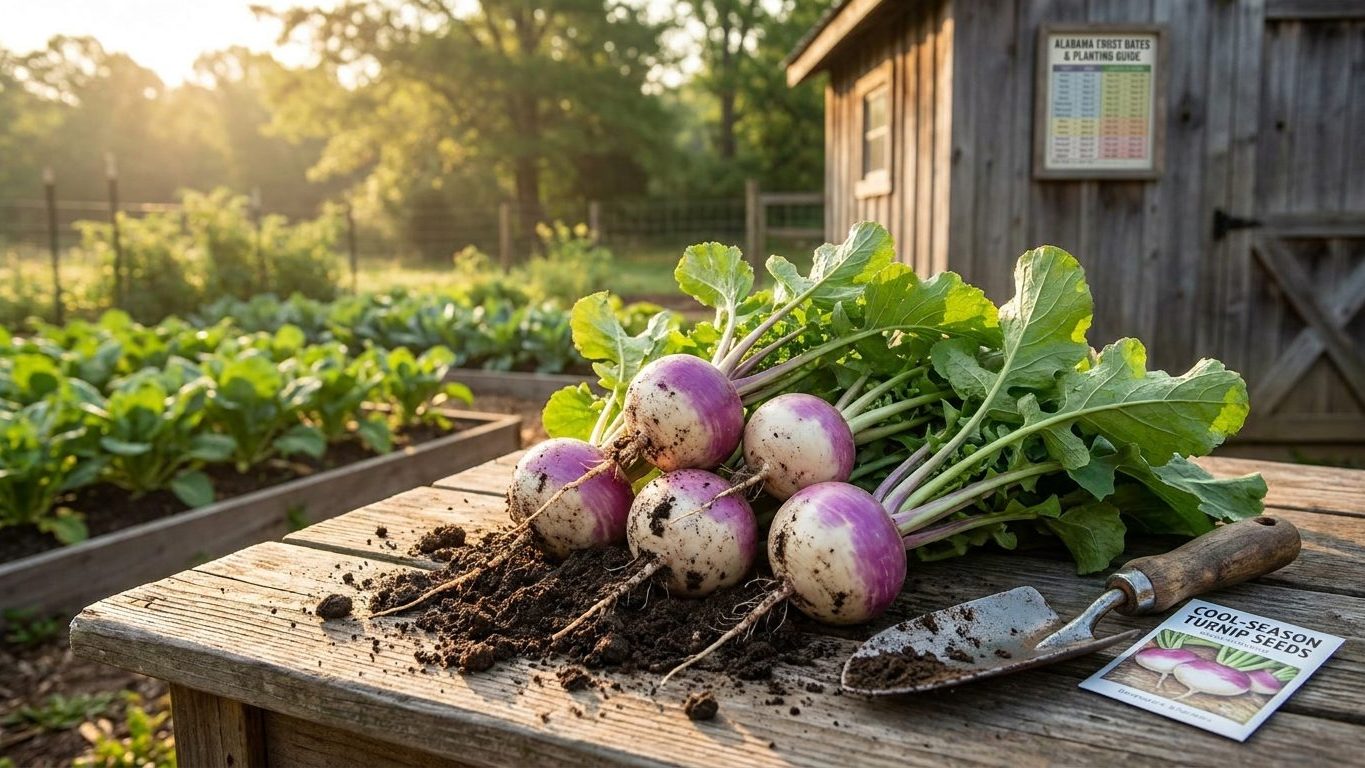

Georgia gardeners get two sowing windows for turnips: a short one in late winter and a longer, more reliable one in late summer through early fall. The fall window matters most here, because Georgia’s mild autumns let turnip roots and greens finish before the ground truly locks up.
The short answer for Georgia
Turnips in Georgia go in the ground twice a year. The spring planting runs from late January into mid-February, timed 4 to 6 weeks ahead of the region’s last spring frost, which NOAA’s 1991-2020 climate normals place between March 11 and March 29 at the Atlanta reference station. That date range is not a promise, it is a probability band: it marks the window in which a 32°F freeze has a 30 to 70 percent chance of occurring, based on three decades of data from station USW00013874. Plant too early and a late freeze can still nip young seedlings; plant right at the edge of that window and you’re gambling on the tail end of the odds.
The bigger, safer window comes in late summer. Georgia’s first fall frost, per the same NOAA normals, arrives somewhere between November 13 and December 1. Turnip roots need roughly 45 to 60 days to size up, and turnip greens can be cut in as little as 30 to 40, so counting backward from that fall frost window puts the ideal sowing stretch from mid-August through mid-September. That gives roots enough time to mature in cooling weather without racing a freeze, and it avoids the worst of Georgia’s mid-summer heat, which turnip seed genuinely dislikes.
Both dates come from a single Atlanta-area weather station, and the caution attached to that data matters as much as the numbers themselves. Atlanta’s airport is an urban heat island, so its frost dates run later in fall and earlier in spring than the rest of the state. North Georgia and the mountains freeze several weeks sooner in autumn; the coastal plain stays frost-free noticeably longer. Treat the Atlanta window as a starting reference, not a fixed rule for every county.
What will not work here

Sowing turnips in the heart of a Georgia summer is the most common failure. June and July soil temperatures routinely climb into the range where turnip seed either refuses to germinate evenly or germinates into seedlings that bolt straight to flower under heat stress instead of building a root. A gardener who tries to squeeze in a summer crop and waters once a week, the way you might a tomato, will watch that planting fail even faster: turnip seedbeds need consistent surface moisture to germinate, and Georgia’s summer evaporation rates outpace a weekly soak long before roots ever form.
Rutabaga, turnip’s slower cousin, runs into a different kind of trouble here. It needs 90 to 100 days to size a proper root, and Georgia’s fall frost window closes as early as November 13 in some years. Sow rutabaga after mid-August anywhere outside the mild coastal plain and the math stops working, especially in north Georgia, where fall frost lands weeks ahead of the Atlanta reference date. That’s not a turnip problem so much as a rutabaga-specific one, but it’s the mistake gardeners make most often when they treat the two crops as interchangeable.
Humidity causes its own quiet failure. Georgia’s humid subtropical summers and early falls create ideal conditions for downy mildew and other fungal issues on brassica greens, and tight spacing makes it worse by trapping moisture around the leaves. A bed sown at the density that might work in a drier climate can turn patchy and diseased here well before harvest, even when the timing on the calendar was otherwise correct. Wider spacing and airflow matter more in Georgia than the seed packet’s minimum distance suggests.
What changes across Georgia
Georgia is not one climate, and its USDA hardiness zones make that plain: the state spans 6a to 9b, one of the widest ranges of any state in the Southeast. That spread runs from the cool mountain counties in the far north down to the warm, nearly subtropical coastal plain along the Atlantic and Gulf-adjacent lowlands. A single statewide sowing date simply doesn’t hold across that range, and the frost data behind this page comes from one station, not a state average.
The practical shift is timing, not method. Gardeners in the mountains and northern Piedmont should expect both frost dates to move: spring’s last freeze lingers later into the season, and fall’s first freeze arrives earlier, which shrinks the safe fall sowing window by what can amount to several weeks compared to the Atlanta reference. Gardeners on the coastal plain get the opposite adjustment, with a longer, more forgiving stretch on both ends and more room to push a fall crop into late September without much risk.
None of this means guessing. The USDA Plant Hardiness Zone Map, built on the average annual extreme minimum temperature for a given location, is the tool built for exactly this question, and it’s freely searchable by ZIP code. This page can tell you that Georgia spans zones 6a through 9b; it can’t tell an individual reader which side of that range their own backyard sits on, and it shouldn’t try. Check the map before adjusting the dates above.
Where to check this for your own county
Everything on this page comes from one weather station and one statewide hardiness range, which makes it a useful starting point and a poor substitute for local advice. Georgia’s land-grant extension service, the University of Georgia Cooperative Extension, publishes county-level guidance built specifically to fill that gap: https://extension.uga.edu/.
Once there, two things are worth hunting down. The first is a local or regional planting calendar, since UGA Extension offices often adjust vegetable sowing windows by area of the state rather than publishing one blanket date for all 159 counties. The second is any list of turnip and rutabaga varieties that have actually been trialled in Georgia conditions, since heat tolerance and disease resistance vary enough between cultivars that a variety bred for a shorter, cooler season elsewhere can underperform here regardless of when it’s sown.
A county extension recommendation will always beat a state-level one, and a state-level one will always beat this page, which draws its numbers from a single reference station near Atlanta. That’s not a knock on the data, it’s just what the data is: a reasonable starting estimate for the middle of the state, built to be adjusted once you know your own county’s numbers. If your local office publishes a printed or online calendar with specific dates for your area, that calendar should override the ranges given here.
If you follow the almanac, here is when to plant turnips by the moon. It is a tradition, not a proven method.
Checking this against your own garden
Calendar dates are averages built from thirty years of station data; your own garden is one specific plot with its own drainage, sun exposure, and soil. Three direct observations will tell you more about your actual planting window than any date range.
Start with soil warmth, checked by hand rather than a thermometer. Turnip seed germinates reliably once the soil feels cool but not cold to the touch, roughly the temperature of tap water left to sit outside. If a fall bed still feels warm through the top two inches in late August, that’s a sign your particular spot, likely a south-facing bed or one near a driveway or foundation, runs warmer than the general county average and can handle a slightly later sowing.
Next, watch germination speed. Seedlings that push up true leaves within about a week of sowing confirm the soil temperature was right; a slow, patchy emergence over two weeks or more suggests the bed was either too cold for a spring sowing or too parched for a late-summer one, and points to adjusting the next round earlier or later accordingly.
Finally, watch for an early flower stalk. A turnip that bolts to flower well before the root has sized up is a warning sign, not a milestone: it means the planting hit a stretch of heat or day length it couldn’t handle, usually because it went in too late in spring or too early in a still-hot fall. That single observation, repeated over a season or two, tells you more about your yard’s real microclimate than any frost date ever will.