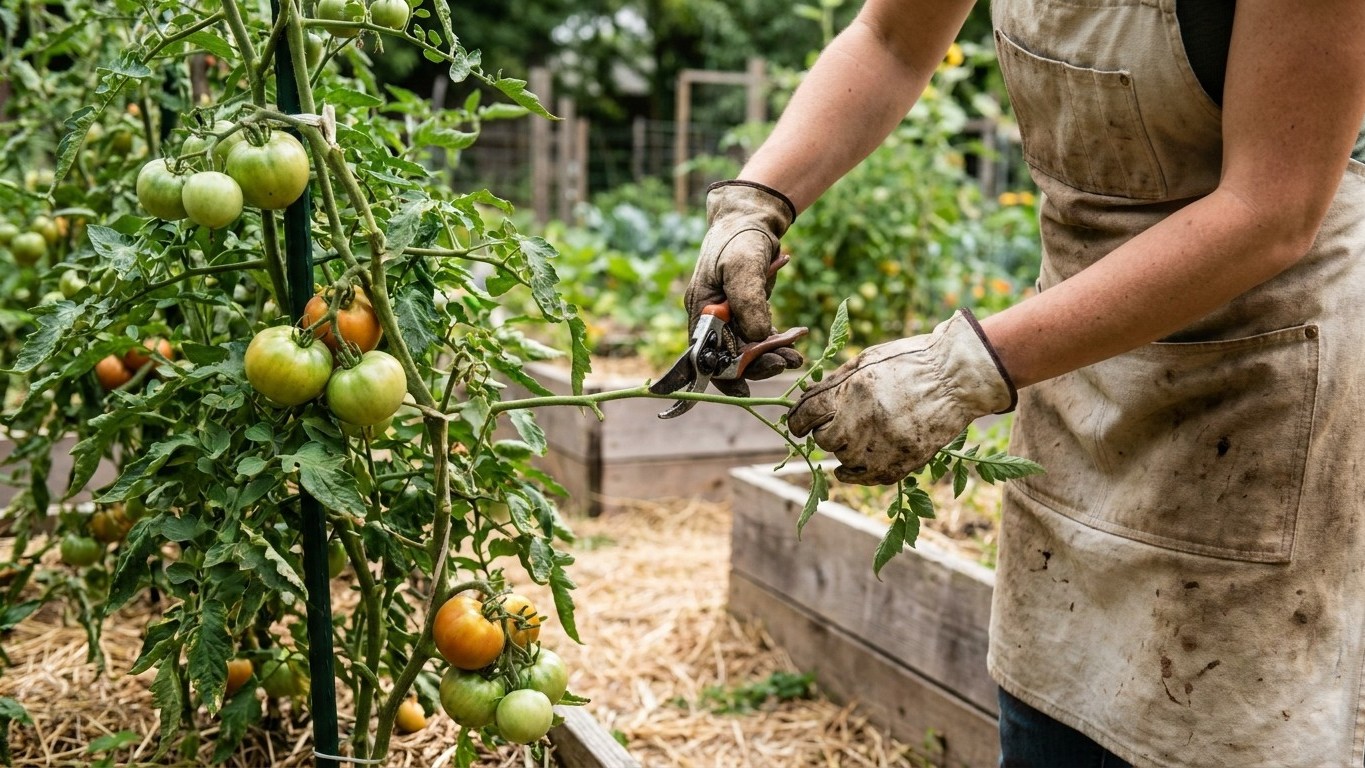

Tomato suckers are the shoots that sprout from the axil, the V-shaped joint where a leaf branch meets the main stem. They grow at roughly a 45-degree angle and, left alone, turn into full side stems with their own leaves and fruit trusses. Pinch out suckers while they’re small, ideally under a couple of inches long, and leave the main stem, its growing tip, and every flower cluster untouched.
Why this matters
A tomato plant only has so much energy to spend. Every sucker you leave becomes another stem competing for the same water and nutrients that would otherwise go into ripening fruit already set on the plant. On an indeterminate variety left completely unpruned, you end up with a dense tangle of stems, most of them producing small, late fruit instead of a few strong stems producing full-size fruit on schedule.
The bigger risk with an unpruned plant is airflow. Dense foliage holds moisture after rain or overhead watering, and that damp, still air is exactly what fungal diseases like early blight and septoria leaf spot need to spread. Skipping pruning doesn’t just cost you yield, it raises disease pressure on the lower leaves, which is usually where blight starts. If you’re already having trouble with soil-borne splash and leaf spot, check how you’re watering, since Watering Tomatoes: How Much, How Often, and Why Consistency Matters Most covers how watering habits feed into the same problem.
When to do it
Start once the plant is established after transplanting and has begun putting out real side growth, usually once you can see two or three sets of true leaves and the first suckers forming in the lower axils. Don’t touch anything before then. A young plant needs all its leaves to build roots and get its footing.
The clearest signal to prune is size, not the calendar. Pinch a sucker while it’s still small enough to snap off with your fingers, generally before it’s grown past a couple of inches. Wait longer than that and you’re cutting a woody stem instead of pinching a soft shoot, which means a bigger wound and a slower plant response. Once the plant starts setting its first flower clusters and small fruit, keep checking every week or so, because new suckers keep appearing all season on indeterminate types. Determinate varieties slow their sucker production once they’ve set their main flush of flowers, which is your cue to ease off.
How to do it

Work down the plant from the top, checking every leaf axil for new growth. A sucker forming in that V-joint looks distinct from a leaf: it has its own tiny stem and will eventually grow its own leaves and flowers if you let it, essentially becoming a second plant growing off the first.
Pinching versus cutting
For anything under about two inches, pinch it off between thumb and forefinger. It should snap cleanly with almost no resistance. For anything larger, or for a mature stem you’ve decided to remove entirely, switch to a clean, sharp pair of pruning shears or snips rather than tearing it by hand, since a rough tear leaves a bigger, more ragged wound that takes longer to heal over.
Wipe your blades with rubbing alcohol between plants, especially if you’ve been working in a bed where you suspect disease. A dirty blade is one of the easiest ways to carry blight or mosaic virus from one plant to the next without ever noticing.
Choosing a leader system
Most home growers run either a single-leader or double-leader system on staked or trellised indeterminate plants:
- Single-leader: remove every sucker, leaving one main stem to climb the stake or string.
- Double-leader: leave the one strong sucker just below the first flower cluster to grow as a second stem, and remove the rest.
- Sprawling or caged plants: prune lightly, removing only the lowest suckers near the soil line to improve airflow, and let the cage support the extra growth.
Whichever system you pick, always remove suckers that form below the first flower cluster. Those lower stems rarely produce much fruit and mostly compete with the top of the plant for resources. Leave the leaf directly attached to a flower truss alone. It’s feeding that cluster of fruit, not competing with it.
What goes wrong

The most common mistake is pruning too hard, too fast. Stripping off every sucker in one pass, especially on a plant that’s already stressed by heat or uneven watering, shocks it and can trigger blossom drop. Spread heavy pruning over two or three sessions rather than doing it all in one afternoon.
The mistake that looks like diligence but isn’t is over-thinning the leaf canopy itself, not just the suckers. Some growers strip lower leaves aggressively to “let more light in,” but those leaves shade the fruit and soil. Remove too many and you expose green shoulders and ripening fruit to direct sun, which leads to sunscald, a pale, papery patch on the fruit’s skin where it’s been overexposed.
Cutting into the main stem by mistake is another one. If you’re pinching in low light or moving fast, it’s easy to grab the wrong shoot and take a chunk of the leader with it. Check twice before you cut anything thicker than a pencil.
Finally, watch for suckers that regrow from a stub left behind after a sloppy pinch. If you leave even a small nub of tissue, the plant will often push out two new shoots from that same point instead of one, which defeats the purpose of pruning in the first place. Pinch or cut flush with the stem, not partway through the sucker.
Doing it differently
Determinate varieties, the bush types that set one main flush of fruit and stop growing taller, generally need little to no sucker pruning at all. Their growth habit is already compact and self-limiting, and heavy pruning can actually cut your total yield since the plant doesn’t keep producing new fruiting stems the way an indeterminate variety does. Save aggressive pruning for indeterminate and semi-indeterminate types that keep growing and fruiting until frost.
In a greenhouse or high tunnel, growers often run a strict single-leader system tied to a string or trellis, since space is tight and airflow needs extra help without open-air wind to move humidity out. Container-grown plants usually do better with lighter pruning than staked plants in open ground, since the smaller root volume can’t always keep up with rapid regrowth, and a bit of extra leaf cover helps shade the pot and roots from overheating.
In a raised bed with cages instead of stakes, many gardeners skip formal leader training altogether and just remove the lowest suckers and any foliage touching the soil, letting the cage carry the rest of the sprawl. It’s a lower-maintenance approach that trades some fruit size for less weekly work, and it’s a reasonable trade if you’re managing more than a couple of plants. Whatever method you use, keep a fresh layer of mulch under the plant to cut down on the soil splash that spreads disease onto lower leaves, which is covered in Mulching Tomatoes: What to Use, How Deep, and When to Lay It Down.
Common questions
Do I need to prune tomatoes at all?
Not strictly, but an unpruned indeterminate plant will sprawl heavily, take up far more space, and usually ripens fruit later and smaller than a pruned one. Determinate varieties get by fine with little or no pruning, so check which type you’re growing before deciding how much work it needs, as covered in How to Grow Tomatoes.
What happens if I accidentally pull off a flower cluster while pruning?
You lose that potential fruit, but the plant recovers fine and will keep setting new flower trusses further up the stem. It’s a reason to go slowly and check each shoot before you pinch, especially early in the season when suckers and small flower stems can look similar to a beginner.
Can I root the suckers I cut off and grow new plants from them?
Yes. A tomato sucker will root in water or damp soil within a week or two and grow into a genetically identical plant, which is a useful trick if you want a late-season backup plant or extra of a variety you like.
Should I prune the leaves below the first ripe tomatoes?
Once a lower truss has fully ripened, it’s reasonable to remove the leaves right below it to improve airflow near the soil line, but don’t strip leaves above fruit that’s still green and growing. Those leaves are still feeding the fruit, and picking is covered in more detail in Harvesting Tomatoes: When to Pick, and Ripening the Rest Indoors.