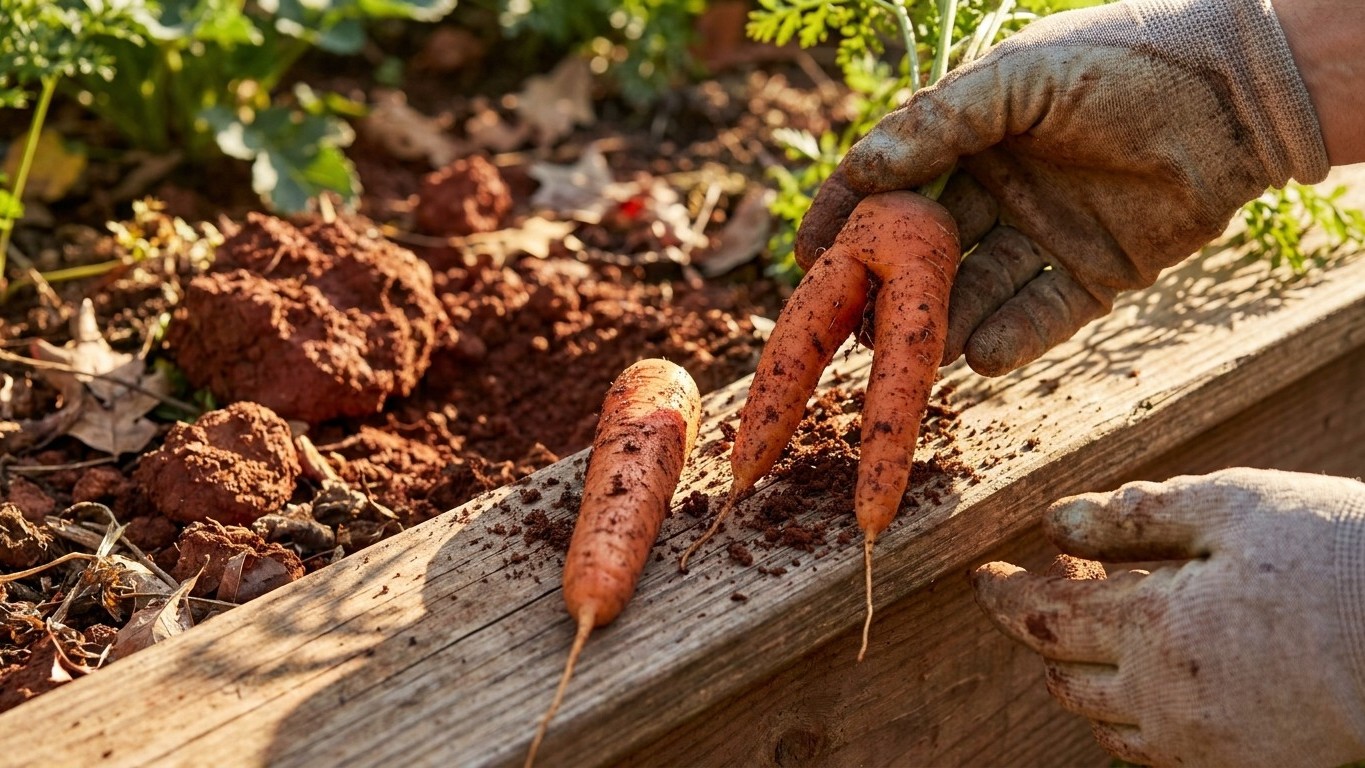

Not simply that. The soil that represents Hawaii, the Hilo series, is loaded with clay and silt, the kind of texture that usually forks a carrot root fast. But this is volcanic ash soil, and it drains and breaks apart differently than ordinary heavy ground. The short version: expect some risk of forking unless you build up the bed, and don’t take the state number as your own garden’s number.
The short answer
Hawaii’s representative soil, mapped by the USDA NRCS State Soils program, is the Hilo series, an Andisol, a soil formed from volcanic ash. That matters because Andisols behave nothing like a typical clay loam even when the lab numbers look heavy. The surface horizon of the major components of the Hilo series runs 10 percent sand, 35 percent clay and 55 percent silt, a texture with almost no sand at all and dominated by silt and clay together. Surface pH sits around 5.8, slightly acid. Organic matter is unusually rich, about 9.0 percent. And despite that clay-and-silt-heavy makeup, the drainage class is listed as well drained.
Utah State University Extension’s guidance on carrots is direct on this point: carrots want deep, sandy, well-drained soil rich in organic matter, and heavy or rocky soil makes the root fork. Judged purely on the sand-clay-silt split, the Hilo series is heavy ground. Ninety percent of its surface fines are clay and silt, only 10 percent sand. That’s the profile Utah State warns will bend, split or fork a carrot root as it tries to push down through compacted, fine-grained soil.
What softens that verdict is the well-drained rating and the volcanic-ash structure. Andisols hold water and phosphorus unusually well while still allowing roots and air to move through the profile, a quirk of how volcanic ash particles bond. That doesn’t erase the forking risk. It just means the fix Utah State recommends for heavy soil, plenty of compost worked in and double digging before you sow, has a better chance of paying off here than it would in a dense, poorly drained clay elsewhere. A raised bed filled with a lighter, sandier mix removes the guesswork entirely and is the safer bet if you want straight, unforked roots without amending the native ground first.
None of this is a verdict on your yard. Hawaii spans hundreds of mapped soil series, and the Hilo series is only the one USDA lists as representative of the state as a whole. A garden a few miles away, on a different lava flow, at a different elevation, or on ground a builder graded and filled, can carry a completely different texture, pH and drainage class. Treat the numbers above as a starting point for what the region’s soil tends to do, not a diagnosis of the dirt under your own carrots.
The test that settles it in your own garden
The state number tells you what to expect in general. Your own bed tells you what will actually happen to a carrot root planted in it. None of the steps below require lab equipment, just a shovel, some patience, and a little attention to what the soil does in your hands and under water.
- Dig a test hole at least a foot deep where you plan to sow carrots, and note how far down you can go before you hit a rock, a hardpan layer, or dense compacted ground. Carrots need open, loose soil to the depth the variety is expected to grow; anything that stops your shovel will stop the root too.
- Check for stones and debris as you dig, since even small rocks and chunks of buried construction fill are common causes of forked and misshapen roots, regardless of what the surrounding soil texture looks like on paper.
- Feel the texture by taking a handful of moist soil from the hole and squeezing it. Soil that forms a slick, sticky ribbon between your fingers is clay-heavy and will need the compost and double-digging that Utah State Extension recommends before you sow. Soil that falls apart and won’t hold a shape is sandy and drains fast, closer to what carrots prefer.
- Watch how water drains. Fill the same hole with water and see how it behaves. Water that sits for a long stretch signals heavy, slow-draining ground that will need raised beds or heavy amending; water that disappears quickly signals lighter, better-draining soil more forgiving of straight root growth.
Run through these four steps in a couple of different spots in the garden, not just one, since texture and drainage can shift within a few feet, especially on ground that’s been disturbed, filled, or terraced.
What goes wrong here
- Forking in heavy ground. With a texture that runs 35 percent clay and 55 percent silt at the state level, and only 10 percent sand, roots can meet resistance they can’t push through and split into two or more legs. The remedy Utah State Extension gives is straightforward: work in plenty of compost and double dig the bed before sowing, loosening the soil well beyond the depth the root will reach.
- Poor germination in a hot spell. Carrot seed is small and sits near the surface, and a crust forming on drying soil during a run of hot weather can keep seedlings from breaking through. Keeping the top inch of the bed consistently moist during germination, rather than letting it dry and crust between waterings, gives the fine seedlings a better chance of pushing up.
- Splitting from uneven water. Roots that get a dry stretch followed by a heavy soak tend to split lengthwise as they swell unevenly. A steady, even watering schedule through the growing period, rather than occasional deep floods after dry spells, keeps the root growing at a consistent rate and avoids that kind of cracking.
- Rocky and debris-filled patches. Even in soil that tests well overall, buried stones and construction debris in a particular bed can catch a growing root and send it forking around the obstruction. Clearing debris by hand when you dig your test hole, rather than assuming the whole bed matches the general soil description, catches this before you sow.
Common questions
Does a high organic matter percentage mean I don’t need to add compost?
Not necessarily. The 9.0 percent organic matter figure for the Hilo series describes the surface horizon as mapped by USDA NRCS, not a cultivated garden bed that’s been dug, planted and watered season after season. A worked bed can lose organic matter over time, and Utah State Extension’s advice to add compost applies to structure and texture as much as to fertility, loosening heavy ground so roots can push through it.
Is the 5.8 pH figure something I should treat as my own soil’s pH?
No. That number is the representative surface pH USDA NRCS records for the major components of the Hilo series specifically, and it’s meant to describe that mapped soil, not every garden across the state. A home soil test is the only way to know the actual pH of your own bed.
Do carrots need a transplant date if I want a certain size root?
No. Carrots are sown directly in place; there’s no transplanting involved. The 70 to 100 days often cited for carrots to mature are counted from the seeding date, not from any transplant date, since the seed goes straight into the bed where the root will grow.
If my soil tests sandy, does that guarantee straight roots?
Sandy, well-drained soil rich in organic matter is what Utah State Extension identifies as ideal for carrots, and it removes the main mechanical cause of forking. It doesn’t guarantee perfect roots on its own, since buried stones, debris, or uneven watering can still cause splitting or forking even in otherwise favorable soil.