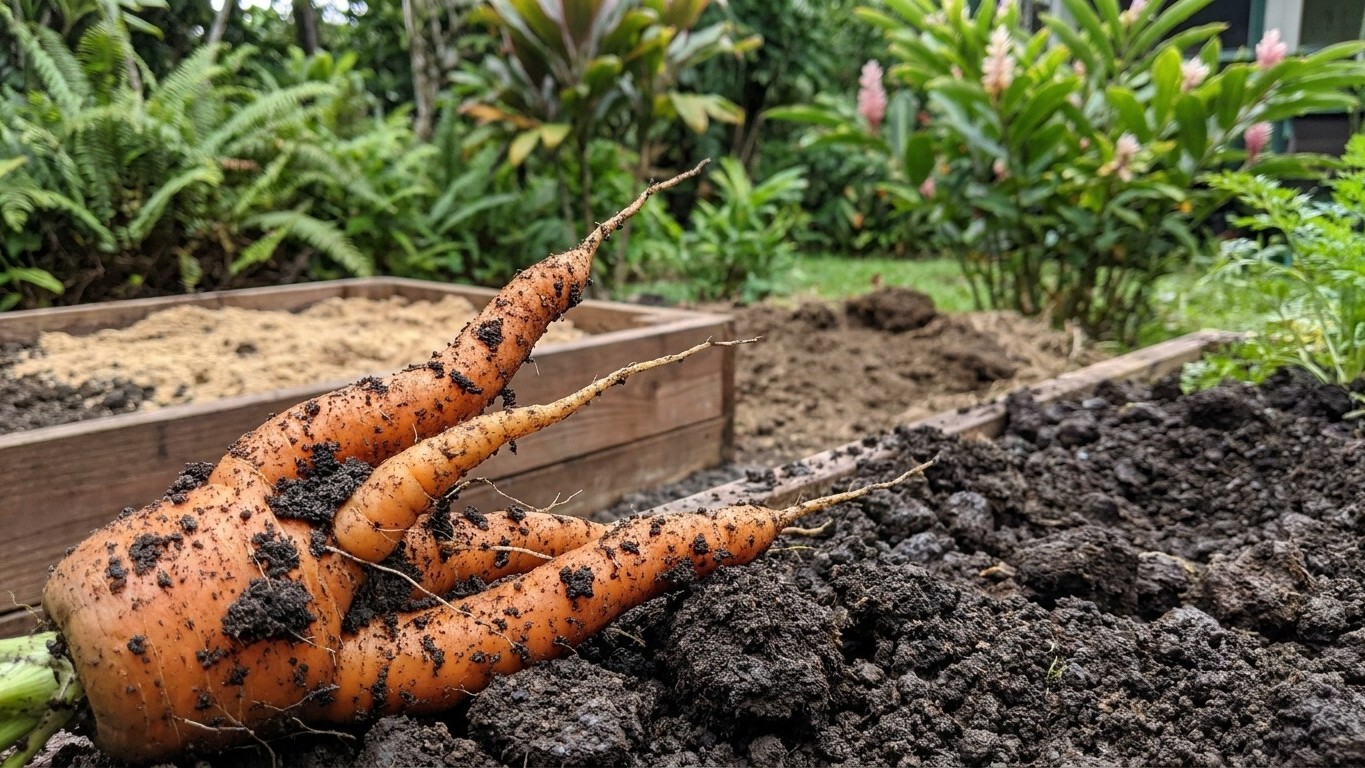

If you’re gardening in Hawaii, the answer is straightforward: your carrots will likely fork unless you build a raised bed or dig deep and mix in compost. The state’s benchmark soil, the Hilo series, runs heavy on clay and silt, the opposite of what a straight carrot root wants. And forget a frost-based calendar entirely, because in the places where people actually garden here, frost never happens.
The short answer
The soil that USDA NRCS uses to represent Hawaii is called the Hilo series, and it tells you a lot before you even pick up a trowel. It’s an Andisol, a volcanic-ash soil, which sounds exotic but mostly means it’s light and porous with an unusual talent for holding both water and phosphorus. The surface horizon runs slightly acid, with a pH around 5.8. But the texture is where a carrot grower needs to pay attention: 10 percent sand, 35 percent clay, and 55 percent silt, with organic matter around 9.0 percent. It’s classified as well drained, yet that texture reading is heavy clay-silt, not the loose, sandy profile a carrot root prefers.
Utah State University Extension puts it plainly: carrots want deep, sandy, well-drained soil rich in organic matter, and heavy or rocky ground makes the root fork. A silty clay soil like the Hilo series, even one that drains reasonably well overall, still resists a taproot pushing straight down. The fix isn’t a different variety. It’s changing the ground the seed goes into, through heavy compost additions and double digging, or by skipping the native soil altogether with a raised bed filled with a loose, amended mix.
| Factor | Hilo series (state soil) | What carrots need |
|---|---|---|
| Texture | 10% sand, 35% clay, 55% silt | Deep, sandy, loose |
| Organic matter | About 9.0% | Rich in organic matter |
| Drainage | Well drained | Well drained |
| Surface pH | About 5.8 | Not specified by this source |
Here’s the caveat that matters more than the numbers themselves: Hawaii spans hundreds of mapped soil series, and the Hilo series is only the one USDA singles out as representative of the state as a whole. Your actual yard could sit on young lava rock, wind-deposited ash at a different elevation, or fill dirt trucked in when a subdivision went in. This is a starting point for thinking about what the region’s ground tends to do, not a diagnosis of the dirt under your own carrots.
The test that settles it in your own garden
State-level soil data can’t tell you what’s six inches under your own raised bed or backyard plot. The only way to know is to go look, with your hands and a shovel, before you commit a packet of seed to the ground.
- Dig a test hole at least a foot deep. Carrots need room to run straight down. If you hit hardpan, dense clay, or a shelf of rock well before that depth, a raised bed becomes the practical answer rather than an afterthought.
- Look for stones and debris as you dig. Any rock, chunk of coral, construction fill, or root mass in the root zone will deflect a growing tip and start a fork, no matter how good the soil chemistry looks on paper.
- Feel the texture between your fingers. Squeeze a moist handful. If it holds a tight, slick ribbon like modeling clay, you’re dealing with the kind of heavy ground that resists a straight taproot. If it crumbles and feels gritty, that’s closer to what carrots want.
- Watch how water moves through it. Fill your test hole with water and see how long it takes to drain. Water that lingers for hours points to compaction or a clay-heavy layer; water that vanishes almost immediately suggests a coarser, more open profile.
When to sow here
This is where Hawaii breaks from almost every other state guide you’ll read. According to NOAA’s 1991-2020 climate normals for a Hawaii station, no freeze occurs in inhabited areas at all. Frost happens only on the summits of Mauna Kea, Mauna Loa, and Haleakala, elevations no home garden touches. There is no last-frost date to count backward from, no frost window to plan around, and no spring thaw to wait out.
That doesn’t mean timing is irrelevant. It just means the clock that matters here runs on rainfall, elevation, and which side of an island you’re on, not a calendar frost line.
- Think elevation instead of season. Higher ground runs cooler and can sit closer to the germination sweet spot carrots prefer, generally cited as 55 to 65 F, for more of the year than low, coastal sites do.
- Factor in windward versus leeward exposure. Windward slopes catch far more rain and stay consistently moist, which affects both germination and how quickly you’ll need to intervene with irrigation. Leeward, drier sides demand more deliberate watering to keep germination even.
- Sow when soil moisture is steady, not sudden. A carrot seed sitting in soil that swings from soaked to bone-dry germinates unevenly. Aim for a stretch when rainfall or irrigation can stay consistent for the two to three weeks it takes seedlings to establish.
- Count 70 to 100 days from the seeding date. Carrots are sown directly into the ground and never transplanted, so every maturity estimate runs from the day the seed goes into the soil, not from any later stage.
What goes wrong here
- Forking in the native clay-silt ground. The Hilo series’ 35 percent clay and 55 percent silt content is exactly the dense profile Utah State University Extension warns will split and deflect a carrot’s taproot. The remedy is compost worked in generously and double digging, or simply growing in a raised bed filled with a looser mix.
- Poor germination during a hot, dry stretch. Carrot seed germinates best in the 55 to 65 F range. In lower-elevation gardens where soil temperatures run warmer for long stretches, seed can sit and rot or germinate erratically. Sowing at a slightly higher elevation, or timing for a cooler, damper spell, keeps germination more even.
- Splitting roots from uneven watering. Hawaii’s rainfall can swing hard between a dry week and a soaking one, especially on windward slopes. That inconsistency causes roots to expand suddenly after a dry spell, cracking the carrot from the inside. Mulching and a steady watering schedule smooth out the swings.
- Crusting after heavy rain on silty ground. The Hilo series’ high silt content can cake into a hard surface crust after a downpour, which then blocks small seedlings from pushing through. A light layer of compost or fine mulch over the seed row helps keep the surface workable.
Checking this against your own county
Everything above describes tendencies tied to one representative soil series and a statewide climate pattern, not the plot behind your house. For the local read, contact your extension service directly: the University of Hawaii’s College of Tropical Agriculture and Human Resources (CTAHR) Cooperative Extension. They can point you toward soil testing options and guidance specific to your island and elevation, which matters far more for carrots than any statewide average.
Common questions
Do carrots need a frost-free season to mature in Hawaii?
No frost season is needed or present in inhabited Hawaii, since freezing temperatures only occur at high summit elevations no garden reaches. Maturity instead depends on steady moisture and soil temperature staying in the range carrots tolerate for growth.
Is the Hilo series soil found everywhere in Hawaii?
No. It’s the series USDA lists as representative of the state overall, but Hawaii contains hundreds of mapped soil series that vary by island, elevation, and lava age. A soil test or a hands-on dig in your own yard is the only way to know what you’re actually working with.
Can I skip amending heavy soil if I just pick a shorter carrot variety?
The sourced guidance here doesn’t name specific varieties, so no variety recommendation can be made from it. What’s clear is that heavy or rocky soil causes forking regardless of the root’s shape, and the documented fix is amending the soil with compost and double digging, or growing in a raised bed.
Why does my carrot bed crust over after rain?
Soil high in silt, like the Hilo series’ 55 percent silt content, tends to cake into a hard surface layer once it dries after heavy rain. A thin layer of compost or fine mulch over the seed row keeps that crust from blocking germinating seedlings.