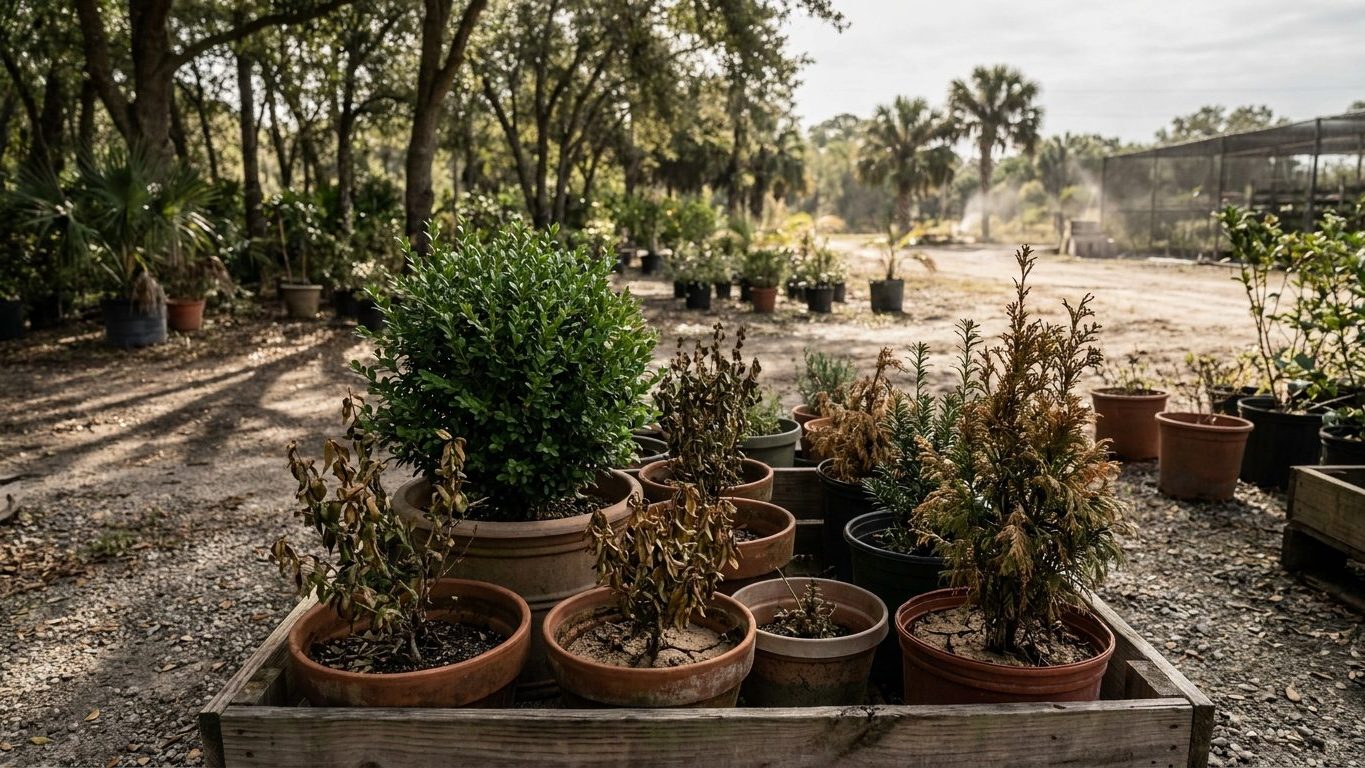

Of the 12 hedge species documented on this site, none holds across all of Hawaii, which spans USDA zones 9a to 13a. Seven fail everywhere in the state. Five survive in only part of it, and four of those five only in the coolest zones, 9a and 9b. Any “hardy” tag on a mainland shrub needs checking against your own zone before you buy.
What actually holds in Hawaii
The seven that fail
Start with the losers, because that is the mistake you can’t undo once the plants are in the ground. Common boxwood (Buxus sempervirens), common privet (Ligustrum vulgare), cherry laurel (Prunus laurocerasus), Anglojap-type yew (Taxus x media), eastern arborvitae (Thuja occidentalis), eastern hemlock (Tsuga canadensis) and arrowwood viburnum (Viburnum dentatum) are all classics of mainland hedging. None of them has a documented hardiness range that touches a single zone Hawaii has. They are cold-country plants, and no nursery tag will change that.
The verdict comes from crossing two sources. Hardiness ranges come from the NC State Extension Gardener Plant Toolbox. The territory’s zones come from the USDA Plant Hardiness Zone Map 2023, built on 1991-2020 normals. That map uses one variable only: the average annual extreme minimum temperature.
The five that hold in part
Five species do overlap. Leyland cypress (x Hesperotropsis leylandii) covers zones 9a through 10b. American hornbeam (Carpinus caroliniana), inkberry holly (Ilex glabra), winterberry holly (Ilex verticillata) and eastern red cedar (Juniperus virginiana) are limited to 9a and 9b. That is a zone answer, not a yes or a no. If your address sits in zone 11 or 12, all five are off the table.
Which zone you are in depends on where you garden, not on which island you live on. Look up your own ZIP code on the USDA map instead of trusting a territory-wide number.
“Holds” here means survives, not thrives. The map measures cold and nothing else, and at the upper end of a plant’s range the limit is often heat. A species listed to 10b on paper may still sulk at the warm end of that zone. Treat the edge of any range as a place where you are gambling.
There is also no frost to plan around. NOAA NCEI’s 1991-2020 Climate Normals record zero days per year at or below 32°F for the station used here, and no computable freeze dates. Frost only reaches the high volcanic summits (Mauna Kea, Mauna Loa, Haleakala), never the places people garden.
The hedges you can never cut back down
One field in the data matters more than any hardiness number: whether a plant regrows from old wood. Two of the five do not. Leyland cypress and eastern red cedar will never come back if you cut into bare, leafless interior growth. The brown stubs stay brown.
The two that can’t be renovated
Leyland cypress grows 3 to 4 feet a year and is sold as a screen of 15 to 25 feet. A hedge left alone for two seasons can outrun the height you wanted, and there is no rescue cut. You can trim the green outer growth, but nothing more. The listed pruning window is late spring to midsummer.
Eastern red cedar is slower, at 12 to 24 inches a year, and makes a screen of 8 to 20 feet. Its rule is late winter, light cuts only. Light means you only shave the outside. Both plants demand the same habit: decide on a final height when you plant, and start trimming to it early instead of waiting until the hedge is oversized.
The three that forgive mistakes
American hornbeam, inkberry holly and winterberry holly all regrow from old wood. You can cut them hard, wait a season, and get a hedge back. Hornbeam adds about 12 inches a year and reaches 6 to 15 feet as a hedge; its window is midsummer, after the first flush of growth. Both hollies add 6 to 12 inches a year and reach 5 to 15 feet, and the listed timing is late winter while dormant.
That last phrase deserves some skepticism. “Dormant” is a mainland idea, tied to winter cold. In a place with no frost season, a plant may never fully shut down, so treat the listed windows as a starting point and ask your extension office what dormancy looks like at your elevation.
Matching the plant to the job
Here are the five side by side, using only what the source lists. Zones are the ones that overlap Hawaii.
| Plant | Zones in Hawaii | Growth a year | Height | Regrows from old wood | Pruning window |
|---|---|---|---|---|---|
| Leyland cypress | 9a to 10b | 3 to 4 feet | 15 to 25 feet (screen) | No | Late spring to midsummer |
| Eastern red cedar | 9a, 9b | 12 to 24 inches | 8 to 20 feet (screen) | No | Late winter, light cuts only |
| American hornbeam | 9a, 9b | 12 inches | 6 to 15 feet (hedge) | Yes | Midsummer, after first flush |
| Inkberry holly (evergreen) | 9a, 9b | 6 to 12 inches | 5 to 15 feet (hedge) | Yes | Late winter, while dormant |
| Winterberry holly (loses leaves) | 9a, 9b | 6 to 12 inches | 5 to 15 feet (hedge) | Yes | Late winter, while dormant |
Choosing by what you need
For a tall wall against a neighbor or a road, only Leyland and red cedar reach the height, and they lock you into it. Leyland is the one outside the coldest zones, reaching 10b. Choose it only if you will trim early and often.
For a clipped hedge you may want to reshape later, the three forgiving plants are the safer bet. Inkberry holds its leaves year-round, which is what most people want from privacy. Winterberry drops its leaves in winter, so it thins out just when you might want cover. It is a better fit for a boundary than for a screen.
All of this applies only to gardens at the cool end of the state. The documented list here is weighted toward temperate plants, and it does not rate the tropical plants that dominate lowland hedges in Hawaii. For those, the University of Hawaii’s extension service is the better guide. For the wider picture, the Hedges hub covers how hedges behave in general. The same range-against-zone test gives different answers elsewhere, as in Hedge Plants for Texas: What Holds, and What Only Looks Hardy and Hedge Plants for Oklahoma: What Holds, and What Only Looks Hardy.
The ground you are planting into
USDA lists the Hilo series as the soil that represents Hawaii. It is an Andisol, a volcanic-ash soil. Andisols are light and porous, yet unusually good at holding both water and phosphorus. NRCS records for the surface layer of the series show a pH of about 5.8 (slightly acid) and a texture of 10 percent sand, 35 percent clay and 55 percent silt, which the record classes as heavy clay. Organic matter is about 9.0 percent, and the soil is well drained.
Those figures come from NRCS Soil Data Access, from four mapped components of the series, queried on August 29, 2026. They describe the mapped surface, not a worked garden bed. This is one series out of hundreds in the state. A lava-rock lot, a graded subdivision pad or a valley floor can be nothing like it, and a builder’s fill will be different again. Use the Hilo numbers to understand what ground in the state tends to do, which here means holding both moisture and nutrients while still draining. Do not read the pH as your pH.
Test before you plant
A hedge is a long commitment, and a soil test costs far less than replacing a row of dead plants. Your county extension office can point you to a lab and help you read the result.
Because phosphorus is held so tightly in ash soils, a test is also the only sound basis for deciding what to add. Guessing at fertilizer is how you waste money.
As for timing, there is no frost calendar to follow. In lowland Hawaii, planting time is set by rainfall, elevation and whether your site is windward or leeward, not by a last-frost date. Ask your extension office what your specific site’s rainfall pattern looks like before you set out plants.
Common questions
Does any hedge plant on this list survive across all of Hawaii?
No. Of 12 documented species, zero hold across the whole range of zones 9a to 13a. Five hold in part, seven in none. Leyland cypress reaches furthest, to zone 10b.
What is the last frost date for planting a hedge in Hawaii?
There isn’t one for inhabited areas. NOAA NCEI’s 1991-2020 normals show zero days per year at or below 32°F for the station used here. Frost occurs only on the high summits. Base planting decisions on rainfall, elevation and exposure.
Can I cut Leyland cypress back hard if it gets too tall?
No. Leyland cypress does not regrow from old wood, and neither does eastern red cedar. Cuts into bare wood leave permanent gaps. American hornbeam, inkberry and winterberry all regrow after hard pruning.
Does a hardiness zone tell me a plant will thrive?
No. The USDA zone rests on one variable, the average annual extreme minimum temperature, so it says nothing about heat, rain or soil. The 2023 map also uses 1991-2020 normals, which makes it a record of the past three decades, not a forecast.