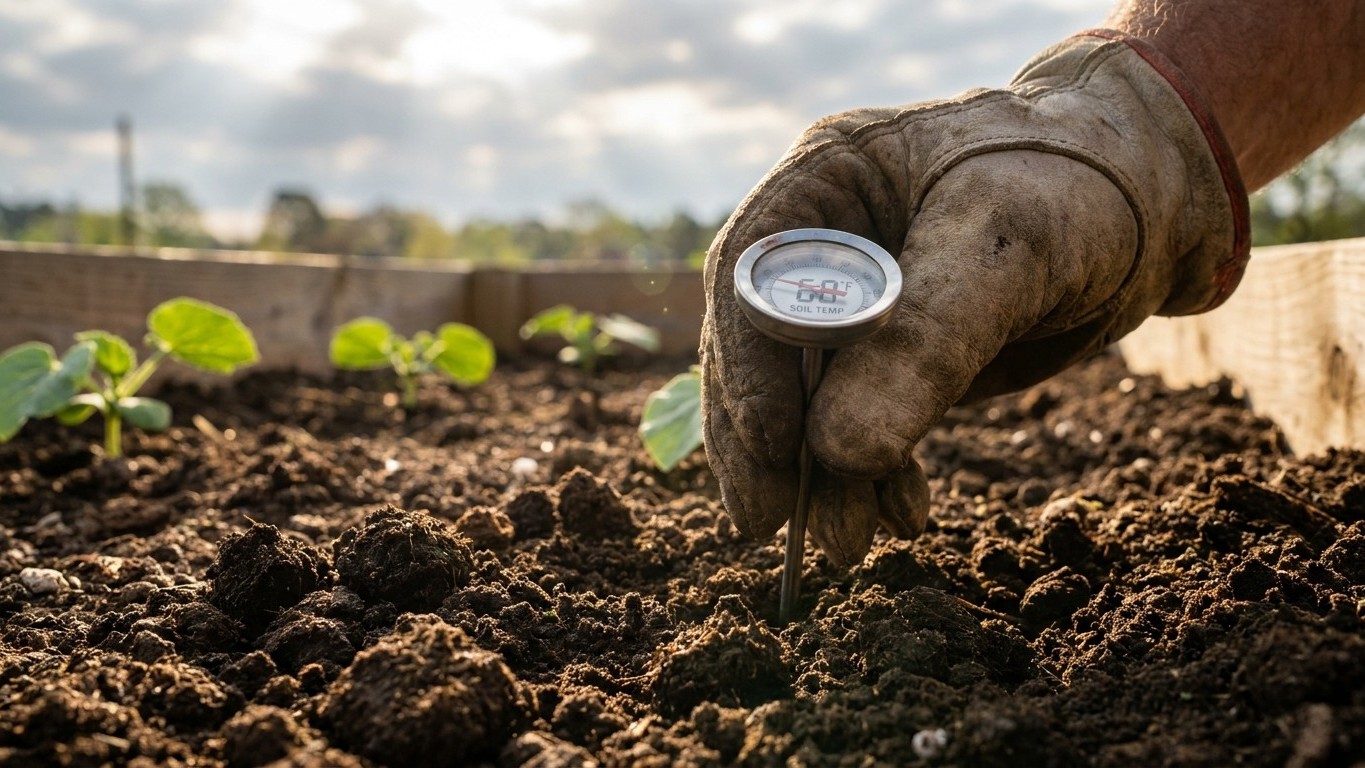

Lowland Hawaii has no frost season at all, so there’s no calendar built around a last freeze date here. What decides when to plant melons is soil warmth, rainfall timing and whether the garden sits on the wet windward side or the dry leeward side of an island.
When the soil is warm enough in Hawaii
Most melon guides start with a frost date. This one can’t, and that’s the point. NOAA’s 1991-2020 Climate Normals for station USW00022521 report zero days per year at or below 32°F, with every freeze percentile flagged as not computable. Frost in Hawaii happens only near the summits of Mauna Kea, Mauna Loa and Haleakala, thousands of feet above any garden bed. A frost date is normally a probability, not a promise, but here it isn’t even a probability. There’s simply nothing to count.
So the useful question isn’t “when does frost end,” it’s “when is the soil warm and dry enough to work.” Melons germinate poorly in cold, waterlogged ground regardless of air temperature, and lowland Hawaii’s soil rarely drops low enough to matter. What varies instead is rainfall. The wetter months bring soil that stays soggy longer after a storm, delaying the point where a melon seed will actually push through rather than rot. On leeward slopes, where rain is lighter and drainage faster, soil reaches workable warmth and dryness sooner and stays that way longer.
Elevation changes this picture fast. A garden at sea level in a leeward district behaves nothing like one a few thousand feet up, where cooler air and heavier cloud cover slow soil warming even without frost. This is why island-wide advice falls apart quickly here, and why the University of Hawai’i’s Cooperative Extension Service (CTAHR) is the better source for a planting window tied to a specific district rather than the state as a whole.
What this means for the type of melon you choose
Rather than racing a frost date, gardeners in wetter or higher districts do better choosing melon types bred for shorter, more forgiving windows and starting them once a dry spell settles in, rather than by the calendar month. In drier leeward gardens, soil warmth is rarely the limiting factor at all. Talk to CTAHR about the types that have actually been trialled in your district, since a variety that performs on the Kona coast can struggle on windward Oahu for reasons that have nothing to do with temperature and everything to do with rain.
How long the season lasts here
Normally this section subtracts a last spring frost from a first fall frost to get the length of the growing window. That subtraction isn’t possible in lowland Hawaii, because both dates are non-events: NOAA’s normals show no computable freeze percentile in spring or fall at station USW00022521. There is no frost to bookend the season, which means, practically speaking, the growing window doesn’t close on a calendar date at all.
That’s a very different situation from most of the continental United States, where a short frost-free window forces gardeners to treat their single sowing as the only shot they get. In lowland Hawaii, the limiting factor shifts entirely to rainfall and soil moisture rather than temperature. A district with a distinct dry season can plant melons across most of the year, provided the soil isn’t sitting wet from storms. That opens the door to more than one sowing in a single year, spaced around the wetter months rather than around frost risk.
This changes how much a transplant versus a direct-sown seed matters, too. Where a short frost-free window forces gardeners toward transplants to squeeze in a harvest before cold arrives, a year-round window removes that pressure. Direct-sowing becomes a reasonable default, since there’s no race against an ending date, and the root disturbance that comes with transplanting (a real risk for a plant that resents having its roots disturbed) becomes an unnecessary gamble rather than a necessary one.
Gardeners who want to make use of that long window, rather than planting once and hoping, should look at the site’s succession sowing guide for how to stagger plantings through a season that, here, is really defined by rain rather than frost.
Heat and water in Hawaii
Honolulu’s reference station logs 18.7 days a year at or above 90°F, per NOAA’s 1991-2020 Climate Normals. That’s a moderate heat load, not an extreme one. Melons need accumulated warmth more than they need any single hot day, and a territory averaging under 19 days that hot in a year is one where heat isn’t guaranteed to build fast, especially at higher elevation or on windward slopes where cloud cover and trade winds keep afternoons cooler. In those districts, the type of melon and how the soil is warmed (black plastic mulch, raised beds, siting against a sun-facing wall) matter more than picking a particular week to sow.
Rainfall is the sharper story. Summer rain across June, July and August averages only about 1.9 inches total at the reference station, against 16.4 inches for the full year. June is the driest month at 0.5 inches, July close behind at 0.52 inches, and August a touch wetter at 0.84 inches. That’s a genuinely dry summer by any standard, and it puts irrigation, not rainfall, in charge of how large the fruit gets and how sweet it finishes.
This is where a hot, dry-summer territory behaves very differently from a cool, damp one, and Hawaii’s leeward districts fall squarely into the dry camp. When rain is this scarce through the growing months, the final two to three weeks before harvest become the period where water management decides sugar content: too little water and fruit stalls small, too much right before picking and the sugar dilutes. That’s a leeward-district story, though. Windward slopes and higher elevations get considerably more rain than this reference-station figure suggests, and gardeners there are managing the opposite problem: soil that stays wet enough, often enough, to invite powdery mildew and slow, uneven ripening rather than drought stress.
Rainfall normals like these describe the reference station, not any one garden. A rain shadow a few miles away, a slope facing the trades instead of away from them, or simply a wetter or drier year than the 1991-2020 average can shift the real number substantially. A rain gauge on the actual plot is what settles it, not this figure alone.
Which melons suit Hawaii
The right melon here is a question of type, not brand name, and the district a garden sits in should drive that choice more than anything else. Because lowland Hawaii doesn’t have a frost-bound season, the usual logic of “pick the earliest type to beat the first fall frost” doesn’t apply in most districts. Instead, the type should match the district’s rainfall pattern and heat load.
In drier leeward areas, where days above 90°F accumulate more readily and summer rain is thin, types that tolerate heat stress and reward reliable irrigation make sense, provided the grower is prepared to manage watering through that final ripening stretch rather than leaving it to chance. In wetter windward districts and at higher elevations, where cloud cover slows heat buildup and rain lingers in the soil, disease resistance becomes the first thing to check for, since powdery mildew and fruit rot are the more common failure points there, not lack of warmth.
Airflow and siting matter more than the calendar in both cases. A melon planted where trade winds can move through the foliage dries faster after rain, which matters most on windward and upland sites. On hot leeward ground, some shade at the root zone or a heavy organic mulch keeps soil temperature from spiking to the point of stressing the plant, even while the fruit itself wants full sun.
This page won’t name a specific variety, and that’s a deliberate choice rather than an omission. The types trialled and recommended for Oahu’s windward coast are not necessarily the same ones performing well on the Big Island’s Kona side, and a name picked without that district-level knowledge is guesswork dressed up as advice. The University of Hawai’i Cooperative Extension Service (CTAHR) maintains the trial data by district and is the source that can actually match a variety to a specific garden’s rainfall, elevation and exposure, rather than to the state as a whole.