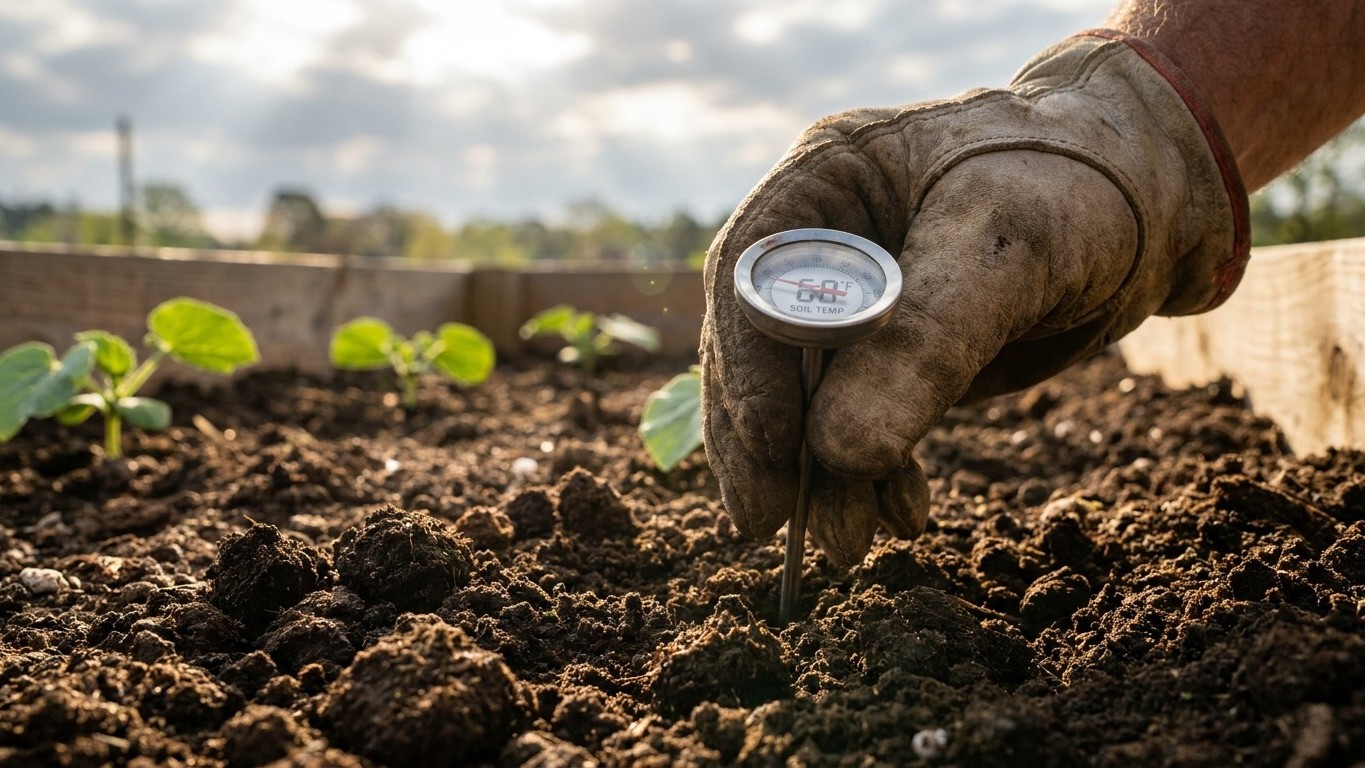

Oklahoma gardeners can put melon seed or transplants in the ground once the frost risk has passed and the soil itself has warmed, typically mid to late April in most of the state. The growing window that follows runs roughly seven months, long enough for a full melon crop and, in many years, a head start on a second one.
When the soil is warm enough in Oklahoma

The date that matters most isn’t the calendar, it’s the thermometer stuck in the dirt. But since nobody plans a garden season around a soil probe reading alone, the last spring frost is the number gardeners actually use. At the Oklahoma City reference station, NOAA’s 1991-2020 climate normals put that date somewhere between March 28 and April 10, with a 30 to 70 percent chance of a 32F freeze in that window. That’s a probability, not a promise, and it’s worth saying only once: some years land early, some late, and a handful surprise everyone.
Suburban and rural properties usually see frost linger later in spring than an airport tarmac does, sometimes by one to two weeks, more if there’s elevation involved. A garden tucked in a low spot or shaded by trees can run a week or two behind a station reading on open ground. So treat March 28 to April 10 as the Oklahoma City benchmark, not a state-wide green light, and check with a county extension office or a personal frost log before committing seed to soil.
Frost, though, is a proxy for something melons actually care about: soil temperature. A frost-free night doesn’t mean the ground is ready. Melon seed sits and sulks, or rots outright, in cold, wet soil, and seedlings set out too early just stall until the soil catches up. Most gardeners wait until the soil is reliably warm and rising, well past the point where the air alone stopped freezing, before direct-seeding melons outdoors. That gap between “frost is over” and “soil is warm enough” is usually a couple of weeks in Oklahoma clay and loam.
Two practices close that gap without guesswork. Laying dark plastic mulch or landscape fabric over the planting bed a week or two ahead of sowing pulls extra heat into the ground during the day. Floating row cover placed over freshly seeded or transplanted melons buys a few more degrees of protection on a cool night without sealing out light. Neither trick beats a genuinely late frost, but both let a gardener plant with more confidence instead of watching the sky and hoping.
How long the season lasts here
Run the two frost windows together and Oklahoma’s frost-free season lands somewhere between 212 and 215 days, depending on where in each range a given year falls. Using the earliest last frost (March 28) against the earliest first fall frost (October 29) gives about 215 days; pairing the latest spring date (April 10) with the latest fall date (November 8) gives about 212. Either way, that’s a season of roughly seven months, one of the more generous windows among the melon-growing states.
A season that long changes the math on how a gardener plants, not just when. Seven months is enough room to direct-seed a first planting in mid to late April, harvest through summer, and still have time left for a second sowing in June or early July aimed at a fall crop before the November frost arrives. That second window is tight enough that it rewards planning rather than improvising, since a melon planted too late in summer runs out of warm days before it finishes ripening.
It also loosens the argument for starting melons indoors. In a short-season territory, transplants are often the only way to get a full-size melon to ripen before frost shuts things down. In Oklahoma’s longer window, direct seeding after the soil has warmed is a reasonable default for most gardeners, and transplants become more of a convenience for an early start than a necessity. The trade-off is real either way: transplants need their roots checked before they go in the ground, since melons dislike root disturbance and a pot-bound seedling can sulk for a week after transplanting, while direct-seeded plants skip that setback entirely.
For gardeners who want to use that longer window fully, the succession sowing guide on this site walks through spacing out plantings so the harvest doesn’t all land in the same two weeks of August.
Heat and water in Oklahoma

Melons grow on accumulated warmth, not on the calendar, and Oklahoma City’s reference station averages 70.7 days a year at or above 90F. That’s a substantial heat load, among the higher counts a melon grower in the U.S. will see, and it means the crop rarely lacks for warmth once it’s established. The bigger question in a territory like this isn’t whether the plant will get hot enough, it’s whether it will get enough water while it does.
Summer rainfall at that same station averages about 11.7 inches across June, July and August, out of 36.4 inches for the year. Broken down by month, June brings 4.49 inches, July drops to 3.59, the driest of the three, and August recovers slightly to 3.6. That pattern, a wetter start to summer followed by a dry midsummer stretch, lines up with exactly the period when a melon vine is setting fruit and needs steady moisture the most.
Rain totals like these never tell the whole story on their own. A thunderstorm that drops an inch in twenty minutes mostly runs off a Oklahoma clay soil rather than soaking down to the root zone, and the same 70-plus days above 90F that ripen the fruit also pull moisture out of the soil fast through evaporation. In practice, that means irrigation, not rainfall, decides how large the melons get, and consistency decides whether they split or rot at the blossom end. Drip irrigation or a soaker hose run on a regular schedule does more for fruit size than an occasional deep soak after a dry spell.
The final two to three weeks before harvest are where sugar content gets decided, and that’s also where a lot of Oklahoma gardeners go wrong by watering heavily right up to picking day. Easing off irrigation slightly as the fruit nears ripeness, without letting the vine wilt, concentrates sugars instead of diluting them. Mulch around the base of the plant helps here too, holding soil moisture steadier between waterings and reducing the swings that heat and dry spells otherwise cause.
Which melons suit Oklahoma
Given a roughly seven-month season, heavy summer heat, and a midsummer dry stretch punctuated by the occasional heavy downpour, three qualities matter more than any specific variety name: how fast a type matures, how it handles heat around its roots, and how well it resists the fungal diseases that a humid Oklahoma thunderstorm season tends to invite.
The season length here doesn’t force a gardener into only the earliest-maturing types the way a shorter northern window would. There’s room for both quicker cantaloupe-type melons and the longer-season watermelon types, including the larger standard varieties as well as the smaller icebox types that finish faster and take up less garden space. Honeydew and other muskmelon-type melons fit as well, though they generally want the fullest run of the season to reach good quality.
Heat management matters regardless of type. Vines planted with enough spacing for airflow dry out faster after a storm, which cuts down on the powdery and downy mildew that thrive in still, humid air. Mulching at the root zone keeps soil temperature more even through those 90-plus-degree afternoons and reduces the moisture swings that stress the plant. In a territory with Oklahoma’s heat load, some light shade cloth over the fruit itself, rather than the whole vine, can prevent sunscald on melons that are otherwise doing fine.
Disease resistance deserves to be the first filter a gardener applies when choosing what to plant, given the combination of summer humidity and periodic heavy rain. That’s also exactly where this page has to stop short of naming names. Which specific melon varieties perform best against Oklahoma’s disease pressure changes from county to county and season to season, and the trials that answer that question happen at the state level, not on a general gardening page. Oklahoma State University Extension (extension.okstate.edu) publishes exactly that kind of locally trialled variety information, and it’s the resource worth checking before buying seed. A recommendation invented here, without that local trial data behind it, would be a guess dressed up as advice, and that’s not worth the paper it’s printed on.