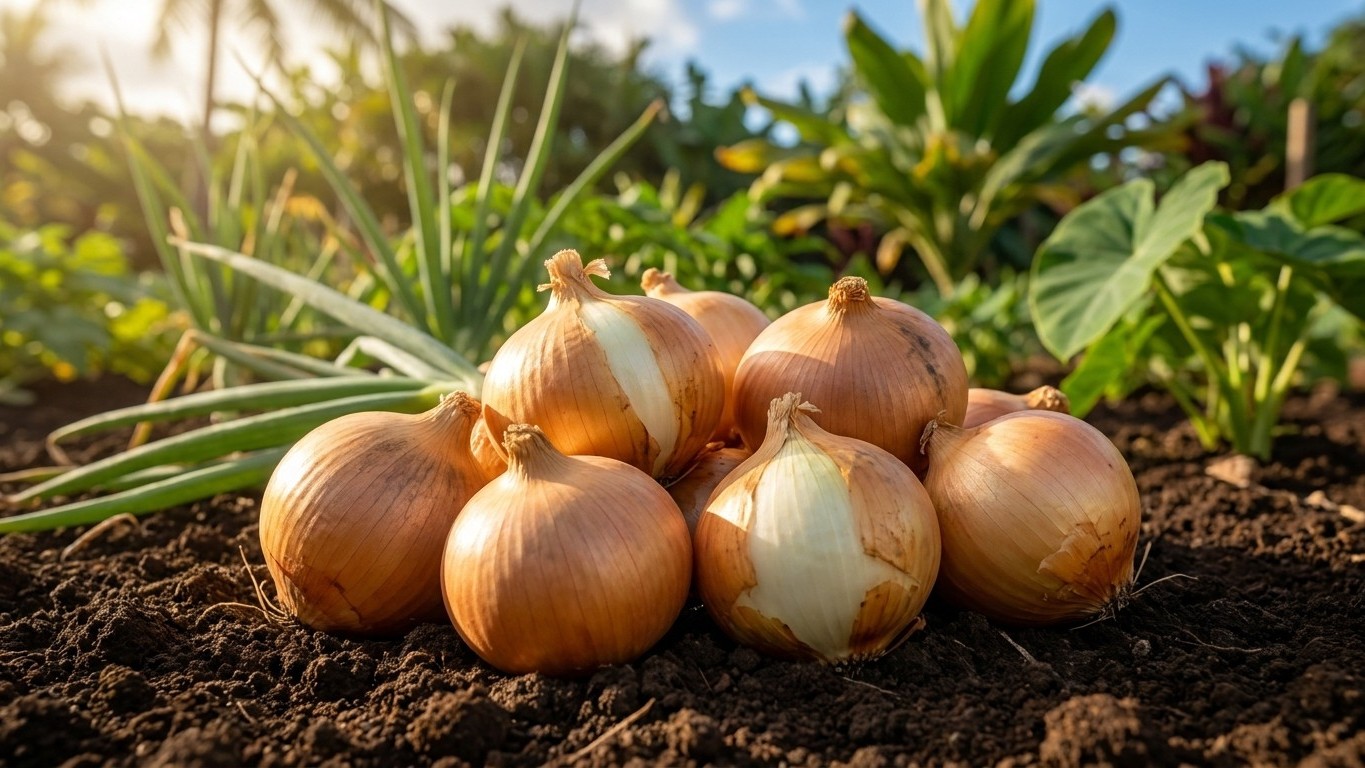

At 21.32 degrees north, the latitude of Honolulu (NOAA station USW00022521), the longest day of the year brings 13 hours and 18 minutes of daylight. That number, not the state’s warm winters, is what decides which onions will actually bulb in a Hawaii garden. The answer is short-day varieties only, and within that group, two catalogued names fit: Gabriella and Madalyn.
The short answer for Hawaii

Onions don’t bulb because the weather warms up. They bulb because daylight hours cross a threshold that tells the plant to stop making leaves and start storing energy in a bulb. Clemson Cooperative Extension (HGIC, Onion) puts that threshold at roughly 12 hours of daylight for short-day varieties, the lowest of the three day-length groups. Honolulu’s longest day, at 13 hours 18 minutes, clears that mark comfortably. That’s the whole story for Hawaii: the day length ceiling here is low enough that only the short-day group ever gets the signal it needs.
Two varieties in the documented catalogue for this site have a published range that covers 21.32°N: Gabriella (short-day, 20-35N) and Madalyn (short-day, 20-35N). Neither has a dedicated page here yet, but both are named because their range brackets Honolulu’s latitude directly. Their day-length requirement sits low enough that they trigger bulbing early in the season, regardless of how large or small the plant has grown by then.
This matters for timing as much as for variety choice. Because short-day onions respond to a low daylight threshold, they’re typically started in fall or winter in mild-winter regions like Hawaii, so the plant has months to build size before day length forces the bulbing switch in spring. Wait too long to plant and the switch flips on a small plant, which is a different problem covered in more depth on the planting-calendar page for this territory. But the variety question comes first, and the math is simple: 13 hours 18 minutes is a short-day number, so short-day onions are the only group that makes sense here.
It’s worth being precise about why the other two groups don’t apply. Intermediate-day onions need roughly 13 to 14 hours to trigger bulbing, and long-day types wait for 14 to 16 hours. Hawaii’s summer daylight peaks at 13 hours 18 minutes and goes no higher. For the long-day group especially, that ceiling is never approached, let alone crossed.
What will not work here
Twenty-six varieties documented on this site carry a published latitude range that starts north of Honolulu’s 21.32°N. Planting any of them in Hawaii does not produce a smaller onion. It produces no onion. The plant keeps making leaves all season because the day never gets long enough to send the bulbing signal, and once the growing season turns, the plant rots in the ground instead of forming a harvestable bulb.
- Ailsa Craig (long-day, 38-60N), needs 14-16 hours of daylight Hawaii never reaches.
- Barolo (long-day, 38-55N), same daylight ceiling problem, no bulb forms.
- Blush (long-day, 38-55N), bred for latitudes far north of Hawaii’s range.
- Bridger (long-day, 35-50N), requires daylight hours Hawaii’s summer doesn’t provide.
- Cabernet (intermediate-day, 35-45N), published range excludes Honolulu’s latitude entirely.
- Calibra (intermediate-day, 35-45N), bulbing trigger sits above Hawaii’s daylight ceiling.
- Candy (intermediate-day, 33-40N), range starts north of Hawaii, wrong daylight zone.
- Elsye (intermediate-day, 32-45N), needs more daylight hours than Hawaii supplies.
- Expression (intermediate-day, 32-45N), same mismatch, leaves all season, no bulb.
- Frontier (long-day, 40-50N), a long-day type, Hawaii’s day length never qualifies.
- Monastrell (intermediate-day, 35-46N), bred for latitudes well north of Honolulu.
- New York Early (long-day, 38-50N), long-day threshold unreachable at this latitude.
- Patterson (long-day, 38-55N), same long-day mismatch as the varieties above.
- Powell (long-day, 43-47N), a far-north range, nowhere near Hawaii’s latitude.
- Red Carpet (long-day, 40-45N), needs daylight hours Hawaii’s summer can’t give.
- Red Long of Florence (intermediate-day, 38-50N), range excludes tropical latitudes entirely.
- Red Long of Tropea (intermediate-day, 35-48N), same daylight-ceiling problem as above.
- Red Rock (short-day, 30-36N), short-day, but published range starts north of 21.32°N.
- Redwing (long-day, 43-65N), an extreme long-day range, far outside Hawaii’s zone.
- Rossa di Milano (long-day, 38-50N), bulbing trigger never arrives in Hawaii.
- Safrane (long-day, 42-50N), same long-day mismatch, no bulb forms.
- Scout (intermediate-day, 32-46N), range starts north of Hawaii’s latitude.
- Sierra Blanca (intermediate-day, 32-45N), same daylight shortfall as other intermediate types.
- Talon (long-day, 42-50N), a far-north long-day range, wrong for Hawaii.
- Walla Walla Sweet (long-day, 35-55N), needs far more daylight than Hawaii offers.
- White Castle (short-day, 30-38N), short-day, but its range still starts north of 21.32°N.
Notice the two short-day names on that list, Red Rock and White Castle. Being “short-day” isn’t enough on its own; the published range still has to bracket the reader’s actual latitude. Both start at 30°N, nine degrees north of Honolulu, which is why Gabriella and Madalyn, with a 20-35N range, are the ones that fit.
What changes across Hawaii
Honolulu, at 21.32°N, is the reference point for every figure above, but the state isn’t a single dot on the map. The main inhabited islands stretch from the Big Island in the south to Kauai in the north, a spread of roughly two to three degrees of latitude. In most of the continental U.S., a spread that size would shift a garden from one day-length group into another, and would call for a table comparing hours of daylight city by city.
Hawaii is the exception, and the reason is geometry rather than luck. Close to the equator, day length barely changes with latitude; the effect that stretches summer days toward 15 or 16 hours in the northern states is compressed to almost nothing across a few degrees near the tropics. A garden on the Big Island and a garden on Kauai see summer daylight within minutes of each other, not the hour-plus swing you’d find comparing, say, southern Georgia to northern Michigan. Practically, that means the short-day recommendation above holds across the whole state, not just around Honolulu.
What does shift across Hawaii is elevation, and that’s worth flagging even though it isn’t a day-length effect. Upcountry gardens on Maui or the Big Island, sitting well above sea level, run noticeably cooler than coastal Honolulu and can see occasional light frost in winter, something the lowland reference station never records. That doesn’t change which onion group to plant, but it does change frost dates and planting timing, which is why the checklist further down points readers toward their own county extension office rather than a single statewide date.
Sweet now, or onions that last
Every onion variety carries a built-in trade-off, and it comes down to chemistry rather than breeding luck. The compounds that give an onion its bite are volatile sulfur compounds, and University of Missouri Extension notes plainly that “as a rule, ‘sweet’ onions do not store as well as the more pungent types.” Those same sulfur compounds that sting your eyes while slicing are also what protects the bulb from breaking down in storage. Fewer of them, and the onion tastes milder raw but won’t last. More of them, and the onion is sharper but keeps for months.
Hawaii’s climate locks gardeners into one side of that trade. Because only short-day varieties bulb here, and short-day types run toward the sweet, low-sulfur end of the scale, a Hawaii garden produces onions built for eating soon, not for stashing in a root cellar. Gabriella and Madalyn will give you a milder onion at harvest, but neither is bred to carry a pantry through the winter the way a long-day type like Walla Walla Sweet does further north, ironically despite its name, since long-day varieties tend to store far longer than their sweet flavor suggests.
Picture what that means for a kitchen in March. In a northern garden that harvested long-day, pungent onions in late summer, a mesh bag of them can still be sitting in a cool closet, months after harvest. In Hawaii, a harvest of short-day onions from the same earlier season won’t have that lifespan. The realistic plan is to treat a Hawaii onion harvest as something to use within a few weeks to a couple of months, not something to bank on for the whole year. Succession planting, staggering sowing dates so bulbs mature in batches rather than all at once, does more for a Hawaii kitchen’s onion supply than any storage trick ever will.
Checking this against your own garden
Everything above is built on Honolulu’s numbers. That’s a solid baseline for most of the state, given how little day length shifts across Hawaii’s latitude range, but a few things are still worth confirming on your own before you commit a season’s growing space to a specific variety.
- Look up your own island and elevation on a latitude finder if you’re gardening well away from Honolulu, especially upcountry.
- Call your county extension office (part of the University of Hawaii Cooperative Extension network) for the actual last-frost guidance in your specific area, particularly at higher elevations.
- Check the catalogue range printed on any onion seed or set you’re considering, and confirm it brackets your own latitude, not just “short-day” on the label.
- Note your local soil drainage and rainfall pattern, since onions rot in waterlogged ground long before day length ever becomes the limiting factor.
- Track your planting date against your extension office’s recommended fall or winter window, since a late start still shrinks the eventual bulb even where the variety choice is right.