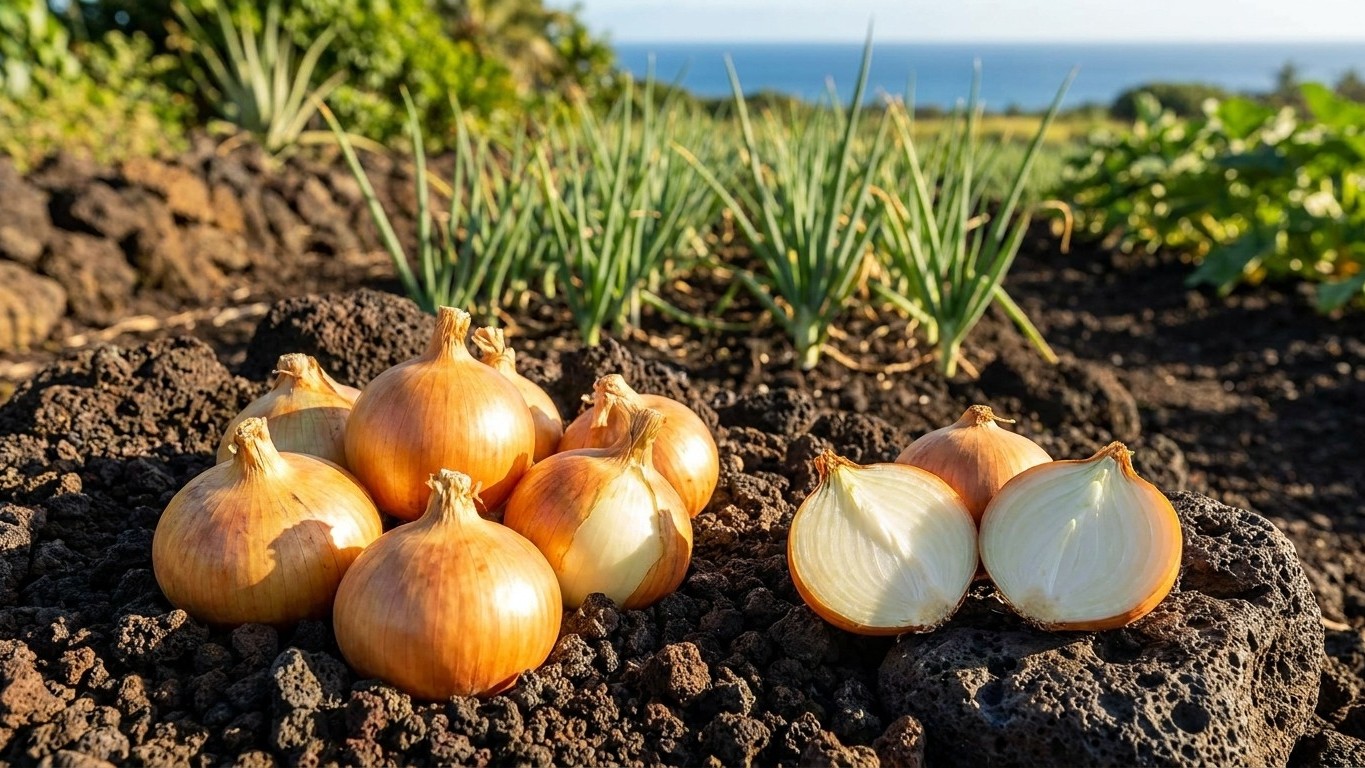

Onions bulb by day length, not by heat, and Hawaii’s day never gets long enough for most of the varieties sold in stores. At 21.32 degrees north, the state’s longest day tops out at 13 hours and 18 minutes, a number that puts every long-day and intermediate-day onion out of reach. Only short-day varieties will actually form a bulb here.
How long your longest day is

Hilo, Hawaii, sits at 21.32 degrees north latitude, and on the longest day of the year the sun there provides 13 hours and 18 minutes of daylight. That single figure decides which onions can grow in Hawaii and which cannot. Short-day onions start bulbing once they sense roughly 12 hours of light, so they trigger easily here and finish their growth cycle well before the daylight even reaches its yearly maximum. Intermediate-day onions wait for 13 to 15 hours, and long-day onions hold out for 14 to 16 hours before they’ll commit to a bulb. With a ceiling of 13 hours 18 minutes, Hawaii’s daylight brushes the very bottom edge of the intermediate-day range and never comes close to satisfying a long-day type.
That’s the whole story in one sentence: Hawaii is short-day territory, full stop. Everything else in this article is detail hanging off that fact, though if you want the specifics on timing, see When to Plant Onions in Hawaii.
Hawaii is not one dot on a map, though. The state stretches from the Big Island’s southern tip near 18.9 degrees north up through Kauai around 22.2 degrees north, a spread of more than three degrees of latitude. That’s not a huge range compared to a mainland state that runs from the Gulf Coast to the Canadian border, but it’s enough to matter at the margins. A garden on Kauai’s north shore sits closer to the upper edge of what counts as short-day territory, while one near South Point on the Big Island sits closer to the lower edge. The practical difference is small since both ends still fall well short of the 14-hour threshold that long-day onions need, but a gardener near the northern islands should still confirm their own latitude rather than assume Hilo’s number applies exactly. The takeaway doesn’t change: no part of inhabited Hawaii gets a summer day long enough to satisfy anything but a short-day onion.
Which varieties bulb in Hawaii
Two varieties documented across The Best Onion Varieties for Hawaii have a published latitude range that actually covers 21.32 degrees north:
- Gabriella (short-day, 20-35N)
- Madalyn (short-day, 20-35N)
Both are short-day types bred for latitudes that start well south of the mainland U.S. and run up through the lower thirties, a range wide enough to include the Hawaiian Islands comfortably. Neither has a dedicated page on this site, but the catalogue data on their day-length classification and range is clear enough to name them here.
The much longer list of what won’t work
Here’s the part that matters more, because it’s the mistake almost every new Hawaii gardener makes at least once: buying a bag of onion sets or transplants at a mainland retailer without checking the day-length label. The following varieties are documented with a published latitude range that starts at 26 degrees north or higher, meaning the daylight in Hawaii never reaches what they need to bulb:
- Ailsa Craig, Barolo, Blush, Bridger, Cabernet, Calibra, Candy, Elsye, Expression, Frontier, Monastrell, New York Early, Patterson, Powell, Red Carpet, Red Long of Florence, Red Long of Tropea, Red Rock, Redwing, Rossa di Milano, Safrane, Scout, Sierra Blanca, Talon, Walla Walla Sweet, White Castle
Notice that even Red Rock and White Castle, both technically classified as short-day onions, are listed here. Their published ranges start at 30 degrees north, which is still too far north to include Hawaii’s 21.32 degrees. Day-length classification alone isn’t enough, the actual range matters.
If you plant any of these in a Hawaii garden, the plant doesn’t know it’s in the wrong place and doesn’t fail gracefully. It grows lush green tops all season, because leaf growth doesn’t depend on day length the way bulbing does. Then, with no trigger ever reached, the plant either keeps pushing out leaves indefinitely or eventually bolts and rots at the base. Gardeners who’ve tried a supermarket onion set and watched it turn to mush in the soil have already lived this exact sequence. It isn’t a soil problem or a watering problem. It’s a daylight problem, and no amount of fertilizer fixes it.
When to plant onions in Hawaii
Frost-based planting calendars, the kind that dominate onion-growing advice for most of the mainland, simply don’t apply here. NOAA’s 1991-2020 climate normals for the Hilo station show zero days per year at or below 32 degrees Fahrenheit, with every freeze percentile flagged as not computable, meaning there isn’t enough freeze data to even calculate a typical frost date. Frost in Hawaii exists only on the summits of Mauna Kea, Mauna Loa, and Haleakala, thousands of feet above where anyone gardens. Down at garden level, there is no last spring frost and no first fall frost to plan around.
That changes the whole planning question. Instead of asking “when’s my frost-free window,” a Hawaii gardener should be asking about rainfall timing, elevation, and whether a plot sits on the windward or leeward side of an island. Windward slopes catch far more rain than leeward ones, and heavy, sustained moisture around the bulb late in the season is what actually threatens an onion crop here, not cold. Onions like a dry spell as they mature and cure; wet soil right before harvest invites rot at the neck and base, the same failure mode as planting the wrong variety, but caused by weather instead of genetics.
Because day length near this latitude changes only modestly across the year compared to mainland gardens further north, the timing window for short-day onions in Hawaii is driven more by moisture patterns than by a hard calendar date. Many island gardeners aim to have transplants or sets in the ground during the cooler, typically drier stretch of the year, so bulbs are sizing up and starting to cure before the wettest months return. There’s no published frost date to hang that decision on, so think of it as a moisture-and-elevation calendar rather than a frost calendar, and adjust based on what a particular plot’s rainfall pattern typically looks like.
Sweet onions or onions that keep
Short-day onions, the only kind that actually bulbs in Hawaii, run sweeter and store for a shorter time than their long-day cousins. That’s not a coincidence of breeding. It comes down to chemistry: an onion’s bite comes from volatile sulfur compounds, and those same compounds are what protect the bulb during storage. Fewer sulfur compounds mean a milder, sweeter onion that’s better fresh off the cutting board, but with less natural defense against the decay that sets in over months in a pantry. More of those compounds mean a sharper onion that keeps for a long time, the kind that gets grown in northern gardens with long summer days.
Because Hawaii’s daylight ceiling rules out every long-day and intermediate-day variety, there’s no path here to onions bred for winter-long storage. What a garden at 21.32 degrees north gives you instead is bulbs meant to be eaten within weeks of harvest, not tucked away for months. According to University of Missouri Extension, sweet onions simply don’t store as well as more pungent types, and that trade-off applies directly to what grows in Hawaii’s short-day conditions.
Practically, that means the onions coming out of a Hawaii garden belong in this week’s meals, not next winter’s soup pot. Cure them properly, keep them somewhere cool and dry, and expect to work through the harvest over a matter of weeks rather than stretching it toward spring. A gardener dreaming of a braided string of onions still solid in March should adjust that expectation to fit what short-day varieties, and Hawaii’s daylight, can actually deliver.