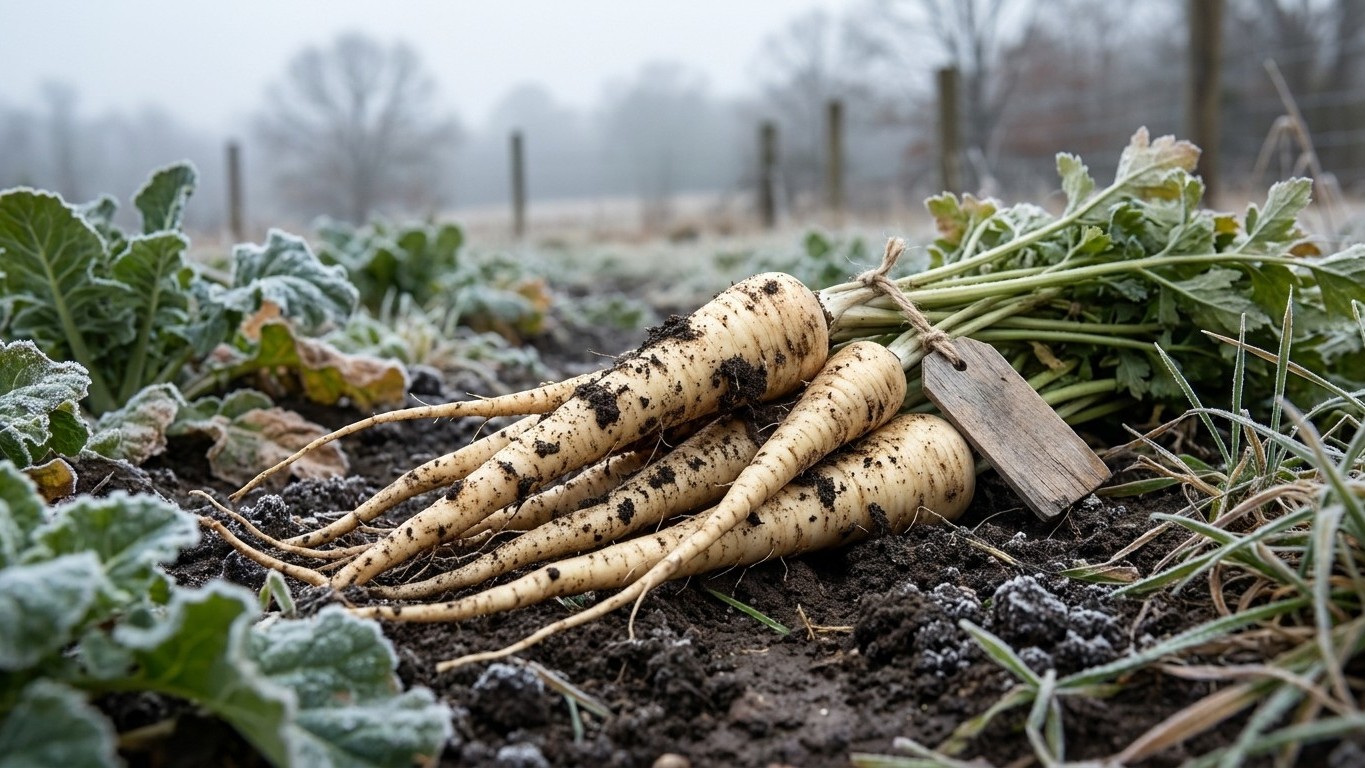

No. In Hawaii’s inhabited lowlands, parsnips will grow into full-sized roots, but they will not sweeten, because the mechanism that converts stored starch into sugar depends on sustained cold exposure that this territory never delivers. The mean minimum temperature for the coldest month sits at 66.8°F in Honolulu. That’s not a chilly week. That’s a mild evening, repeated for thirty days straight.
The short answer
Here’s the question that actually decides this: does the territory deliver several frosty weeks somewhere in its growing calendar? For lowland Hawaii, the answer is no, and it isn’t close. NOAA’s 1991-2020 climate normals put the coldest month’s average minimum at 66.8°F, measured at the Honolulu reference station. Compare that to freezing, which sits 65 degrees lower, and the gap explains everything a home gardener needs to know before planting a single parsnip seed.
Parsnips are one of the few root vegetables that actually benefit from being left in cold ground. According to Utah State University Extension, the roots taste best after several weeks of cool, frosty weather, because that cold converts stored starch into sugar. It’s a slow chemical shift, not something that happens overnight, and it needs sustained low temperatures, not just a cool evening or two. A single chilly night does nothing. A month of nights hovering near freezing does everything.
Hawaii’s climate simply doesn’t produce that kind of stretch anywhere people garden. The islands do get frost, but only on the summits of Mauna Kea, Mauna Loa, and Haleakala, elevations well above 10,000 feet where nobody is running a vegetable bed. Down where the soil, the irrigation, and the gardeners actually are, temperatures stay warm year-round, governed far more by rainfall patterns and windward versus leeward exposure than by any seasonal cold snap.
So the parsnip grown in a Hawaii garden will do exactly what a parsnip does when it’s never chilled: it will bulk up into a normal-looking root, tan-skinned and cream-fleshed, and it will taste like a mild, slightly starchy carrot cousin. Perfectly edible. Perfectly fine roasted or mashed. But it won’t have that concentrated, almost caramel sweetness that gardeners in frost-prone climates wait all fall for. That sweetness is a cold-weather signature, and this territory’s temperature profile doesn’t sign it.
This isn’t a failure of technique. A gardener could do everything else right, deep sandy bed, careful spacing, patient watering, and still end up with a starchy rather than sweet harvest, simply because the one ingredient the crop actually needs, sustained cold, isn’t available here. That’s worth knowing before investing a full season in the crop.
Does the season fit?
Parsnips need 100 to 120 days from seeding to harvest, according to Utah State University Extension, and that clock starts the day seed goes into the ground, not when seedlings emerge. In most of the mainland, gardeners anchor that sowing date 2 to 3 weeks before the last spring frost, then count forward and watch for the first fall frost to arrive after the roots have matured. Hawaii breaks that model at the first step, because NOAA’s climate data for the reference station shows no freeze occurring in inhabited areas at all: every freeze percentile comes back not-computable, and the recorded days at or below 32°F sit at zero. There is no last spring frost and no first fall frost to count from.
Here’s how the arithmetic actually works once that frost-based calendar is set aside:
- Start with the plain fact that no frost date exists to anchor a sowing decision, so the calendar has to run on temperature and rainfall instead, which stay comparatively stable across most of the year in lowland Hawaii.
- Count forward 14 to 21 days for germination alone, since parsnip seed is notoriously slow to sprout and gardeners who dig up bare soil during that window often assume the seed failed when it hasn’t.
- Add the remaining 100 to 120 days of root development on top of germination, which stretches the full timeline from seed to harvest closer to four full months when both stages are counted honestly.
- Check that window against a warm, frost-free year: length of season is not the limiting factor here, since a four-month stretch of workable growing weather is available in most lowland locations without a frost cutoff forcing an early harvest.
- Recognize that the season fits comfortably in terms of days available, but that comfort is purely about time, not about the cold exposure the crop needs afterward to convert its starch to sugar.
So the season question and the sweetness question are two separate answers. Time-wise, there’s room to grow a parsnip from seed to full maturity without rushing. Flavor-wise, that same generous stretch of warm days is exactly what keeps the sugar conversion from ever kicking in.
What goes wrong here
- Forked, split roots from heavy or stony ground. Parsnip taproots push straight down, and any compaction, clay layer, or buried rock splits them into forked, awkward shapes. Utah State University Extension recommends deep, sandy soil, and says heavy soil needs to be double dug before planting. In Hawaii’s volcanic soils, which vary widely from loose cinder to dense clay depending on location, this matters more than usual: test the bed’s texture at 12 to 15 inches deep before sowing, not just at the surface.
- Forked roots from overwatering. This is a separate cause from soil texture, and it’s easy to conflate the two. Excess moisture around the developing taproot encourages the root to branch rather than grow straight, even in soil that’s otherwise loose and workable. Water deeply but less frequently, letting the top few inches dry between sessions, rather than keeping the bed constantly saturated.
- Bare soil dug up too early, assuming failed germination. Parsnip seed takes 14 to 21 days to sprout, noticeably slower than most root crops. Gardeners who check at day seven or eight, see nothing, and till the bed under are destroying seed that simply hasn’t emerged yet. Mark the sowing date and wait out the full three weeks before judging the planting a failure.
- A root that grows fully but never sweetens. This is the one failure with no soil-based fix. Because the coldest month’s average minimum sits at 66.8°F and no frost reaches inhabited elevations, the starch-to-sugar conversion that defines a parsnip’s peak flavor simply doesn’t happen here. The remedy isn’t a gardening technique. It’s an expectation: harvest for a mild, carrot-like root rather than waiting for a sweetness that this climate isn’t built to produce.
Common questions
Can parsnips be grown in Hawaii at all?
Yes. The roots will germinate, develop, and reach full size within the standard 100 to 120 day window from seeding. What they won’t do is sweeten, since that transformation requires sustained cold that lowland Hawaii’s temperature profile doesn’t provide.
Does refrigerating harvested parsnips substitute for cold-ground exposure?
The sourced information here addresses field conditions and the crop’s need for several weeks of cool, frosty weather in the ground, not post-harvest cold storage. No published figure in this data set covers refrigeration as a substitute, so that question isn’t answered by the facts available.
Why does the coldest month’s temperature matter more than the hardiness zone?
A hardiness zone describes the coldest a plant can survive, not how much cold exposure a crop like parsnip needs to trigger flavor changes. The 66.8°F average minimum for the coldest month is the figure that actually decides whether frost-driven sweetening can occur, and in this case it rules it out entirely.
How long does parsnip seed take to sprout in Hawaii’s warm soil?
Utah State University Extension lists 14 to 21 days as the standard germination window for parsnip seed generally. Warm soil doesn’t speed this up in any way documented in the sourced data, so gardeners should still wait the full three weeks before assuming a sowing has failed.