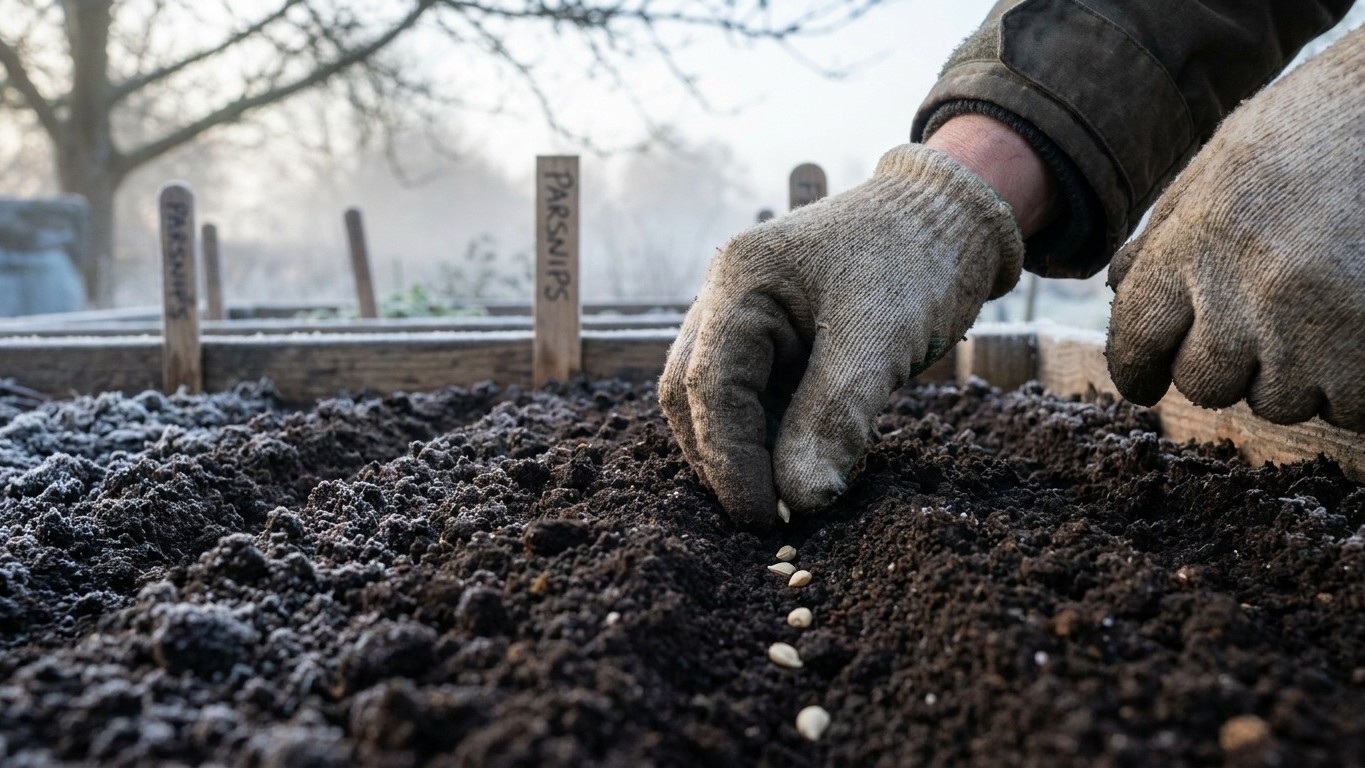

Since lowland Hawaii never experiences frost, at all, in any month, parsnips can technically go into the ground on almost any date the soil is workable. But that same absence of frost means the roots will grow, size up, and taste like parsnip, without ever getting the cold snap that turns stored starch into sugar. The calendar question here isn’t when frost allows sowing. It’s when rainfall, heat, and elevation give the crop its best 100 to 120 days.
The short answer
Start with the number that settles most of this: 66.8°F. That’s the mean minimum temperature of Honolulu’s coldest month, according to NOAA NCEI’s 1991-2020 Climate Normals. Not a record low, not an overnight dip during a rare cold snap, but the average low across the coldest stretch of the year, drawn from three decades of data. A hard freeze sits roughly 35 degrees colder than that figure. There simply isn’t a month in lowland Hawaii where temperatures drift anywhere close to frost, let alone hold there for the several weeks a parsnip needs to change flavor.
That number decides the outcome for this crop before a single seed goes in the ground. Utah State University Extension notes that parsnips taste best after several weeks of cool, frosty weather, which converts the root’s stored starch into sugar. Hawaii’s climate cannot deliver that step. Not because the elevation is wrong or the hardiness zone doesn’t match, but because the actual exposure to frost doesn’t exist anywhere people garden in this state.
So the honest answer is this: a Hawaii garden can grow parsnips just fine. The roots will develop, fill out, and have the texture and mild flavor the vegetable is known for. What they won’t do is undergo the frost-triggered conversion that gardeners in colder states rely on for that deep, almost nutty sweetness. Growing parsnips here means accepting a milder, starchier root rather than chasing a frost that isn’t coming.
It’s worth being precise about why, because it’s tempting to treat “high elevation” or a comfortable hardiness zone as a stand-in for “frost exposure.” It isn’t one, and it never becomes one just because a hillside garden runs cooler than the coast. Upcountry communities on the Big Island or in the higher parts of Maui do sit noticeably cooler than Honolulu, but cooler is not the same as frosty, and none of that changes the underlying record: NOAA NCEI logs zero days per year at or below 32°F across inhabited Hawaii. Frost in this state belongs to the volcanic summits, Mauna Kea, Mauna Loa, Haleakala, elevations no vegetable garden ever reaches.
For anyone deciding when to sow, this reframes the whole project. Timing isn’t about squeezing a crop between a last spring frost and a first fall frost, because neither date exists here. It’s about choosing the cooler, drier stretch of the year and the coolest spot the property offers, then accepting the sweetness question as already answered by the climate: it won’t happen from garden exposure alone, no matter when the seed goes in.
Does the season fit?
- Count from seeding, not from transplant. Parsnips are always sown directly where they’ll grow; they don’t transplant well, so the 100 to 120 day clock starts the moment seed touches soil, not weeks later when seedlings appear.
- Add the germination lag before counting anything else. Parsnip seed is slow, typically 14 to 21 days before it even breaks the surface. A gardener who checks at day ten and sees bare soil hasn’t failed; that’s simply how long this seed takes, and re-sowing early wastes a planting.
- Look for the frost window most calendars are built around. In much of the continental states, gardeners sow 2 to 3 weeks before the last spring frost, then count forward to the first fall frost to see if 100 to 120 days fit inside that box. Hawaii’s lowlands report zero days per year at or below 32°F, so there’s no last frost and no first frost to box the season with.
- Replace frost with rainfall, heat, and elevation as the real boundaries. Without a frost date closing off either end of the year, the arithmetic changes entirely: the 100 to 120 day window isn’t at risk from cold, it’s at risk from wet ground that encourages rot and forking, and from sustained heat at low elevation that stresses the root before it fully sizes up.
- Verdict: comfortable on time, unresolved on climate. Because no frost deadline exists, the growing window fits the math at almost any point in the year. The harder question isn’t whether there’s enough time, it’s whether the chosen stretch offers cool, well-drained conditions long enough for the root to develop properly, since that’s the actual limiting factor here, not a calendar date.
What goes wrong here
- Forked roots from heavy or stony ground. Compacted, rocky, or clay-heavy soil splits the taproot as it tries to push down, producing a root shaped like a wishbone instead of a single spear. Utah State University Extension recommends deep, sandy soil for parsnips, and where that’s not the native condition, double digging the bed to break up compaction and remove stones before sowing is the fix.
- Forked roots from overwatering. This is a separate cause from soil texture, not a variation of it. Consistently soggy ground, especially common during Hawaii’s wetter months, encourages the same forking even in reasonably loose soil, because excess moisture disrupts even root development. The remedy is steady, moderate watering rather than heavy saturation, and choosing a planting window that avoids the soggiest stretch of the local rain pattern.
- A season that stalls out from heat rather than cold. Since frost never arrives to end the season, the real threat to a full 100 to 120 day run is sustained high temperatures at low elevation, which slow root bulking. Sowing during the cooler part of the year, or choosing a higher, breezier spot on the property, gives the root more of the mild conditions it needs to finish sizing up.
- A winter too mild to ever sweeten the crop. This isn’t a mistake so much as a fixed condition of the climate: without several weeks of frosty weather, the starch-to-sugar conversion Utah State University Extension describes simply doesn’t happen here. There’s no remedy available in the garden itself, since the mechanism depends on cold the state’s lowlands never produce.
Common questions
Can parsnips be sown at any time of year in Hawaii?
Because there’s no frost season to work around, sowing isn’t restricted to a narrow spring or fall window the way it is in colder states. The better guide is choosing a stretch with manageable rainfall and cooler temperatures rather than watching for a frost date, since none exists in NOAA NCEI’s record for inhabited areas of the state.
Do parsnip seeds need cold soil to germinate?
The seed itself doesn’t require cold to sprout, but it is slow regardless of climate, typically taking 14 to 21 days to emerge. Gardeners in Hawaii should expect that same lag and resist the urge to re-sow early just because the soil looks bare after a week or two.
Will Hawaii-grown parsnips ever taste as sweet as ones grown where winters are cold?
Not from garden conditions alone. Utah State University Extension ties that sweetness directly to several weeks of frosty weather converting starch to sugar, and Hawaii’s lowlands never produce frost, so that particular flavor development simply isn’t available here the way it is in a colder-climate garden.
Does higher elevation in Hawaii change any of this?
Higher, cooler parts of the state can offer more comfortable growing temperatures than the coast, which may help the root develop steadily. But cooler is not frost, and NOAA NCEI’s data shows zero freeze days per year across inhabited Hawaii regardless of elevation, so a hillside garden won’t deliver the frost exposure that triggers sweetening.