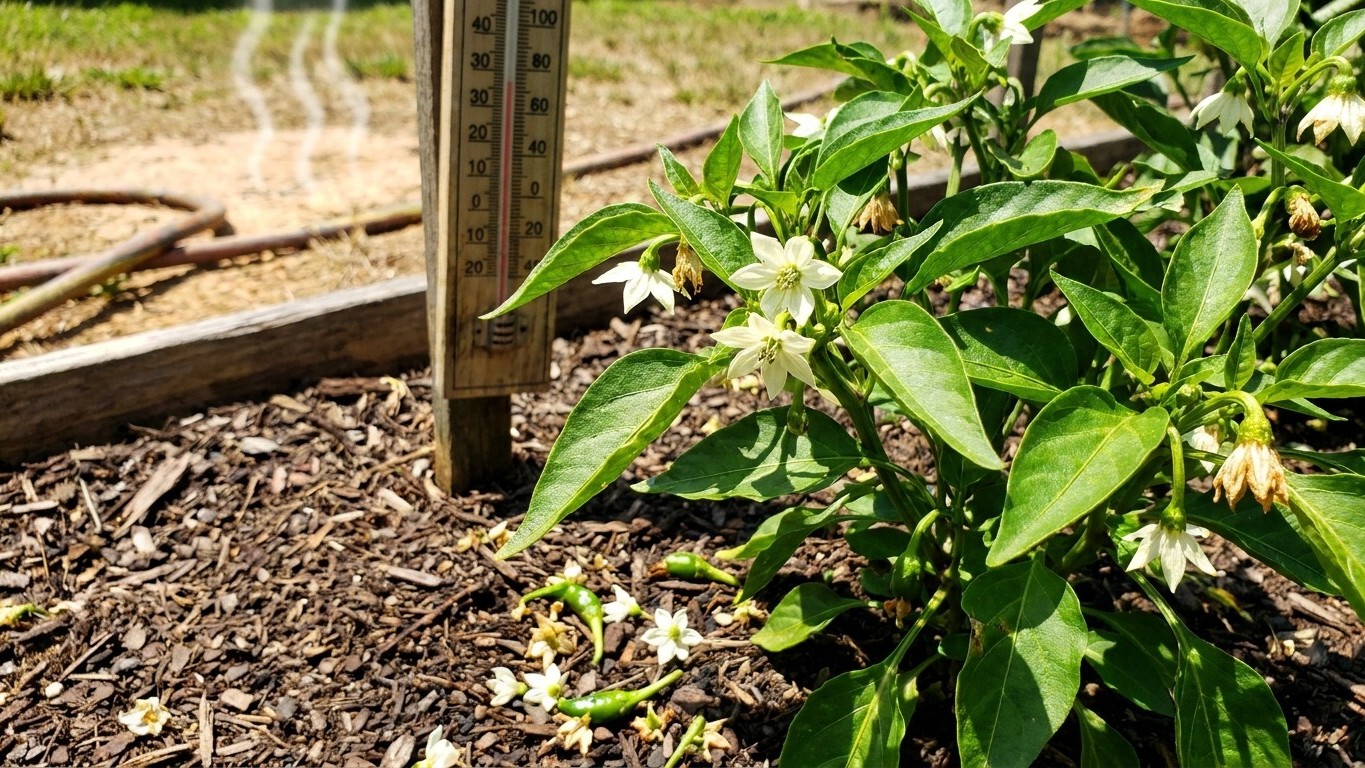

Peppers stall out in Hawaii mostly because of heat, not cold. The islands rarely see the kind of hard freeze that kills a pepper plant outright, but plenty of lowland gardens run hot enough, often enough, to knock blossoms off the plant before they ever become fruit. Add elevation swings of a few thousand feet within a single county, plus windward-versus-leeward rainfall differences, and “too hot” stops being a useful explanation on its own.
The short answer
Honolulu’s reference station averages 18.7 days a year at or above 90 F, according to NOAA’s 1991-2020 Climate Normals. That number sounds modest next to a mainland desert summer, but it’s exactly the threshold that matters for peppers: once daytime highs climb past 90 F during flowering, blossoms can look perfectly healthy and still drop unpollinated, according to Utah State University Extension. A pepper plant doesn’t need a heat wave to fail. It needs repeated exposure to that single number, spread across the weeks it’s trying to set fruit, and in leeward lowland gardens on Oahu, the Big Island’s Kona side, or dry pockets of Maui and Kauai, that exposure adds up over a season even without any single scorching day making headlines.
The other failure point runs in the opposite direction: nights below 55 F. Cold nights interfere with pollen viability the same way excess heat does, just through a different mechanism, and Utah State University Extension is explicit that pepper fruit set fails at both ends of that range, not just the hot one. This site tracks days at or above 90 F for Hawaii, but it does not carry summer night minimum data for this territory. That’s a real gap for gardeners here, because Hawaii’s elevation range is enormous. A garden in upcountry Maui, at Volcano on the Big Island, or in the cooler valleys of Kauai can run noticeably colder at night than a beachfront lot ten miles away, and no state-level average captures that. Watch your own overnight lows with a simple min-max thermometer placed in the garden bed itself rather than assuming anything from where you sit on a map.
There’s a third number worth holding onto once flowers actually open and get pollinated: fruit needs 35 to 45 days from flowering, not from the original sowing date, to finish developing, per Utah State University Extension. That distinction matters here because a plant that flowers early in a cool, wet stretch and then hits a run of 90-plus days mid-development can still lose fruit that had already set, not just future blossoms. The heat threat in Hawaii isn’t confined to the flowering window; it follows the fruit through its whole development cycle.
When to start seed here
Most seed-starting guidance leans on a frost date as the anchor point, but that math doesn’t work in Hawaii. NOAA’s 1991-2020 Climate Normals for station USW00022521 report zero days per year at or below 32 F, with every freeze percentile flagged as not computable, because no freeze occurs in inhabited areas of the islands. Frost exists only on the high volcanic summits, Mauna Kea, Mauna Loa, and Haleakala, never where anyone is gardening a pepper bed. So the usual “count back from last frost” arithmetic has no starting point here, and the calendar has to be built around soil temperature and local conditions instead.
- Drop the frost date entirely. There isn’t one at garden elevation, so don’t build a schedule around it. Growing windows in Hawaii are set by rainfall pattern, elevation, and whether a site sits windward or leeward, not by a freeze calendar.
- Find your soil’s 60 F date instead. Utah State University Extension calls for transplanting once soil reaches 60 F. In Hawaii’s lowlands, soil at that temperature or higher is common for most of the year, so the practical question becomes when your specific microclimate is warm and settled enough, not whether it will ever be cold.
- Count back 8 to 10 weeks for indoor starting. Once you’ve picked a transplant target date, based on your soil warming and your local rain pattern easing off, subtract 8 to 10 weeks. That’s your indoor seed-start date, following the same window Utah State University Extension gives for peppers generally.
- Cross-check against the 90 F count. With 18.7 days a year at or above 90 F on average, aim to have flowering already underway before the hottest stretch of your local season arrives, rather than starting flowering right as heat load peaks.
- Adjust for elevation and exposure. A garden at higher elevation or on a windward, rain-fed slope will warm and dry differently than a leeward coastal plot. Track your own soil temperature rather than borrowing a date from a neighbor a few hundred feet lower or higher.
What goes wrong here
- Blossom drop from heat or cold. Flowers open, then fall off unfertilized after a stretch of days at or above 90 F, or after a run of nights that dip too cold for pollen viability. Since this site doesn’t track night minima for Hawaii, keep a min-max thermometer in the bed and note when overnight temperatures fall toward the low end of the range Utah State University Extension flags as risky. If a hot spell is forecast during flowering, light afternoon shade cloth over the row can trim peak leaf and flower temperature without blocking pollinator access.
- Sunscald on exposed fruit. Hawaii’s tropical sun angle is strong nearly year-round, and fruit left exposed after heavy pruning or on plants with sparse leaf cover can develop soft, sunken, bleached patches on the side facing the sun. Leave more foliage in place through the growing season rather than stripping leaves for “air flow,” and stake plants so foliage naturally shades the fruit cluster.
- Blossom-end rot from uneven watering. Hawaii’s rainfall swings hard between wet and dry stretches depending on windward or leeward exposure, and that inconsistency interrupts calcium uptake at the root, showing up as a flat, leathery, dark patch on the blossom end of the fruit. Even, consistent soil moisture, helped by a few inches of mulch, matters more here than any fertilizer fix, since the underlying issue is water delivery, not a calcium shortage in the soil itself.
Common questions
Does Hawaii ever get cold enough to worry about frost damage on peppers?
No, not where people garden. NOAA’s Climate Normals for the reference station show zero days per year at or below 32 F, with freeze data flagged as not computable because it essentially never happens in inhabited areas. Frost is limited to the summits of Mauna Kea, Mauna Loa, and Haleakala.
Why do my pepper flowers fall off even when the weather doesn’t feel that hot?
Fruit set fails once daytime highs climb past 90 F during flowering, and Honolulu’s reference station averages 18.7 days a year at that mark. A string of those days during your plant’s flowering window is enough to cause drop, even if it doesn’t feel like a heat wave day to day.
How do I know if my nights are too cold for pepper pollination if this site doesn’t track that data for Hawaii?
Put a min-max thermometer in the garden bed itself. Utah State University Extension identifies nights below 55 F as the cold-side failure point for pepper fruit set, and because Hawaii’s elevation varies so much from one garden to the next, only a direct reading in your own bed will tell you where you stand.
My peppers set fruit, but then it stayed small and never ripened, what happened?
Check the timing against flowering, not sowing. Utah State University Extension notes fruit takes 35 to 45 days from the flower opening, not from when you started seed, to finish developing. If a heat spell above 90 F or a cold snap below 55 F hit during that window, the fruit may have stalled mid-development rather than failed to set at all.