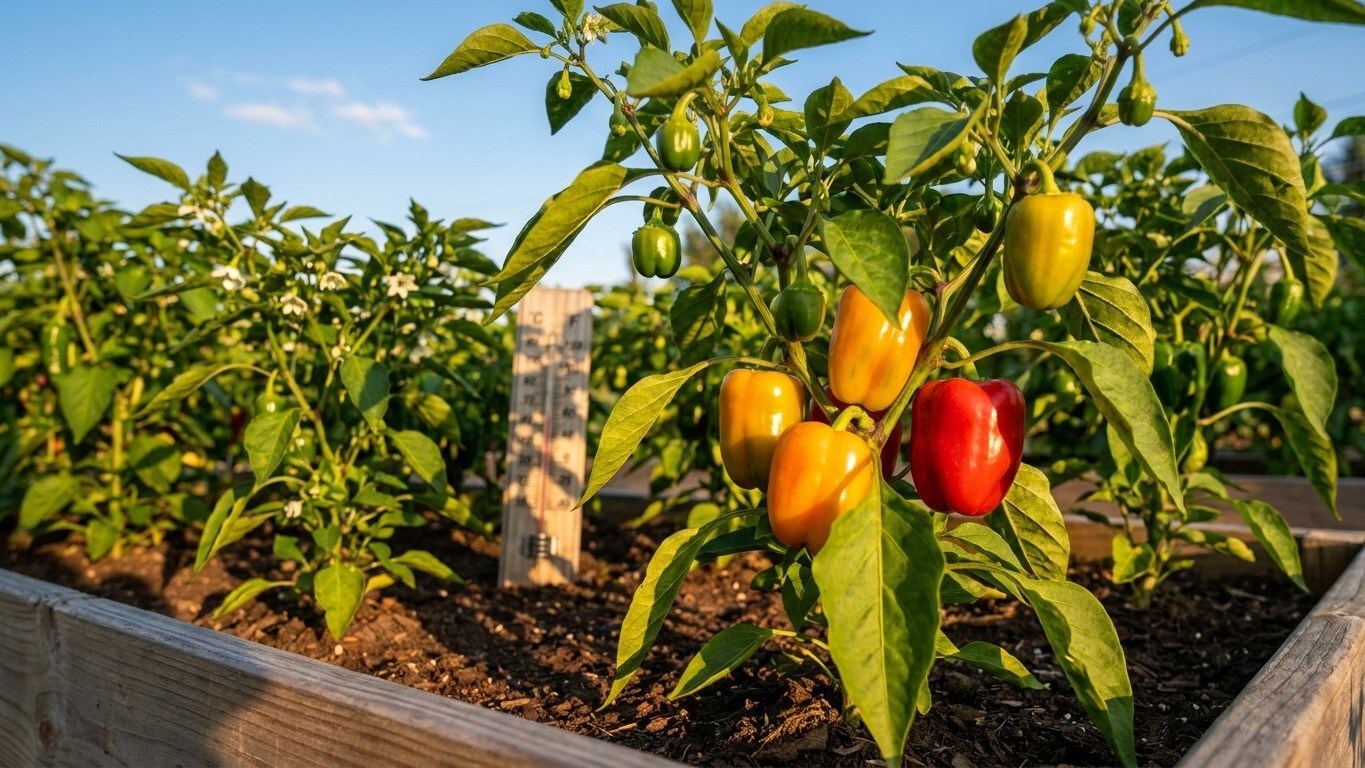

In lowland Hawaii, start pepper seed indoors 8 to 10 weeks before you plan to set transplants outside, timed to when your garden soil holds steady at 60 F rather than around any frost date, since lowland Hawaii doesn’t get frost. That usually means sowing in whatever stretch gets you past the hottest run of days above 90 F and clear of the heaviest rains, and that stretch shifts by island, elevation, and windward versus leeward exposure. There’s no single date for the whole state.
The short answer
The reference station in Honolulu averages 18.7 days a year at or above 90 F. That’s the number that should drive your planting decisions more than any calendar date, because pepper fruit set starts failing once daytime highs push repeatedly past that mark. Flowers open, get pollinated, then drop before they ever swell into fruit, and the plant just sits there looking healthy while producing nothing. If your garden runs hotter than the reference station, whether because you’re on a leeward slope, at low elevation, or in one of the drier valleys where heat builds up fast, you’ll hit that failure point more often than the state average suggests.
Fruit set fails at the other end too, and this side gets ignored constantly. Nights that drop below 55 F stall pollen viability just as effectively as an overheated afternoon does. The trouble is that this site tracks daytime heat loads (that 18.7-day figure) but doesn’t carry summer night minimums for any location. Hawaii’s elevation range makes this especially tricky, since a garden a few hundred feet higher than a neighbor’s can run several degrees cooler after sunset, and nobody publishes a night-by-night breakdown for every backyard.
What this means practically: watch your own thermometer through the growing season, not a regional average. Upland gardens, wherever they sit on whichever island, can slip into cool-night territory even when the daytime readings feel tropical. Coastal and low-elevation plots rarely see that problem, but they’re the ones more likely to bump against the 90 F ceiling instead. Neither failure looks dramatic in the moment. Plants keep flowering, keep looking green, and the grower often blames the variety or the soil before realizing the real culprit is a temperature window the plant simply can’t work in.
The practical takeaway is to treat both thresholds as guardrails, not just the heat one everybody talks about. A pepper crop that never sees a night below 55 F or a day much past 90 F will set fruit reliably almost anywhere in the islands, regardless of which month you started it.
When to start seed here
Because lowland Hawaii doesn’t have a frost season to anchor a calendar, the countback here starts from soil temperature and heat timing instead of a spring frost date. Here’s how to work out your own window:
- Identify your target transplant window. This isn’t a frost date, since none exists at garden elevations here. Instead, pick the stretch of weeks when your soil reliably reads 60 F and you’re not heading straight into the year’s hottest run of 90-plus-degree days. In most lowland gardens, soil sits above 60 F for the bulk of the year, so the limiting factor becomes avoiding peak heat and peak rain rather than waiting for warmth.
- Check your local rain pattern. Windward sites get heavier, more consistent rainfall than leeward ones, and waterlogged soil during transplant week sets seedlings back even when temperatures are fine. Leeward gardens tend to have drier, more predictable soil conditions but face more heat stress days.
- Count back 8 to 10 weeks from that target transplant date. That’s how long pepper seedlings need indoors, under grow lights or on a bright windowsill, before they’re sturdy enough to go into the ground. If your target transplant window falls in a given month, your sowing date lands roughly two months earlier.
- Adjust for elevation. Gardens sitting higher up a mountainside warm more slowly in spring-equivalent months and cool faster in the evening, so soil may take longer to hold at 60 F. If you’re gardening upslope, push your countback a couple of weeks later rather than guessing at a fixed date.
- Re-check before you transplant, not just before you sow. Soil temperature and recent night lows both matter at the moment you actually move seedlings outside. A cold snap or an unusually hot stretch in the days right before transplant can undo weeks of careful indoor timing.
Run this sequence with your own thermometer readings rather than a generic date, and you’ll land closer to the right window than any statewide recommendation could get you. A gardener in a dry leeward valley and one in a wet windward gulch a few miles away can end up with sowing dates weeks apart, and that’s expected.
What goes wrong here
- Blossom drop during a hot spell or a cool night. This is the single most common complaint from pepper growers in the islands, and it traces straight back to the two thresholds above: days pushing past 90 F, or nights dropping below 55 F. The plant flowers, the flowers fall off unpollinated, and no fruit follows. There’s no cure once it happens to a given flush of blooms, but the plant will usually set fruit again once temperatures move back into range, so don’t pull a plant that’s dropped a round of flowers. Track your own daytime highs and nighttime lows for a week or two if drop is happening repeatedly, since that tells you whether you’re fighting the hot end or the cool end.
- Sunscald on exposed fruit. Hawaii’s sun intensity is strong enough that fruit exposed by heavy pruning or thin foliage can develop pale, papery patches on the side facing direct light. The fix is simple: leave enough leaf cover over developing fruit rather than stripping the plant back hard, and avoid transplanting into full exposed sun without any afternoon shade if your site runs especially bright and dry.
- Blossom-end rot on the fruit tip. This shows up as a dark, sunken patch on the bottom of the pepper and it’s a calcium delivery problem tied to inconsistent watering, not a soil deficiency in most cases. Uneven watering between long dry stretches and heavy rain (a common pattern on windward sites) interrupts the plant’s ability to move calcium into developing fruit. Even, regular moisture through fruit development fixes most cases without adding anything to the soil.
Common questions
Can I start pepper seed at any time of year in Hawaii?
Lowland Hawaii doesn’t have a frost-driven off-season, so sowing dates spread out more than they would in a mainland climate with a hard winter. That said, timing still matters: you want your transplant date to land in a stretch that avoids the heaviest run of days above 90 F and the wettest weeks for your particular site, so the window narrows even without a frost to work around.
Does frost ever affect pepper planting anywhere in Hawaii?
Not at garden elevations. Frost occurs only on the high volcanic summits, Mauna Kea, Mauna Loa, and Haleakala, none of which anyone is growing peppers on. Planting decisions in the islands are governed by rainfall, elevation, and whether a site sits windward or leeward, not by any frost calendar.
What soil temperature should I wait for before transplanting?
Utah State University Extension puts the mark at 60 F. In most lowland Hawaii gardens, soil holds above that for the majority of the year, so the bigger scheduling question usually becomes avoiding peak heat and rain rather than waiting for the soil to warm up in the first place.
How do I know if my nights are too cool for fruit set?
This site doesn’t publish summer night minimums for any Hawaii location, so there’s no published figure to hand you here. The practical approach is to put a simple outdoor thermometer near your pepper bed and check it over a couple of weeks, particularly if you’re gardening at higher elevation, where evening temperatures can run noticeably cooler than a nearby coastal site even on the same island.