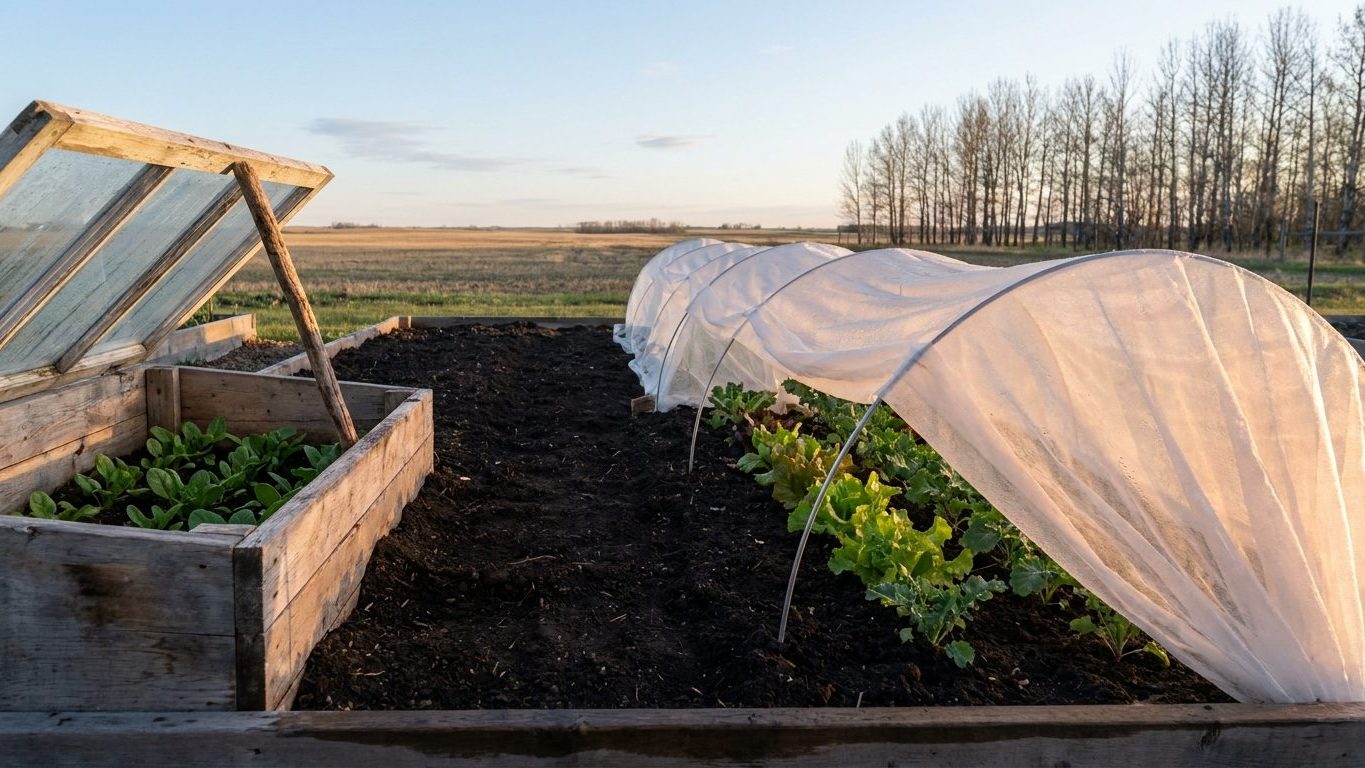

In Hawaii, the season extenders that work are the ones that manage rain, wind, sun and heat. Shade cloth, rain shelters, insect netting, windbreaks and mulch earn their keep. Frost covers and cold frames mostly sit idle, because no freeze occurs in inhabited areas. Which tool fits depends on your elevation and on whether your garden faces the trade winds or sits in their lee.
The short answer for Hawaii
The mainland logic of “protect plants from the last frost, stretch the fall” has nothing to grab onto here. NOAA’s 1991-2020 Climate Normals for the Honolulu station record zero days per year at or below 32°F, and the freeze percentiles come back flagged as not computable. The mean daily minimum of the coldest month is 66.8°F. Cold does not end your season. Rain, heat, wind and pests do, so the extenders that pay off are the ones aimed at those four.
Tools that earn their place
- Shade cloth over lettuce, spinach and other cool-season greens that bolt or scorch in strong sun.
- Rain shelters, meaning a plastic roof on a low frame with open sides, for tomatoes and other crops that split or rot in constant wet.
- Insect netting over brassicas, cucumbers and squash, where pests do the damage a freeze would do elsewhere.
- Windbreaks, from a hedge to a section of wind cloth, wherever the trades flatten seedlings and dry the soil.
- Mulch and raised beds to hold moisture in dry spells and shed it in wet ones.
Why frost gear is the wrong starting point
Frost shows up only on the high volcanic summits (Mauna Kea, Mauna Loa, Haleakala), never where people garden. That changes what “extension” means. You are not adding weeks to the front or back of a frost-free window, because the window never closes. You are widening the stretch of the year in which a fussy crop will actually produce. A lettuce bed under shade cloth in a hot, bright month is season extension in the Hawaiian sense. So is a tomato bed under a roof during a long wet spell.
The Extending the Growing Season in Hawaii overview covers the wider picture. This page stays on the narrower question of which products and structures to buy, build or skip.
What will not work here
Frost cloth is the obvious casualty. A row cover sold to add a few degrees on a freezing night does nothing useful when the coldest month still averages a daily low of 66.8°F. Cold frames and heated propagation setups fall in the same bin for lowland gardens. The money is better spent on shade or a roof.
Sealed plastic greenhouses are the next mistake. With nights already that mild, trapping heat is a liability. An unvented hoop house in full sun can cook seedlings in an afternoon. If you build under plastic here, build for airflow: open sides, roll-up walls, a roof that sheds rain but lets the breeze through.
Frost-date calendars fail too. The seed packet that says “sow two weeks after last frost” gives you nothing to count from. Any calendar built on frost dates will mislead you, which is why this page offers none. Local timing is set by rainfall, elevation and exposure.
Crops that need a real cold spell are a quieter problem. Garlic and some bulbs and perennials rely on winter chill to bulb or bloom, and a mild climate with no freeze often cannot supply it. Extenders do not fix that. You can only warm a garden, not chill one, so those crops are better treated as experiments or skipped.
Day length matters too, and no cover changes it. Honolulu sits at 21.32 degrees north, so the difference between the longest and shortest days is modest compared with the mainland. Onions decide when to stop making leaves and start making a bulb by day length, not warmth. Long-day onions can sit all season making tops and never bulb. Short-day types are the match. That figure belongs to Honolulu, so if you garden on Kauai or on the southern end of the Big Island, check your own latitude.
Watering habits fail in two directions. On the dry leeward sides, a weekly soak is not enough for shallow-rooted vegetables, and mulch plus more frequent, lighter watering holds up better. On the wet windward sides, tight spacing traps humidity around leaves and invites mildew and rot. Give crops room, stake or trellis them, and let air move.
What changes across Hawaii
Hawaii is not one garden. The USDA Plant Hardiness Zone Map (2023 edition, built on 1991-2020 normals) spans 9a to 13a across the state. That is a range of four full zones, and the system measures one thing only: the average annual extreme minimum temperature. There is no single zone for “Hawaii,” so any advice that treats the islands as one climate is guessing.
The reference city here is Honolulu, a leeward, low-elevation spot with the warm minimums quoted above. Move uphill and the picture shifts. Nights cool with altitude, so upcountry and higher-elevation gardens can grow crops that sulk in the lowlands, and they may want more wind protection and less shade. Frost remains a summit phenomenon, but a cooler site can still slow warm-season crops enough that a low tunnel or a sunnier bed makes sense. For when covering helps at all, see When to Cover Your Garden in Hawaii.
Exposure shifts things as much as elevation. A windward garden gets frequent rain and persistent wind, which points to rain shelters, drainage and windbreaks. A leeward garden gets sun and dry stretches, which points to shade cloth, mulch and dependable irrigation. Two gardens a few miles apart can need opposite tools.
To see where your own property falls, use the USDA hardiness map and look up your location directly. This page will not tell you your zone, and a map lookup takes under a minute. Treat the result as a baseline for cold only. It says nothing about rainfall or wind, which matter more here.
Where to check this for your own county
Your state extension service is the next stop. In Hawaii that is University of Hawaii CTAHR Extension, the land-grant extension program for the state. Two things are worth looking for there: the local planting calendar for your island or county, and the varieties that have been trialled in conditions like yours.
That second item deserves the most attention. A variety that performed well in a lowland trial may struggle at 2,000 feet, and the reverse holds too. Look for cultivars selected for heat tolerance, disease resistance in wet conditions, or the short-day response that onions need. If a trial report names the site, compare its elevation and rainfall to your own before copying it.
A county recommendation beats a state one. This page is the state one: it works from a single reference station in Honolulu and a statewide hardiness range, which means it can describe patterns but cannot know your hillside. County and island-level guidance reflects the rainfall, soil and elevation where you actually plant. When the two disagree, trust the local one.
The climate figures used here come from NOAA’s published normals, and you can check them yourself through the NOAA NCEI Climate Normals data for the Honolulu station. Remember what they represent. They describe one low-elevation, leeward location, not your yard.
Checking this against your own garden
Your own observations outrank every date and recommendation on this page. Three are worth tracking, and none needs an instrument.
Soil warmth by feel. Push your hand a few inches into a bed in the morning. Soil that feels cool and damp well into the day tells you the site is shaded, wet or high enough to run cooler, which favors sunnier beds and raised mounds. Soil that is warm and dry early points the other way, toward mulch and shade cloth for tender crops.
The first flush of male flowers. On squash, cucumbers and melons, male blooms appear before female ones. When they show, and how quickly female flowers follow, tells you whether the bed is warm enough and sunny enough for the crop. Long delays or flowers that drop without setting fruit hint at heat stress or too much wet.
The first true leaves. The seed leaves come first, then the true leaves. Seedlings that stretch pale and leggy are reaching for light you are not giving them. Leaves that bend or tear show where wind arrives, and where a windbreak belongs.
Keep a simple notebook of dates and conditions for a season or two. The pattern will be more reliable than any statewide table.
Common questions
Do I need frost protection in Hawaii?
Not where people garden. No freeze occurs in inhabited areas, and frost is confined to the high summits of Mauna Kea, Mauna Loa and Haleakala. Spend on shade, rain protection and wind control instead.
Can I garden year-round in Hawaii?
In most lowland spots, cold never stops you, but rain, heat and pests can. Some crops fit certain months better than others, so timing follows your local rainfall and exposure rather than a frost date.
Is shade cloth worth buying?
For leafy greens and other cool-season crops in strong sun, yes. It is among the most useful tools for lowland gardens, especially on dry, bright leeward sides.
What does the 9a-13a hardiness range mean?
It is the USDA’s 2023 spread of zones across Hawaii, based on average annual extreme minimum temperature. Conditions vary widely by elevation and location, so look up your own spot on the USDA map rather than assuming a single zone.