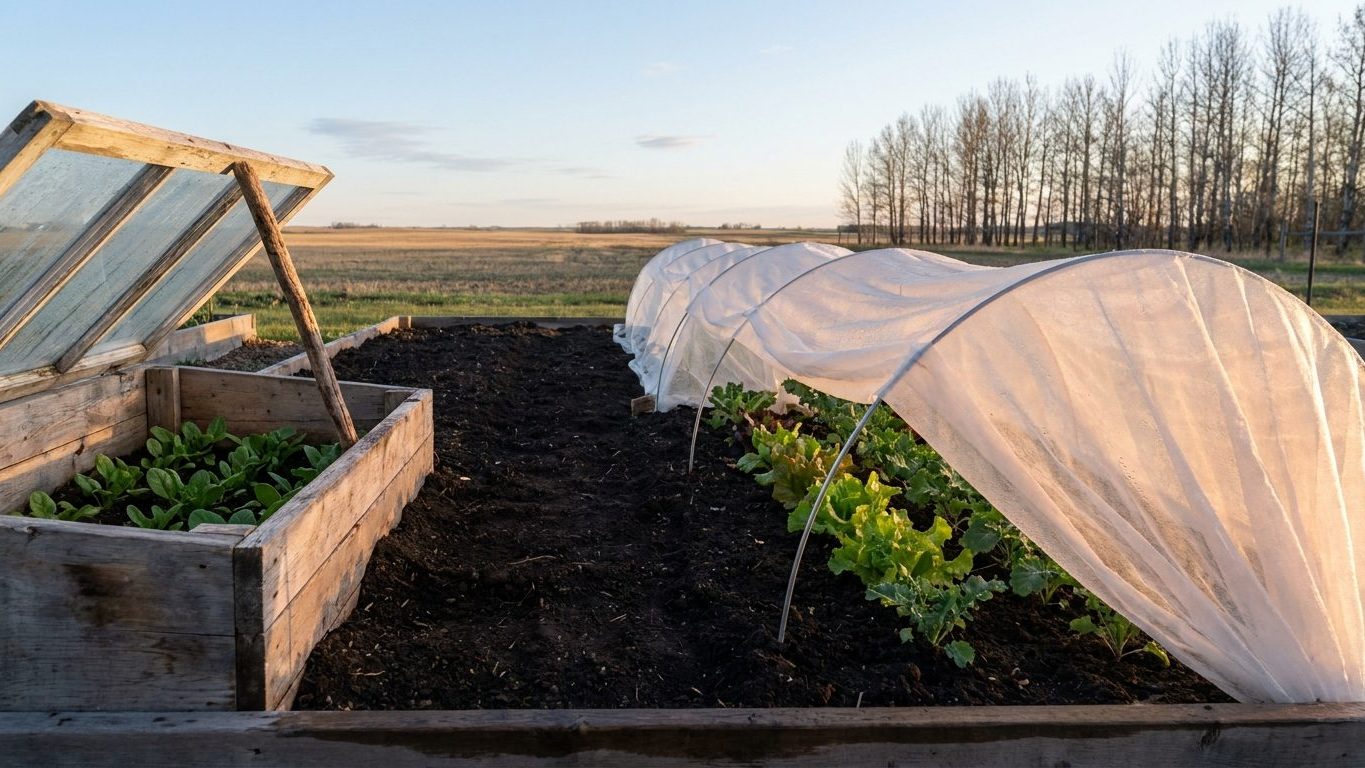

Floating row cover over hoops, cold frames and walk-in high tunnels are the season extenders that pay off in Idaho, and the right pick depends mostly on elevation. In Boise’s low valley, a few weeks of protection at each end of the season is enough. Higher and farther north, the same cover buys less than you’d hope. Every date below belongs to Boise, and the state is not Boise.
The short answer for Idaho
Start with floating row cover on hoops and a simple cold frame, then add a high tunnel only if you want winter harvests or garden well above the valley floors. That order matches the numbers, because Idaho’s frost risk is mostly a problem of nights hovering near freezing, which cheap covers handle well.
The reference figures come from the NOAA NCEI 1991-2020 Climate Normals for the Boise station. The last spring frost falls between April 23 and May 7. Both dates are probabilities of a 32°F freeze, taken from the 30-70% band, so they mark the stretch where a late freeze goes from likely to merely possible. A freeze after May 7 is less likely, but nothing rules it out. In fall, the first frost falls between October 7 and October 21, which means today, October 14, sits squarely inside that window. A cover that holds a few degrees on one or two cold nights can push a tomato or pepper harvest past that first hit.
The mechanism matters here. Covers add a few degrees on still, clear nights, when heat radiates off the soil and the air drops fast. They do not create a different climate. Boise’s coldest-month mean daily minimum is 25.4°F, so deep winter nights run well below freezing, and a single layer of fabric will not carry tender crops through that. Hardy greens under a tunnel are a different story, since they tolerate cold and mostly need shelter from wind and wet.
Which extender does which job
| Extender | Best job in Idaho | Where it falls short |
|---|---|---|
| Floating row cover on hoops | Frost nights in spring and fall | Little help in a hard freeze; wind lifts it unless anchored |
| Cold frame | Hardening off seedlings, fall and early spring greens | Small footprint; overheats on sunny days unless vented |
| Water-filled plant protectors | Setting out tomatoes and peppers early | One plant each; awkward for anything planted densely |
| Walk-in high tunnel | The biggest gain at both ends, plus winter greens | Cost, venting, and snow that has to be shed |
For a broader look at how these fit together across the state, see Extending the Growing Season in Idaho.
What will not work here
Planting warm-season crops on the earliest Boise date and trusting plastic to cover the gap is the most common failure. The April 23 to May 7 window is a frost estimate, and it says nothing about soil temperature. Cold soil stalls tomato, pepper and squash roots even when the air is mild, and a cover that traps heat on a sunny afternoon can’t warm soil that stays cold underneath.
Long-season crops are the second casualty. The gap between the Boise spring window and the fall one is roughly 24 weeks. That sounds generous until you count a slow melon or a late pepper variety from transplant to ripe fruit. Extending by two or three weeks helps a crop that was already close. It will not rescue one that needed another two months.
Thin covers fail in the cold. A mean winter minimum of 25.4°F in Boise means a lightweight fabric has no chance of holding lettuce or spinach through December and January nights, let alone in zones colder than the valley. Gardeners who leave a single layer of row cover on in midwinter usually learn this by January. Cold-hardy crops under a low tunnel, with the cover pulled back for ventilation on mild days, make a fairer bet.
Sealed plastic is a trap on sunny days. A closed low tunnel or cold frame can overheat quickly under clear skies, and Idaho’s clear days arrive even in cold months. Seedlings cook, blossoms drop, and gardeners who only check the structure in the evening find out too late. Venting by mid-morning, or using fabric instead of plastic for the early weeks, solves most of it.
The last failure is borrowed numbers. The frost dates on this page come from one valley station, and its own caution is blunt: most of Idaho is higher and colder, with far shorter seasons. A gardener at altitude who sets out transplants on Boise’s calendar is betting against a much shorter season. The page doesn’t have frost dates for anywhere else in the state, and guessing them would be worse than saying so. If you’re deciding when to cover your garden in Idaho, treat the Boise figures as the early end of the range, not the middle.
What changes across Idaho
The USDA Plant Hardiness Zone Map (2023, built on 1991-2020 normals) puts Idaho across zones 3b to 7b. That is a spread of 40°F in average annual extreme minimum temperature, and it means there is no single answer for the state. A garden in a low southwestern valley and one in a high mountain basin are working with different seasons, different winters and different crops.
The zone system measures one thing only: how cold the worst nights get, on average, in a year. It says whether a perennial or a hardy overwintering crop survives. It says little about how many frost-free weeks you get, which is the number that decides what a row cover can do for tomatoes. A cold-zone garden with long summer days can still outgrow a milder one in some respects, but its shoulder seasons are short, and that is where extenders earn the most.
Readers in the north or at altitude should shift in two directions. Lean on sturdier protection (double layers, tunnels with real anchoring, structures built to shed snow), and shorten the crop list toward fast varieties. Plan to start transplants indoors and harden them under cover before they go out, since covered beds can’t make up for a May that stays cold.
Latitude adds a second layer. Boise sits at 43.57° north, and the state reaches the Canadian border. Day length, not warmth, tells an onion when to stop making leaves and start making a bulb, so a variety suited to Boise’s day length may behave differently much farther north. If you live near the edge of the state, check your own latitude before copying a Boise onion schedule.
To find your own zone, use the USDA map itself rather than a neighbor’s guess. This page won’t tell you which zone you’re in.
Where to check this for your own county
The University of Idaho Extension is the state’s land-grant extension service, and it is the right next stop. County offices exist because a state-level page can’t see the valley-by-valley, even farm-by-farm differences that decide whether a cover works.
Look for two things there. First, the local planting calendar for your county, which will give frost dates and sowing windows from nearby records rather than from Boise. Second, the varieties trialed in your county, because a tomato or onion that performs in a trial plot at your elevation has been tested against your real season length.
A county recommendation beats a state one, plainly. This page is the state one: it has Boise’s frost windows, the Boise winter minimum, and the zone range for all of Idaho, and it does not have county-by-county dates. Where the two disagree, trust the county.
Extension offices can also tell you which structures hold up locally, including how much snow a hoop frame needs to shed and which fabrics survive your wind. Ask them before you build anything permanent.
Checking this against your own garden
Your own observations outrank every date on this page, because they record your microclimate, not a valley station’s. Three are worth watching, and none needs equipment.
- Soil warmth by feel. Push your hand a few inches into the bed in the morning. If it still aches with cold, hold off on warm-season transplants whatever the calendar says. A bed that feels mild weeks before your neighbor’s is warmer, perhaps from a south-facing wall or good drainage.
- The first flush of male flowers. On squash and cucumbers, male blossoms open before female ones. If they show up early under cover and the plants look sturdy, your spot is warming well. If they lag, the site is cooler than you assumed.
- The first true leaves. After the seed leaves, the first true leaves signal that a seedling is growing, not just surviving. Slow, pale or stunted ones tell you soil or air is colder than the plant likes.
Write the dates down for a season or two, and they will tell you more than any average.
Common questions
What is the cheapest season extender that works in Idaho?
Floating row cover over simple hoops. It handles the frost nights near 32°F that threaten spring transplants and late fall crops, and it costs far less than a tunnel.
Do I need a high tunnel?
Only if you want winter harvests or garden at elevation, where seasons are shorter. In Boise’s valley, hoops and fabric cover most needs.
When is Idaho’s last spring frost?
In Boise, between April 23 and May 7, based on NOAA’s 32°F freeze probabilities (30-70% band). Most of Idaho is higher and colder, so the dates run later elsewhere, and this page does not have them.
Can I use the Boise dates anywhere in Idaho?
No. Boise is a low valley, and the zone range for the state runs from 3b to 7b. Check your county’s extension calendar instead.