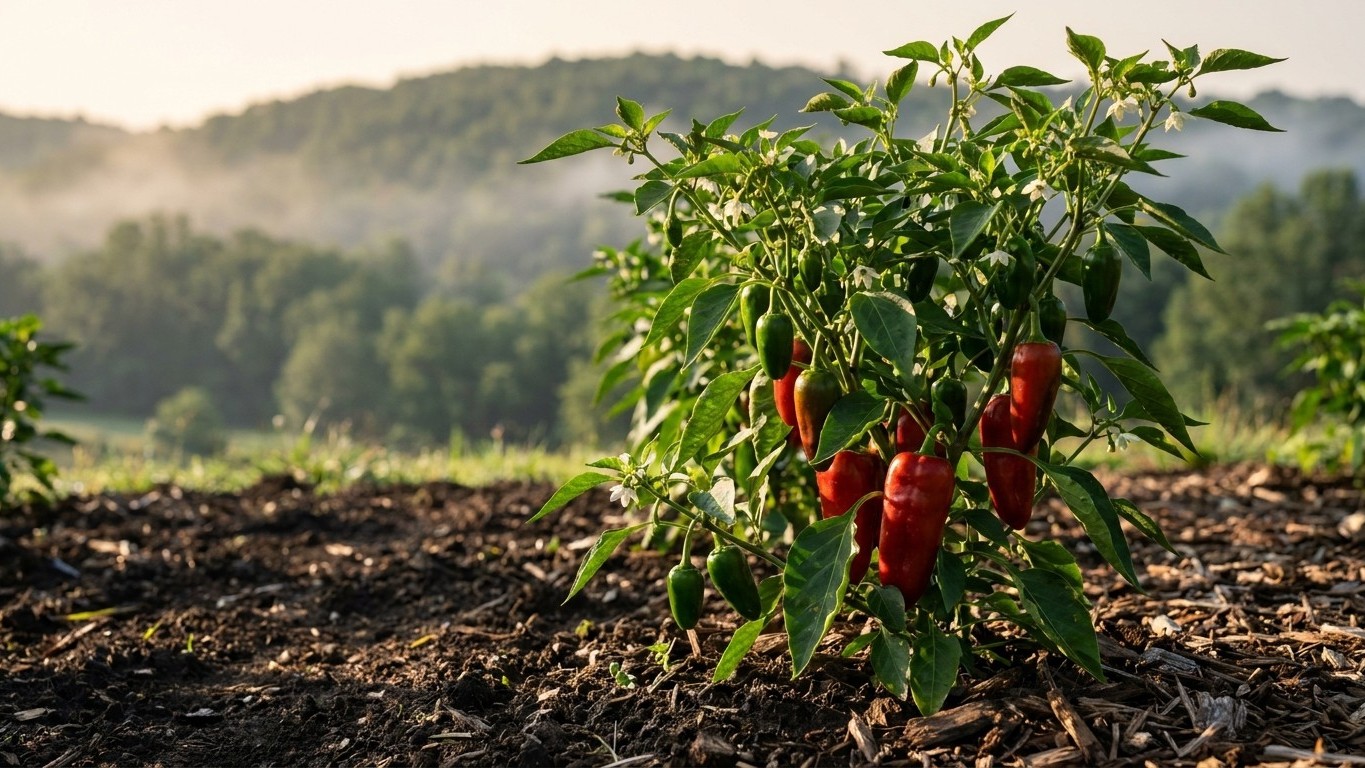

In North Carolina, what takes the biggest bite out of a pepper crop is usually weather, not a bug. Flowers drop in a heat spell or on a cold night, fruit scalds in strong sun, and the bottoms rot when watering swings. Timing decides which of these you meet. Below are the heat count, the seed-starting arithmetic, and the three failures with a fix for each. Insect and animal pests are not covered by the verified data on this page.
The short answer
The reference station for the state, Charlotte, averages 35.0 days a year at or above 90 F, according to the NOAA NCEI climate normals. That is a measure of summer heat load, meaning how often the thermometer crosses the line where plants struggle. It says nothing about the average summer temperature. Thirty-five days is five full weeks, roughly one day in every ten. It is also an average, so a hot summer can run well above it.
Utah State University Extension, the authority behind the temperature limits here, says pepper fruit set fails at both ends: days above 90 F, and nights below 55 F. On a day above 90 F, the flowers open that day are the ones at risk. They can drop instead of forming fruit. Peppers keep making new blossoms, so a hot spell usually costs you a batch of flowers rather than the whole plant’s output. But five weeks of such days scattered across a season add up to a lot of lost batches, which is why heat is the first thing to plan around here.
The cool end is the half most gardeners forget. This site does not carry summer night minimums, so it cannot tell you how often your nights dip under 55 F, and guessing would be a mistake. Latitude is a poor guide, and so is how cold the winters get. A town with a mild January can still have a chilly June night, and the reverse is just as true. The practical answer is to watch your own nights. A cheap min/max thermometer set at plant height by the bed, checked each morning through the flowering season, gives you the real number for your yard in about a week.
One caution on geography. Charlotte sits in the Piedmont, and the 35.0 figure belongs to that reference station. The mountains and the coast will not match it, and this page does not publish counts for them. If you garden west of the Blue Ridge or near the coast, treat 35.0 as a Piedmont benchmark and lean on your own thermometer. The Growing Peppers in North Carolina guide covers the full season, and Why Peppers Fail to Set Fruit in North Carolina goes deeper on the flowering problem.
When to start seed here
Work backward from one date: the day you can safely set transplants outside. Two conditions control it, and both must be true. The frost danger has to be over, and the soil has to reach 60 F. Utah State University Extension also says transplants need 8 to 10 weeks indoors before that day. Here is the arithmetic, which you can redo for any county.
- Find your last spring frost. For Charlotte, NOAA NCEI puts the window for the last 32 F freeze at March 23 to April 5, using the band where freeze probability sits between 30 and 70 percent. Charlotte is Piedmont. The Blue Ridge mountains to the west run several weeks later, and the coastal plain runs earlier, so swap in your own county’s window.
- Check the soil. Push a soil thermometer a few inches down in the morning. Frost-free is not the same as warm enough. If the ground is still under 60 F when the frost window closes, your transplant date is the day it crosses 60 F, not the frost date.
- Pick the later of the two dates. That is your transplant day. As a worked example, take April 5, the late edge of the Charlotte frost window, and assume the soil is ready.
- Subtract 8 to 10 weeks. Eight weeks before April 5 is February 8. Ten weeks before is January 25. So the seed-starting window for that example runs from late January to early February. Use the March 23 edge instead and it shifts to January 12 through January 26.
- Add the wait for fruit. Clemson Cooperative Extension, working next door in South Carolina, says peppers should be ready for harvest about 70 to 85 days after transplanting. From an April 5 transplant, that points to roughly mid to late June. Treat it as an estimate, because the ripening clock really runs from flowering, not from sowing.
Starting earlier does not buy you an earlier crop. Seedlings held indoors past the 10-week mark outgrow their pots, and they cannot go outside until the soil agrees. Pick a variety suited to the length of the season, and the Pepper Varieties That Ripen in a North Carolina Season page is the place to start. Note that the Utah State source names varieties but gives no heat rating, days to maturity or fruit size for any of them, so this page attaches no such numbers to a name.
What goes wrong here
Most pepper failures in this climate come from heat, cold or uneven moisture. Each of the three below has a remedy you can start this week.
- Blossom drop in a hot spell or a cool night. Flowers fall off without setting fruit when days pass 90 F or nights fall under 55 F. Against a Charlotte average of 35.0 hot days, expect it to happen at least once. On hot days, shade cloth over the bed in the afternoon and steady watering lower the stress. On cool nights, a row cover draped over the plants at dusk and removed in the morning can take the edge off. Do not pull the plants. They flower again once the weather turns, and you should keep your own night readings in a notebook.
- Sunscald where the sun is strong. Fruit exposed to direct summer sun develops pale, papery, sunken patches that later turn gray or moldy. It tends to show up when a plant has lost leaves to disease or hard pruning, or when staking leaves fruit in the open. Keep the foliage intact, avoid trimming back the canopy in summer, and use shade cloth in the hottest part of the afternoon. Pick damaged fruit so it does not rot on the plant.
- Blossom-end rot. A dark, leathery, sunken patch at the tip of the fruit, opposite the stem. It usually follows uneven watering, when the plant cannot move calcium into the fruit quickly enough, even if the soil holds plenty. Water deeply and on a regular schedule, add mulch to hold moisture steady, and test the soil before adding any calcium. Cut off affected fruit so the plant puts energy into healthy ones.
Common questions
How many days over 90 F does North Carolina get?
At the Charlotte reference station, the mean is 35.0 days a year at or above 90 F, from NOAA NCEI climate normals. That is a Piedmont figure. Counts for the mountains and the coast are not carried on this page.
Should I store peppers in the refrigerator?
Not for long. Clemson Extension gives the best storage conditions as 45 to 50 °F with 80 to 90 percent relative humidity, for two to three weeks. A home refrigerator runs colder than that, and below about 45 °F peppers pit and soften from chilling injury. Two to three weeks is a ceiling under ideal conditions, not a promise. A cool pantry or basement, or a short stay on the counter, usually suits them better.
When can I move transplants outside?
After your last frost and once the soil reaches 60 F, whichever comes later. For Charlotte, the NOAA NCEI window for the last 32 F freeze is March 23 to April 5. The Blue Ridge runs several weeks later and the coastal plain earlier.
Do insects and animals eat peppers in North Carolina too?
They can, but this page carries no verified pest calendar, so it names no insects and gives no dates. For what is active in your area, your county Cooperative Extension office is the best source, and it can tell you what to scout for and when.