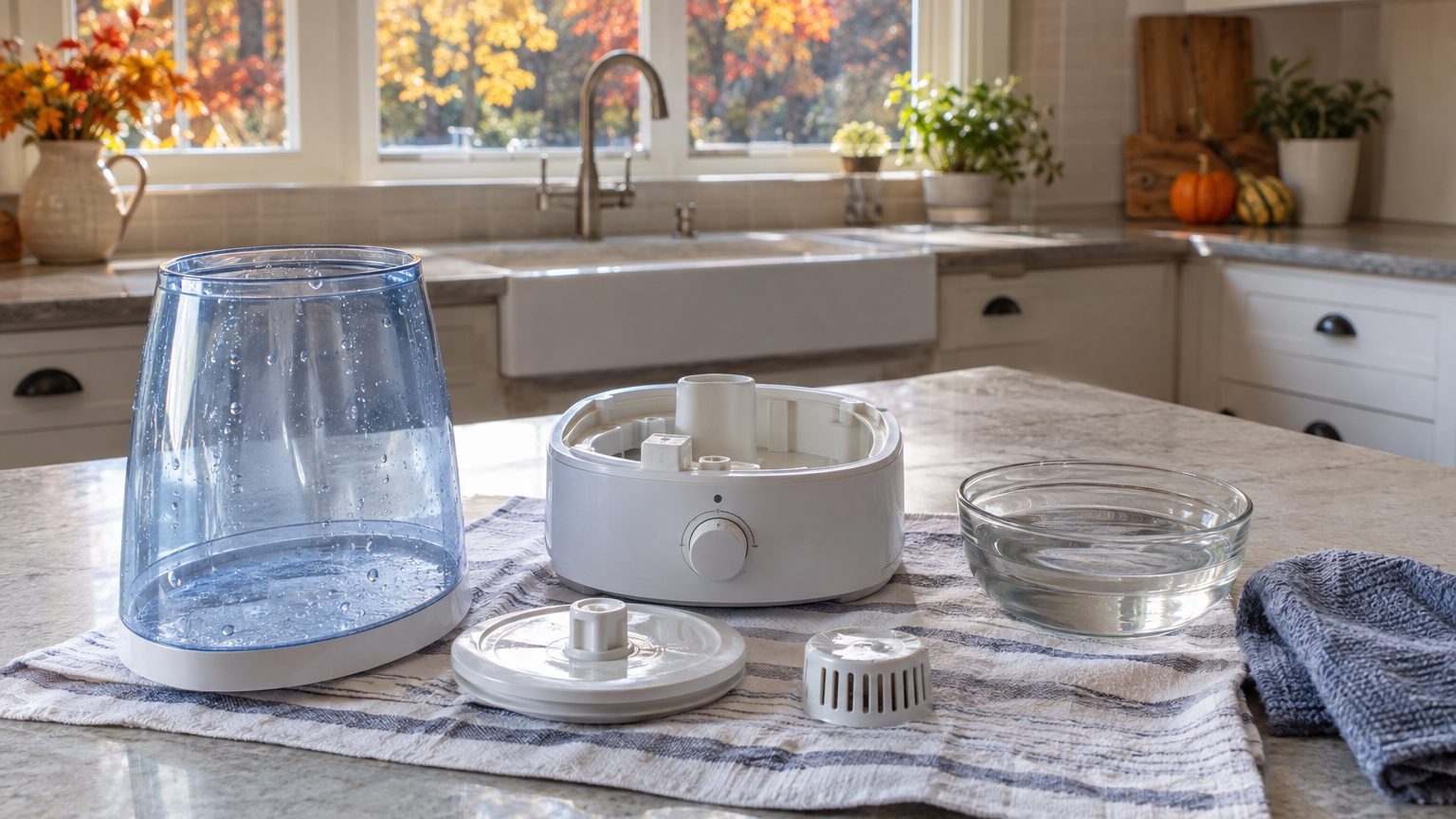

A humidifier that looks clean is not clean, and topping off the tank when it runs low does nothing about what is already in there. Empty the tank every day and give the whole machine a proper cleaning every third day, wiping every surface dry as you go. Before the heating season starts, find the manual (or look up the model number online) so you know exactly how your unit comes apart.
Empty it daily, clean it every third day

The U.S. EPA’s guidance on home humidifiers says to empty the tank, wipe all surfaces dry, and refill the water in portable humidifiers daily, and to clean portable units every third day. The reason is stated plainly: microorganisms often grow in humidifiers equipped with tanks containing standing water. A tank that sits full for days is exactly that. Colorado State University Extension gives the same advice from the household side: use and clean humidifiers according to the manufacturer’s directions, and refill daily with fresh water.
The daily routine
Daily care takes a couple of minutes once it becomes habit. Don’t add fresh water on top of what is left, because the old water is the standing water the EPA is talking about.
- Unplug the unit before you handle the tank or base.
- Pour out any water left in the tank and in the base.
- Wipe the tank and every wet surface dry with a clean cloth.
- Refill with fresh water and set the tank back on the base.
The every-third-day clean
The deeper clean means taking the unit apart as far as the manual allows and cleaning every part that touches water. That usually includes the tank, the base or reservoir, and the cap or float. Models differ a lot. A warm-mist unit, a cool-mist unit with a wick filter and an ultrasonic unit with a vibrating plate each have parts that need different handling.
Cleaning products and dilutions vary, so the manufacturer’s instructions come first. The manufacturer’s instructions come first, including which cleaner is safe for your tank plastic, how to treat the heating element or ultrasonic plate, and when a filter or wick should be replaced rather than washed. If you have lost the manual, most makers post a copy on their website under the model number. Rinse well after cleaning, according to those directions, so no cleaner residue goes into the air with the mist.
Which water to use
The EPA advises using water with low mineral content to prevent the build-up of scale and the dispersal of minerals into the air. It also notes that some people are bothered by a “white dust” that may appear on surfaces while these devices run.
The two problems share a cause. Water carries dissolved minerals, and when it evaporates or is turned into mist the minerals do not go away. Inside the machine they are left behind as hard scale on the tank walls, the heating element or the plate, which is the build-up the EPA mentions. In machines that throw out a fine mist, the minerals travel with the droplets. When the droplets dry on a table or a TV stand, the minerals stay behind as a pale film. That is the white dust.
So a layer of white powder on the furniture next to the humidifier tells you the water is high in minerals. It is not a cleaning failure, although scale on the inside of the tank is a sign you are overdue for the every-third-day clean.
What you can do about it:
- Check the manual for the water type the maker specifies. Some units tolerate tap water better than others.
- If you have hard water, ask your water utility how hard it is, or look at your most recent water quality report.
- If white dust shows up, switch to a lower-mineral water and see whether it stops.
The EPA’s guidance covers the dust as a nuisance and the minerals as something dispersed into the air. If you have a breathing condition and questions about humidifier use, ask your doctor.
How humid is enough
More is not better. The EPA’s Care for Your Air guide says to keep indoor humidity between 30 and 50 percent. A humidifier running without a check on the actual number can push a room past the top of that range, and it can do so overnight in a closed bedroom.
The tool for this is a hygrometer, a small gauge that reads relative humidity. Inexpensive digital ones sit on a shelf and cost little. Put it in the room where the humidifier runs, away from the mist outlet, because a reading taken right beside the machine will be too high. Then run the unit at a setting that holds the room inside the EPA’s range, and turn it off or down when the reading climbs.
Your house tells you when you have overshot. The first sign is usually window condensation in winter, with water beading on the glass or pooling on the sill, especially on single-pane windows or on the coldest corner of the room. That is moisture leaving the air where it meets a cold surface. If you see it regularly, cut the humidifier output rather than wiping the glass every morning.
Humidity also has a lower floor you should not ignore. The EPA range has a bottom end as well as a top one.
Keep in mind that a portable humidifier only handles the room it sits in. If dampness shows up in lower parts of the house regardless of what the humidifier does, the cause is probably elsewhere, and basement humidity is a separate problem with its own fixes. A humidifier upstairs will not cause a damp basement by itself, but it will not help one, and a hygrometer on each level shows you which floor is the problem.
Whole-house humidifiers
Everything above applies to portable units with a tank you fill by hand, which is the type the EPA’s daily and every-third-day advice addresses. A humidifier built into the furnace is a different machine. It draws water from the plumbing, has its own pad or drum and its own water line, and is maintained on a different schedule. Do not assume the portable routine carries over.
For how those units work and what they need, read the page on furnace humidifiers. Follow the furnace maker’s instructions for that equipment, and do not apply a portable cleaning method to it unless the manual says to. If you have both a furnace humidifier and a portable unit in the bedroom, watch the hygrometer, since the two together can raise humidity higher than either would alone.
Common questions
Can I leave water in the humidifier overnight and just top it off in the morning?
No. The EPA says to empty the tank, wipe all surfaces dry and refill with water daily, because microorganisms often grow in tanks holding standing water. Topping off mixes fresh water with old, so the standing water never leaves.
What should I clean my humidifier with?
Whatever your manual says. Look in the manual or on the maker’s website for the cleaning method, and follow it exactly.
Why is there white powder around my humidifier?
The EPA notes that some people are bothered by a “white dust” on surfaces during use. It comes from minerals in the water. Using water with low mineral content, as the EPA advises, is the fix, and the scale inside the machine will build up more slowly too.
My humidifier has been in storage. Can I just fill it and run it?
Clean it first, following the manual, and do not run it with old water inside. Check any filter or wick for replacement guidance from the maker. Canadian readers should also check Canadian guidance where it differs from the U.S. sources cited here.
Guidance from agencies and manufacturers can change, so confirm the current recommendations with the EPA and your humidifier maker’s manual before you act.