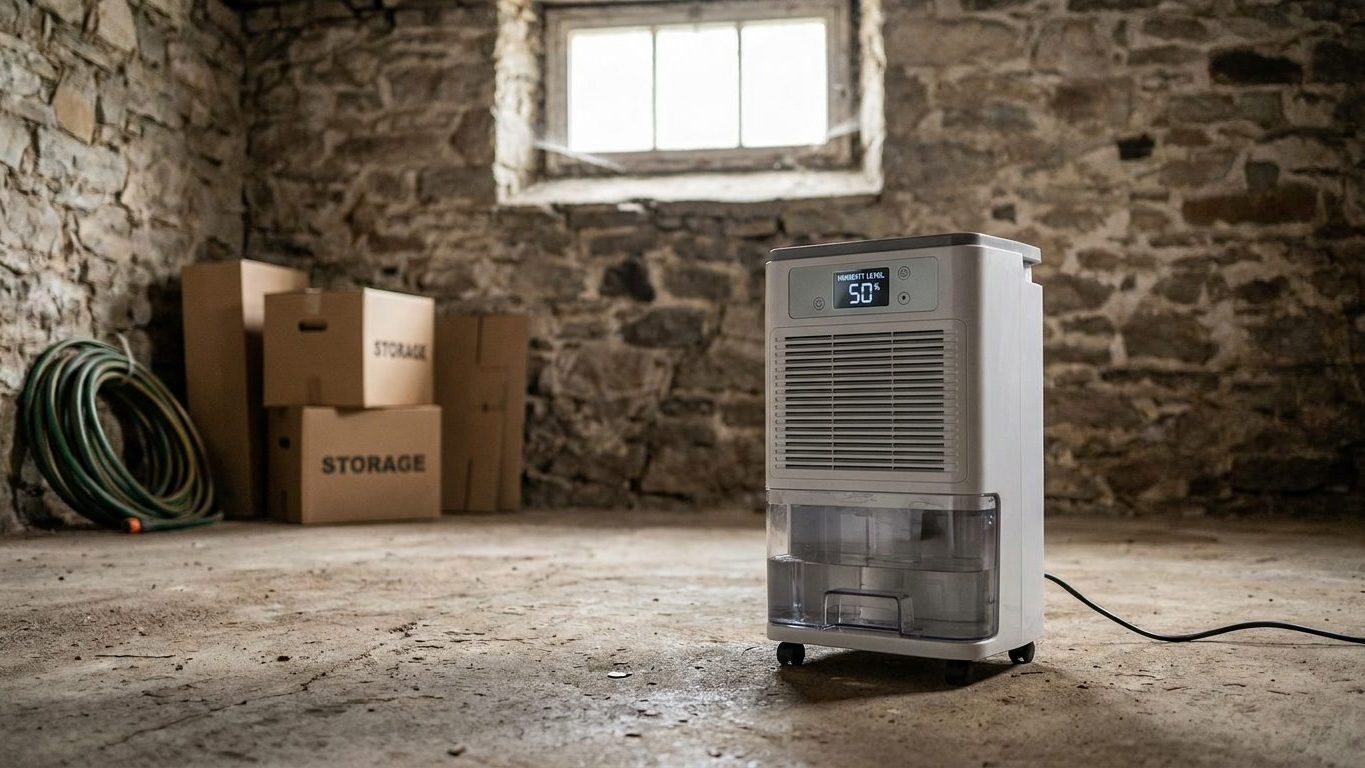

That sour, damp smell that shows up in the basement every July, even though nothing has flooded, is condensation, not a leak. Warm humid summer air meets concrete, pipes and ductwork running well below room temperature, and the moisture in that air turns to liquid the moment it touches them. The fix is to control how much humid air reaches those cold surfaces and to run a dehumidifier sized to the space, before spending a dollar on sealing anything.
What is actually going on

The number that explains everything in this article is the dew point. It’s the temperature at which air holding a given amount of moisture can no longer hold it as vapor, and has to release it as liquid on whatever surface it touches. A basement is the coolest space in most houses, often the only part of the structure sitting partly below grade and in contact with the earth year round. In summer, when outdoor air is warm and loaded with moisture, that air only has to drop a few degrees once it reaches the basement to hit its dew point. It hits it on concrete walls, on the cold water supply line, on ductwork carrying air-conditioned air, on anything below the temperature the moisture in the room is willing to tolerate before condensing.
This is why a basement can feel and smell wet without a single crack, without a single rainstorm finding its way in. The moisture is arriving as vapor, not as liquid water pushing through the foundation, and it’s condensing after it’s already inside. That distinction matters because it changes what fixes the problem. Sealing the interior walls with a coating does nothing for this mechanism except hide the staining that condensation leaves behind. It also does nothing against a separate and more serious problem: water under pressure on the outside of the foundation, which will find its way around an interior coating regardless of how well it’s applied. Drainage on the outside always has to be addressed before anything is done on the inside, because an interior treatment can only manage vapor, never groundwater under hydrostatic pressure.
Where mold fits into this
Persistent condensation, given enough time, feeds mold on cardboard, wood framing, drywall and insulation. There’s no federal standard for how much indoor mold is acceptable, no home test kit that settles the question with a number, and no square footage below which a colony is officially fine to ignore. Anyone telling you a spore count or a coverage threshold is making it up. What’s not in dispute is that people react to mold very differently, some barely noticing it and others reacting badly to a small patch, and that anyone with asthma or another respiratory condition should not be the one cleaning it up or even spending time in the space while it’s disturbed. This site doesn’t give bleach ratios or cleaning product mixes for the same reason it doesn’t give a mold threshold: the honest first step is removing the water source, then deciding what to do with the material it touched. For the fuller picture on that decision, see Mold in a Basement: What This Site Will and Will Not Say.
What to look at, and in what order
Opening basement windows in summer to “air it out” is one of the most common mistakes, and it usually makes the humidity worse rather than better. Outdoor summer air often carries more moisture than the basement air it’s replacing, even when it feels cooler on your skin near the window. Once that humid air meets the basement’s cold surfaces, it’s back to condensing again, just with a fresh supply. The instinct to ventilate isn’t wrong in general, it’s wrong for this specific space in this specific season.
Work through the checks below in order. Each one is cheap and reversible, and each result tells you something about what the next check should focus on.
| Step | What to check | What the result rules in or out |
|---|---|---|
| 1 | Gutters, downspouts and where they discharge relative to the foundation | Water dumped near the foundation points to a surface-water source, not groundwater. Rules out a deeper drainage problem if fixing this alone solves it. |
| 2 | Ground slope against the foundation walls | Ground that slopes toward the house instead of away from it is funneling roof and yard runoff straight at the wall. Rules in a grading fix before anything indoors. |
| 3 | Relative humidity tracked over several weeks, not a single reading | A level that stays high on dry days as well as wet ones points to condensation from air, not an active leak. A level that spikes only after rain points the other way. |
| 4 | Where condensation actually forms, on pipes, ductwork or specific wall sections | Condensation limited to cold metal surfaces confirms a dew point problem, not a structural water entry point. |
| 5 | Window wells and window seals | Standing water or gaps here rules in a simple, localized entry point rather than a whole-foundation issue. |
| 6 | Sump pump operation and discharge line | A pump that isn’t running, or one discharging right back next to the foundation, rules in a fixable mechanical problem before assuming the worst. |
Only after working through that list does a dehumidifier sized to the square footage of the basement make sense as the next move, and even then it’s managing the symptom while the drainage checks above address the cause.
Watch it, or get someone in
A homeowner can reasonably monitor humidity readings, watch for musty smell returning after it’s been dealt with, and note whether condensation reappears on the same pipes or wall sections after a dry stretch. Keeping a simple log of when it’s worse, tied to weather and to whether the dehumidifier has been running, is genuinely useful information to hand to a professional later.
What a homeowner should not be diagnosing alone is anything involving the structure itself. A crack that’s widening, a wall that’s bowing inward, or a floor that’s heaving are structural questions, not humidity questions, and they call for a structural engineer, not a contractor who also sells waterproofing. That distinction matters more than it sounds like it should. An engineer is paid to assess and has no financial stake in which repair you choose, or whether you choose one at all. A waterproofing salesman’s estimate is not an independent opinion, however knowledgeable the person giving it, because their business depends on selling the repair. If a wall is showing signs of moving, that’s covered in more depth at A Basement Wall That Is Bending Inward, and it’s worth reading before anyone gives you a number for fixing it.
Two different professionals for two different jobs
A drainage contractor is the right call once the checks above point to water arriving from outside, whether that’s grading, gutters or a failing sump system, and their job is moving water away from the foundation. A structural engineer is the right call the moment there’s any sign the foundation itself is moving or has been compromised, and their job is telling you what’s happening, not selling you the fix for it. Bringing in the wrong one first wastes the visit. A drainage contractor can’t tell you whether a bowing wall is dangerous, and an engineer isn’t going to regrade your yard.
What has to happen first
The sequence is where money gets wasted on this subject more than anywhere else. Interior work done before exterior drainage is fixed is money spent twice, because water under pressure outside the foundation will keep finding its way in regardless of what’s been applied to the inside face of the wall. Outside drainage comes before inside treatment, every time, no exceptions for a basement that’s “only a little damp.”
Diagnosis comes before repair too. A dehumidifier bought before anyone has checked gutters, grading and the sump pump is treating a symptom whose cause hasn’t been identified yet. It may well help, but it’s masking rather than solving, and it will need to keep running indefinitely if the actual water source is never addressed.
Finishing work comes last, after the water problem is actually resolved, not while it’s still being monitored. That applies to insulation on basement walls and to flooring laid over a slab, both of which trap moisture against the surface they cover if that moisture hasn’t already been dealt with. If the basement is going to be finished, insulation choices and vapor control matter enormously and deserve their own attention rather than an afterthought bolted onto a humidity fix. The same goes for whatever’s going down on the floor, since a slab that still carries moisture from below will ruin flooring that isn’t suited to it. For the full picture of how a basement’s water problems connect to the rest of the house, from roofline to slab, start with Foundations and Basements: Almost Everything Here Is Water.
Common questions
Will running a dehumidifier fix a damp basement for good?
It will reduce the humidity while it’s running, but it doesn’t address why moisture is getting in or why the basement is cold enough to cause condensation. If gutters, grading or the sump system are the actual source, the dehumidifier just runs constantly without ever solving the underlying issue.
What humidity percentage should I be aiming for in the basement?
There’s no single official number that applies everywhere, and this site won’t invent one. The practical target is a level low enough that you stop seeing condensation on cold surfaces and stop smelling must, tracked with a hygrometer over time rather than chasing one specific figure.
Can I just paint the walls with a waterproof coating instead of dealing with drainage?
A coating can reduce vapor moving through the wall and hide old staining, but it does nothing against water under pressure on the outside of the foundation. If that pressure exists, the water finds another path around the coating, often showing up as a new stain somewhere else on the same wall.
How do I tell condensation apart from an actual leak?
Condensation shows up on cold surfaces like pipes and ductwork and tends to track with humid weather rather than rainfall specifically. A leak usually correlates with rain events, often shows up at a specific crack, joint or window well, and leaves water on the floor rather than just beading on a surface.