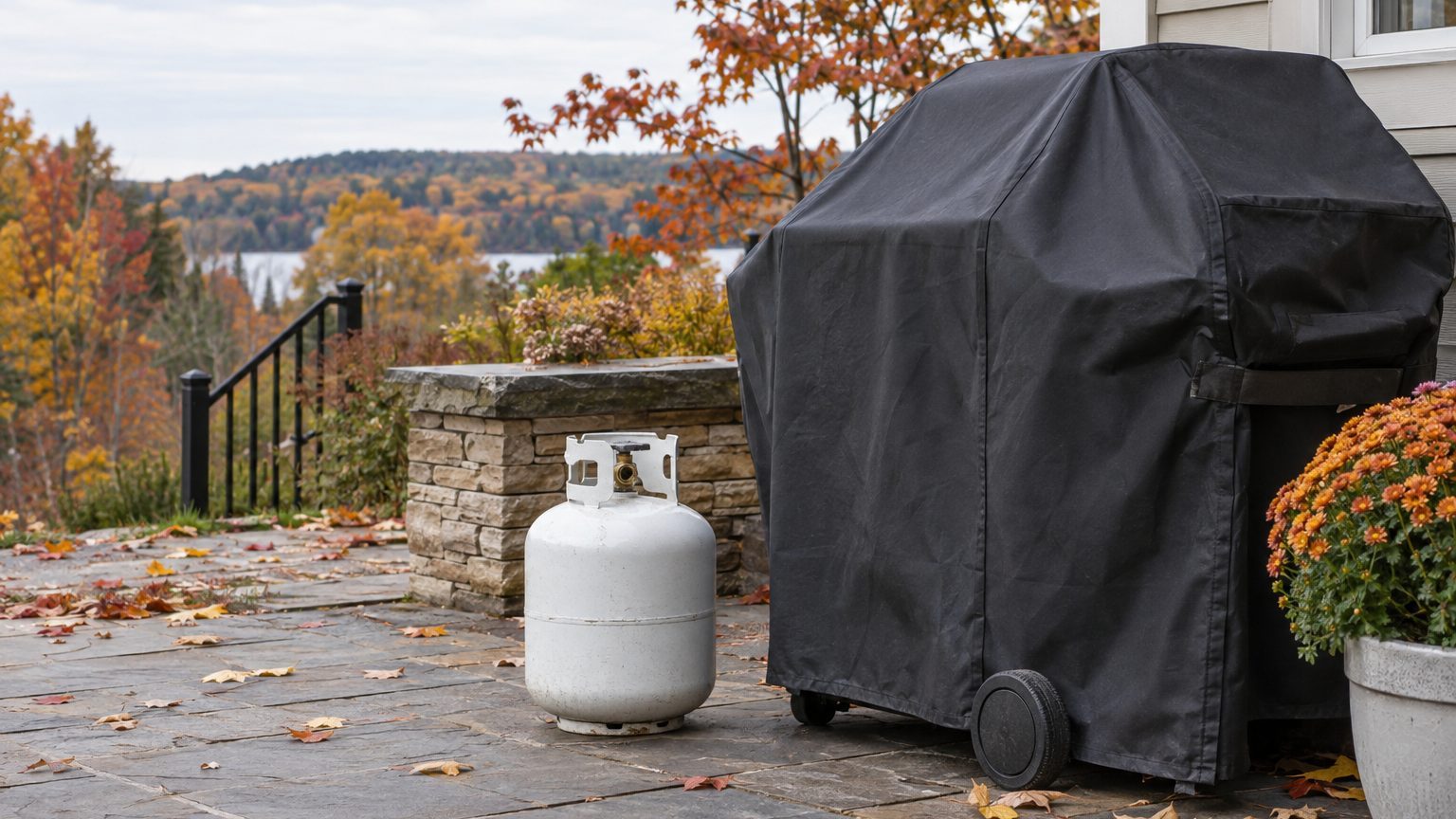

Winter storage for a propane tank means leaving it outside, which is the opposite of what you do with the garden hose. The cold does not change the rule, and an empty tank follows it too. When the grill season ends, close the valve, plug the outlet, and set the tank upright and secured in an open outdoor spot.
Outdoors, upright, valve closed

The North Carolina Department of Agriculture & Consumer Services says tanks containing propane, or that ever had propane in them, are to be stored outdoors. Measurement Canada, the Government of Canada’s measurement agency, says cylinders should always be stored upright and secured, in a well-ventilated area and away from sources of ignition.
Neither line carries a winter exception. Outdoors is the whole rule, and the consequence is plain: **a propane tank does not go in the house, the garage or the basement**, however cold the week gets or however tidy the garage would look with the tank tucked in a corner.
What “outdoors” rules out
- Any room of the house, including a mudroom or utility room
- An attached or detached garage
- The basement or crawl space
- A heated space you pick because the tank “might not like the cold”
The North Carolina wording says “or that ever had propane in them.” That phrase pulls the empty cylinder into the rule. The tank you plan to swap at the first spring refill is stored exactly like a full one, outside.
Upright, secured, ventilated, away from ignition
Measurement Canada names four conditions, and each one has a winter version. Upright means the tank stands on its base and never lies on its side. Secured means it is held so wind, a snow shovel or a slipping drift cannot knock it over. Well-ventilated means open air, so think twice before wrapping a tarp tight around the tank for shelter. Away from sources of ignition means the grill’s burner, pilot lights, sparks and open flame stay clear of it.
No distance is given for that last condition, so your grill or heater manual and your propane supplier are the places to look. Your grill or heater manual and your propane supplier are the places to look.
A reader in the United States can lean on the North Carolina guidance for location. A reader in Canada should use Measurement Canada and the provincial authority, and where the two ever differ, the Canadian text governs.
Close the valve and plug it
A tank that sits outside all winter needs to be shut before you walk away from it. The North Carolina Department of Agriculture & Consumer Services tells you to check that the valve closes completely, and then to make sure the valve is closed. Toronto Fire Services adds a second step for when you disconnect the hose: the special plug provided must be threaded onto the outlet of the service valve.
- Turn the grill burners off, then close the tank valve.
- Check that the valve closes completely.
- Make sure the valve is closed before you touch the hose.
- Disconnect the hose from the tank.
- Thread the special plug onto the outlet of the service valve.
The North Carolina line asks for two separate actions, the check and then the confirmation. **Do both.** A valve that feels shut and a valve that is shut are not the same thing, and the check is what tells them apart.
Where the plug comes from
Toronto’s wording says the plug is “provided,” meaning it comes with the cylinder or its valve. Find it before the grill goes under its cover for the season. If it has gone missing, ask the supplier who refills your cylinders, or read the manual for the cylinder and the grill. Do not substitute something from the toolbox.
Away from heat
The North Carolina Department of Agriculture & Consumer Services says to keep tanks away from heat sources and to try to keep them out of the sun. In summer that advice is obvious. In winter it gets overlooked, because a cold tank looks like it needs warming up.
**It does not.** Never put a tank beside a heater or fire pit to take the chill off, and never set it where the grill’s firebox, still hot from last night’s cooking, sits against it. The same applies to a patio heater that you have switched off but that has not cooled yet.
Low winter sun still falls on a south-facing wall. The North Carolina wording says to try to keep the tank out of the sun, so choose the shaded side of the house or a spot a fence or hedge keeps shaded, as long as the spot is open air and not a closed-in box. No distance from the house or the grill is given, so your manual and your supplier can supply one. Your manual and your supplier can supply one.
Outdoor propane stays outdoors
The pull to move a grill or a camp stove indoors comes in the first cold snap, especially if the power is out. Don’t. Appliances built for outdoor use are **never used indoors**, and burning propane in a closed space puts carbon monoxide into the air you breathe. If you want propane heat inside, the only route is an appliance made and labeled for indoor use. Our page on kerosene and propane heaters covers that category and what to look for.
Bringing it home or to a refill
Tanks travel in winter too, usually to a swap cage or a refill counter. The Technical Standards and Safety Authority, Ontario’s safety regulator, describes the cylinder as safely secured in an upright position in the passenger compartment with the windows open. Measurement Canada’s wording is broader. Cylinders should always be transported and stored in an upright and secured position.
Put those together and the picture is clear. **Upright and secured** are the two conditions that appear in both, and **windows open** is the TSSA’s addition for the passenger compartment. The TSSA is Ontario’s authority, so a reader elsewhere in Canada or in the United States should check the rules of their own province, state or supplier.
A grill cylinder is not a house tank
Everything above concerns portable cylinders, the kind you carry, swap and store beside the grill. A house tank that feeds a furnace is a different system with its own supplier and its own rules. For that, read about propane furnaces.
If you are thinking of a stored cylinder as backup for a power outage, the storage rules above do not bend for it. Our page on keeping a house warm in a power outage deals with the heating side.
Common questions
Can I store an empty propane tank in the garage?
No. The North Carolina Department of Agriculture & Consumer Services says tanks containing propane, or that ever had propane in them, are to be stored outdoors. An empty cylinder is a tank that had propane in it, so it goes outside like a full one.
Can I leave the tank connected to the grill all winter?
The sources cited here address what to do when you disconnect. Close the valve, check that it is fully closed, and thread the plug onto the outlet of the service valve. Whether to leave a cylinder connected through the season is a question for your grill manual and your propane supplier.
Is it okay to leave a propane tank outside in freezing weather?
Yes, outside is where the tank is meant to be. None of the cited sources sets a cold limit for a stored tank. Their warnings are about location, heat and sun. For anything specific to your cylinder or regulator, check the manual.
Do the same rules apply to the big tank beside my house?
The rules here are for portable cylinders. A tank that supplies a house is a separate installation, and the company that fills it is the right place to ask about its care.
Rules and guidance on propane storage change, so confirm the current requirements with your state, provincial or local fire authority and your propane supplier before you act.