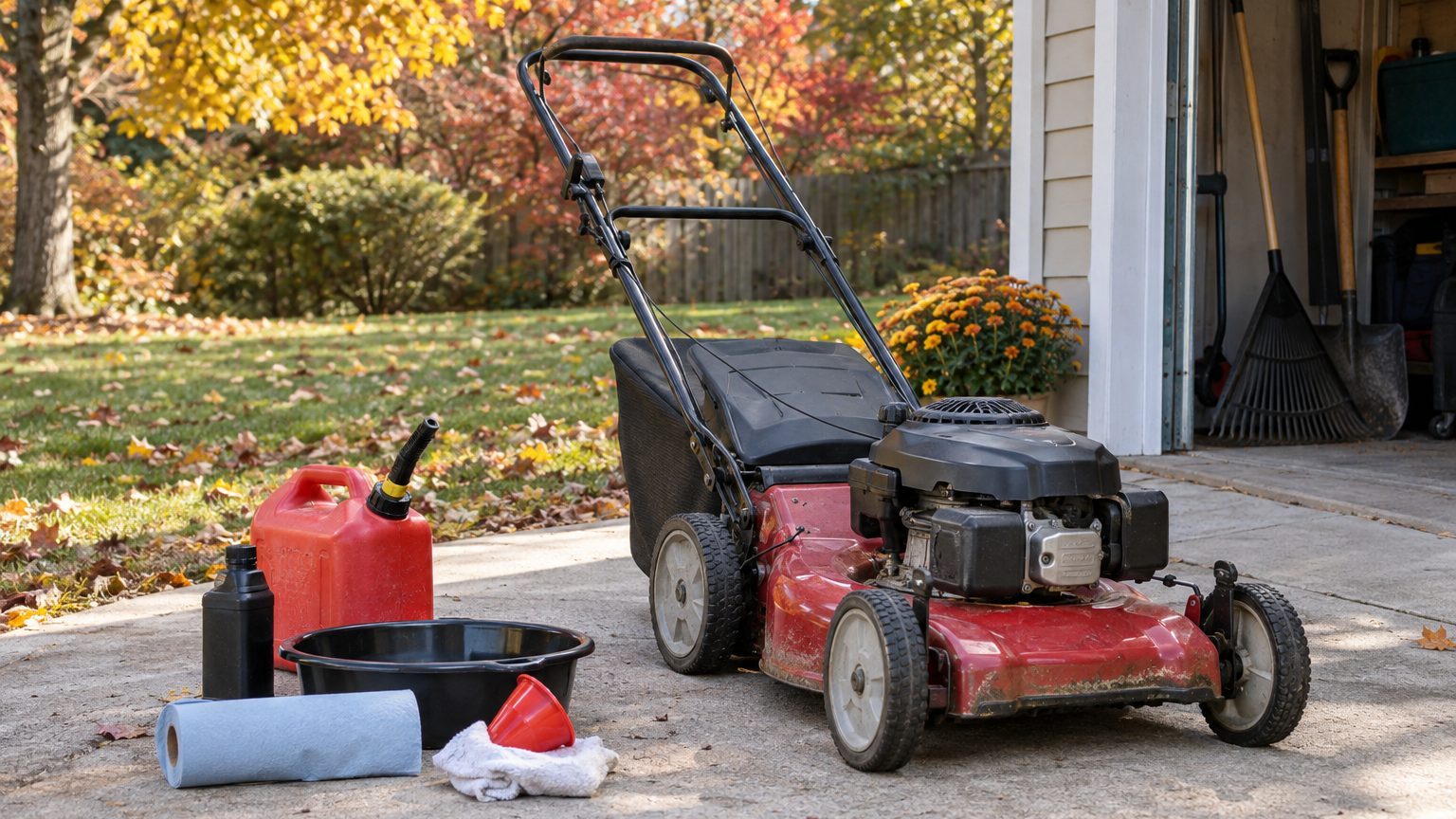

Stale gasoline left in the tank and carburetor decides whether your mower starts next spring. Over a long idle stretch the fuel breaks down and leaves gummy deposits in the carburetor and jets, and no amount of yanking the cord clears them. So before you park the mower for the season, either run the tank dry or fill it with fresh gasoline treated with fuel stabilizer.
Deal with the fuel first

Illinois Extension says 4-cycle engines should be run dry, or you can add fuel stabilizer to a full tank of fresh gasoline. The reason is blunt. Illinois Extension calls a stale fuel mixture and gummed-up carburetors and jets the most common reason yard equipment does not start the following spring. Everything else in the shutdown is worth doing, but this is the step that pays for itself.
Pick one method and finish it
Running the tank dry means using up the gas on your last mowing of the season, then letting the engine idle outdoors until it stops by itself. If you are still working through the lawn care routine for the fall, plan the final cut so the tank is nearly empty when you finish. It saves a separate trip to the engine.
The stabilizer route suits you better if you would rather store the mower with a full tank. Start with fresh gasoline, not whatever has been sitting in a can since summer. Add the stabilizer at the rate printed on the bottle, then run the engine for a few minutes so the treated fuel reaches the carburetor. Stabilizer poured into the tank but never circulated protects only the tank.
Check your owner’s manual for the fuel your engine is rated for, since that varies by model. If your mower has a two-cycle engine, the Illinois Extension line quoted here covers 4-cycle engines only, so follow the manual’s storage instructions for the fuel mix.
The rest of the shutdown, in order
Once the fuel is handled, work through the remaining jobs. Each gets a fuller explanation below.
- Disconnect the spark plug wire (or remove the battery on an electric mower).
- Change the oil if it is due.
- Check the air filter and replace it if it is clogged.
- Inspect the spark plug.
- Check the blade, and sharpen or replace it.
- Scrape and clean the underside of the deck.
- Deal with the battery on a cordless model.
Working in this order keeps you safe, because the ignition is disabled before your hands go near anything that turns.
Disconnect the spark plug before the blade
Disconnect the spark plug wire before you touch the blade. Illinois Extension says that before removing the blades you should disconnect the spark plug or, for electric mowers, remove the battery, to prevent any accidental engagement of the blades. A blade can swing with only a small turn of the crankshaft, and a mower that is out of gas can still fire on a last bit of vapor in the line. Pull the wire off, tuck it where it cannot touch the plug, and only then reach under the deck.
For a cordless mower, take the battery out and set it somewhere away from the mower. Do not just flip a switch off and trust it.
Why the blade is worth the effort
The fall shutdown is the right moment to deal with the blade because you have time and the mower is empty. Illinois Extension notes that dull blades bludgeon, rip, and tear grass blades, leaving ragged wounds that are more difficult to heal. A torn tip browns and invites trouble, and a lawn that goes into winter with frayed grass starts the spring a step behind.
Look at the cutting edge for rounding, nicks, and bends. A blade that is merely dull can be sharpened. One that is bent, cracked, or badly chewed should be replaced, and the right part number is in your manual. Sharpening angle and the tightness of the retaining bolt are model specific, so follow your manual for both rather than going by feel. If you would rather not do it yourself, a small-engine shop will sharpen a blade for little cost, and the off-season is when they have time.
Before you tip the mower, check your manual for which side to lay it on. Tipping it the wrong way can send oil or fuel to places they should not go, and that is much easier to avoid than to clean up.
Oil, air filter, spark plug
These three parts are cheap to look after and expensive to ignore. Illinois Extension covers all of them in its mower maintenance guidance:
- Oil: for most residential lawnmowers, Illinois Extension says oil is typically changed every year.
- Air filter: Illinois Extension notes the filter fills with dust and debris over time and needs to be changed per the manufacturer’s direction.
- Spark plug: Illinois Extension says to inspect spark plugs, making sure the contacts are clean and free of scoring.
Changing the oil in fall rather than spring has a practical advantage. Used oil holds combustion byproducts, and you would rather not leave that sitting in the crankcase for months. Run the engine briefly first so the oil is warm and drains more fully, then catch it in a pan. Your owner’s manual sets the oil type and the amount, so use what it specifies, not whatever is on the shelf. Take used oil to a recycling drop-off or a parts store that accepts it, and check with your county or municipality for local rules.
The air filter depends on the type. Paper elements get replaced, and foam elements are cleaned and re-oiled according to the manual. A filter that looks gray and packed with debris is not going to improve over winter, so deal with it now.
Pull the spark plug with the correct socket and look at the tip. Heavy black deposits, a worn electrode, or a cracked porcelain insulator all mean replace it. A plug in good shape can go back in. Either way, leave the wire disconnected until the mower is ready for use again.
The deck and the battery
Clean the underside of the deck
Illinois Extension warns that grass clippings stuck to the bottom of the mower deck hold water, causing the metal to rust and shortening the lifespan of the equipment. A packed deck that goes into a damp shed stays damp for months. With the spark plug wire still off, tip the mower the way your manual allows and scrape the buildup with a plastic scraper or a putty knife. A wire brush finishes the job. Let the deck dry completely before you set it upright again.
If you ran the mower over leaves on the last passes, expect a mat of wet leaf material stuck in the corners. Scrape that out too, and see what to do with fallen leaves if you want to put the rest of them to work. A light coat of spray lubricant or a wipe of oil on bare metal gives the steel some protection, though the manual may recommend a specific product.
Handle the battery on a cordless mower
Battery mowers skip the fuel and oil, but the battery needs its own attention. Toro’s operator’s manual for its Flex-Force Power System 60V MAX Recycler lawn mower says not to store a fully charged or fully depleted battery. That is one manufacturer’s instruction for that mower. Other makers have their own storage rules, so read the manual for your brand before you put the pack away. Keep the battery indoors off the mower, in a spot your manual considers suitable.
With the mower clean, empty, and serviced, cover it or park it where it will stay dry. The same afternoon is a good time to run through your fall home maintenance checklist, since the hose, the trimmer, and the other outdoor tools often need the same shutdown.
Common questions
Can I just leave the gas in the mower over winter?
You can, but only if you have treated it. Illinois Extension says to run a 4-cycle engine dry or add stabilizer to a full tank of fresh gasoline. Untreated fuel left sitting is the setup for the gummed-up carburetor that blocks a spring start.
Do I need to winterize an electric mower?
Yes, though the list is shorter. There is no fuel or oil to deal with, but the blade, the deck, and the battery still matter. Remove the battery before working on the blade, as Illinois Extension advises, and store the pack according to your manual.
Is washing the deck with a hose a good idea?
Washing is fine if you let everything dry afterward. Illinois Extension points out that clippings stuck under the deck hold water and rust the metal, so the point is to get the buildup off and keep the metal dry. Scraping first makes a hose far more effective. Keep water away from the air filter and the engine.
Can I skip the oil change if I barely used the mower?
Maybe, but the manual decides. Illinois Extension says oil is typically changed every year for most residential mowers. Check the interval in your owner’s manual, and when it is close, change it.
Rules on used oil disposal and on which fuels your engine may use can change, so confirm current requirements with your owner’s manual, your county extension office, or the official source before acting.