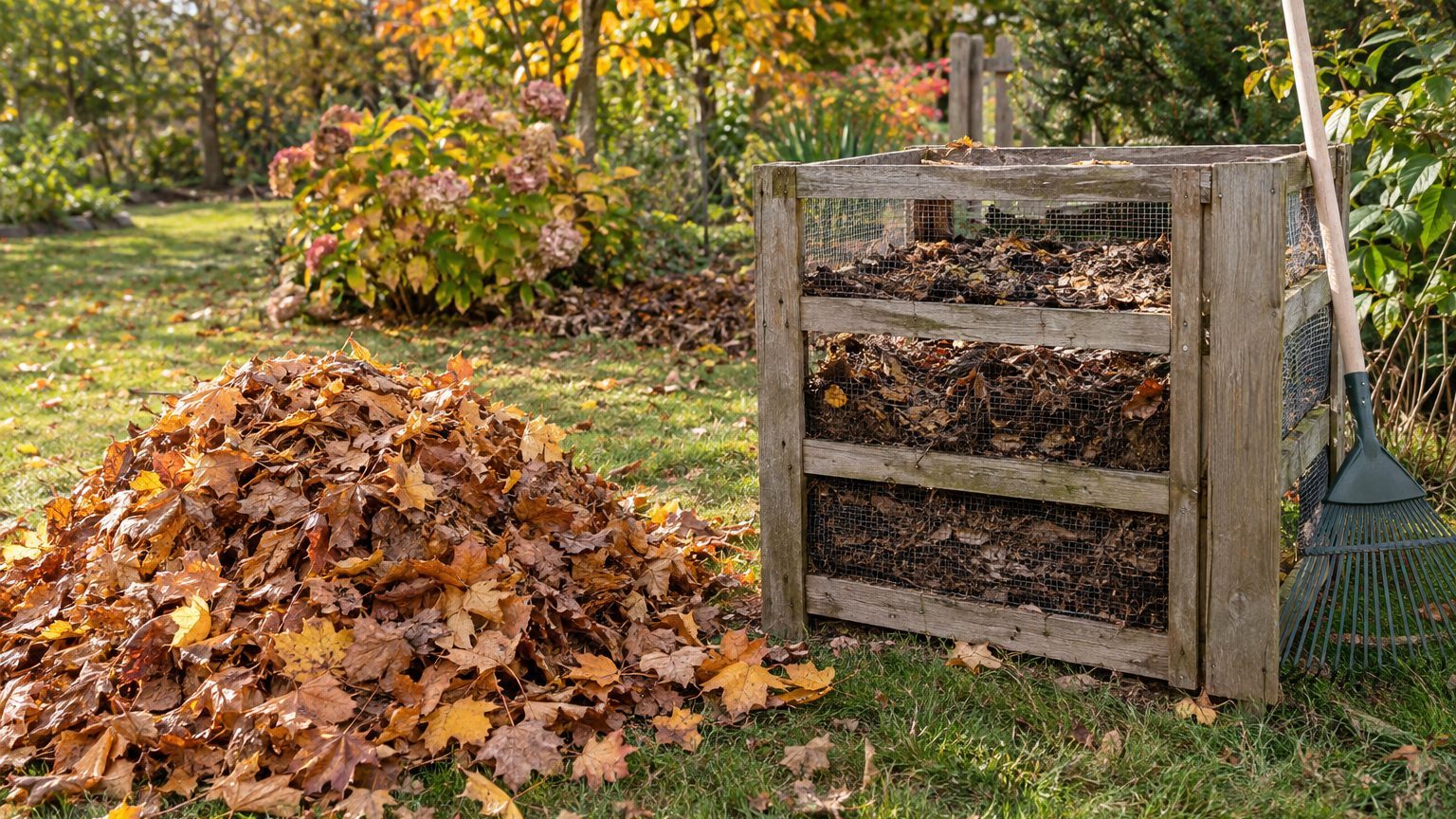

Leaf mold is not compost: it is leaves alone, left to decay. You pile leaves in a bin or seal them in a bag, and time does the rest. Run the mower over the leaves first, then load them into a wire bin or a punctured bag and leave them alone.
Leaf mold is leaves left to rot, and it is slow

The Royal Horticultural Society (RHS), a UK source, describes leaf mold as formed from decaying leaves and calls it an invaluable free soil conditioner. Penn State Extension adds the fact that shapes your whole method: shredded leaves decay much more quickly than whole leaves. So you make a pile or a bin, or you bag them, and you shred first whenever you can.
Why it takes so long
Leaves are the classic brown in the browns and greens balance, and on their own they give you leaf mold instead of the mixed material you get from composting.
How long to wait
The sources give different answers, and the difference is mostly about which leaves you use. The RHS activity guide for children says it may take up to a year before the leaf mold is ready to dig in. The RHS Campaign for School Gardening says conifer and evergreen leaves such as holly can take up to three years to rot down. Both are UK figures. Your climate will move them, so use them as a guide and judge the pile by how it looks and feels.
Treat the result as a soil conditioner, which is how the RHS describes it. None of the sources quoted here calls it a fertilizer, so keep feeding your plants the way you already do. As for timing, start whenever your trees drop their leaves. That depends on your local weather and your first frost, not on a calendar.
The bin method
A bin is the tidiest way to handle a yard full of leaves, and it keeps them from blowing across the neighbor’s lawn. Penn State Extension describes a wood or wire bin, 3 to 6 feet in diameter and at least 3 feet in height. That is a big enough mass to hold together and settle as it rots.
Build it and fill it
- Pick a spot you can reach with a wheelbarrow and will not mind looking at for a long while.
- Build the bin from wood or wire to the Penn State dimensions above. Wire fencing bent into a ring and held with ties or stakes is the cheapest version.
- Shred the leaves before they go in. Mowing over a raked pile does the job, and so does a leaf shredder.
- Load the shredded leaves into the bin. Add leaves only, because what goes in a compost pile is a longer list than a leaf bin needs.
- Walk away. There is no turning schedule and no recipe to follow.
Moisture and checking progress
Check with your county extension office if your leaves tend to arrive bone dry. The RHS does say to moisten dry leaves in its bag method, which shows the idea matters. Past that, the work is looking. Pull a handful from the bottom of the pile. When the leaves have broken down into dark, crumbly material and you can barely make out the original shapes, they are ready.
Remember the RHS timing from above: it may take up to a year before leaf mold is ready to dig in, and evergreen leaves can stretch that out. A bin you cannot see into is easy to forget, which works in your favor here.
The bag method
If you have no room for a bin, or only a small pile of leaves, use the Royal Horticultural Society’s bag method. The RHS says to place the leaves into a bin liner, moisten them if they are dry, then pierce holes in the bag. In the US a bin liner is a heavy-duty trash bag, so pick a sturdy one that will not split when you move it.
Doing it right
Shred the leaves first if you can, since Penn State Extension notes that shredded leaves decay much more quickly than whole ones. Stuff them into the bag, then check how they feel. If they crackle, moisten them before you seal the bag. Then pierce holes in the bag, as the RHS directs. The sources give no hole count or bag size, so use your judgment and make enough holes that the bag is not airtight.
Tie the top and stash the bag somewhere out of the way, behind the shed or along a fence. You can fill several bags and line them up. The bag has one real advantage over a bin: you can label each bag with what went in it, which lets you keep evergreen leaves apart from the rest. Check the bag now and then and open it up when the contents look dark and crumbly.
A bag also does the hauling for you. When the leaf mold is finished, you carry the bag to the bed instead of shoveling out of a bin.
Or leave them on the lawn
The laziest method works too. Cornell Cooperative Extension of Tompkins County says you can just mow the lawn and leave the chewed-up leaves where they fall. Nothing gets raked, bagged or stored. The mower does the shredding, and the pieces settle into the turf. If you want the details on how this fits with the rest of your autumn chores, see fall lawn care.
When the lawn route is not enough
Mowing in place only works when the leaves are chopped fine enough to drop out of sight. A thick drift that covers the grass is a different matter, so rake the heavy layers off and send them to a bin or bag. Leaves can also gather in places a mower never reaches, and a gutter full of them is a hazard as well as a chore. The page on cleaning gutters safely covers that job, and the leaves you pull out can go straight into the bin.
Once your leaf mold is finished, spread it on beds the way you would any mulching material, or dig it in where the soil needs conditioning. Either way you have turned a pile of yard waste into something for the garden at no cost.
Common questions
Is leaf mold the same as compost?
No. Leaf mold is made from leaves alone, left to decay. Compost is built from a mix of materials. The RHS calls leaf mold a soil conditioner, and that is how you should use it.
Can I put pine needles or holly leaves in with the rest?
You can, but expect to wait. The RHS Campaign for School Gardening says conifer and evergreen leaves such as holly can take up to three years to rot down. Keep them in a separate bin or bag so they do not slow the batch of ordinary leaves.
How do I know when leaf mold is ready?
Look at it and squeeze a handful. It should be dark and crumbly, with few recognizable leaf shapes left. The RHS says it may take up to a year before leaf mold is ready to dig in, but your own pile may run faster or slower depending on the leaves and the weather.
Do these UK sources apply in the US and Canada?
The basic process is the same, since leaves rot the same way everywhere. Your climate sets the speed, though. Penn State Extension and Cornell Cooperative Extension of Tompkins County cover the American side. If you are in Canada, check your province’s or municipality’s guidance where it differs.
Rules on leaf burning, curbside pickup and yard waste vary by town, so confirm current local rules with your municipality or county extension office before acting.